







Throwing some shade, and shame, at next-level A.I. scammers | John Moore

Miners Alley Playhouse/Matthew Gale Photography

The scammers are getting scummier.
My story isn’t as big as, say, a dastardly pastor bilking his followers out of $3.2 million in a cryptocurrency scheme. But this little cautionary tale both hits close to home and stretches, police believe, all the way to Senegal.
If you run a nonprofit that dispenses funds to people in need, or if you just love a good caper – pull up a chair.
The bottom line is that the bad guys out there are getting much more sophisticated in their methods to separate you from your money. Gone are the quaint days of stupid mass emails from scumbags asking you to help them buy a painting or get them out of a Nigerian prison.
This new era of scamming is even more calculated than those phishing emails hoping you will click a wrong button and unknowingly unlock all your passwords and banking information.
This is next-level stuff where the criminals are using A.I. and other new technologies to more proactively defraud nonprofits like mine out of our donor money. Not by stealing it behind our backs. By trying to fool us into believing they deserve it as much as anybody else.
Some background: In 2013, I founded an all-volunteer, grassroots nonprofit called the Denver Actors Fund. Since 2013, we’ve helped Colorado theater artists pay down their medical bills by $1.3 million. All made possible by hundreds of caring, everyday donors along with area theater companies that raise money on our behalf, one penny at a time.
We don’t have a ton of resources, so no one will ever mistake us for the Ford Foundation. And our services are not available to the general public. So you wouldn’t think some international criminal fraud network would target us.
But then again, money is money, so – why not?

When Roy MacFarlane died of cancer on July 24, 2023, it left Kristin Hamer MacFarlane alone to raise their 5-year-old daughter. Kristin, a longtime scenic artist with the DCPA Theatre Company, received $5,168 from the Denver Actors Fund to pay off Roy's medical bills. Earlier this month, scammers unsuccessfully tried to defraud the nonprofit out of $1,400.
Courtesy Kristin Hamer MacFarlane


When Roy MacFarlane died of cancer on July 24, 2023, it left Kristin Hamer MacFarlane alone to raise their 5-year-old daughter. Kristin, a longtime scenic artist with the DCPA Theatre Company, received $5,168 from the Denver Actors Fund to pay off Roy’s medical bills. Earlier this month, scammers unsuccessfully tried to defraud the nonprofit out of $1,400.
It starts with an application
Our service begins when a member of the Colorado theater community fills out a simple online application for assistance. We ask only the person’s contact information, birthdate, a general summary of their situation, and to tell us exactly how they qualify for our assistance.
That part’s simple: A qualified applicant must only have taken part in the making of a credible theater production somewhere in Colorado (on stage or off) over the past five years. To date, we have helped 600 families through cancer and car accidents and lots more in between.
And in our 10 years, no one has overtly tried to defraud us … until now.
On Jan. 4, I received a new application from a longtime Colorado stage actor who, for the sake of this telling, I will call “Elizabeth Beck” (not her real name). She qualified, she wrote, because she was one of 14 actors who shared the role of David Byrne in the Denver Center’s recent high-profile production of “Theater of the Mind.” Check marked.
I was momentarily shaken when I read Elizabeth’s story. She recently left her husband, she said, after he put her in the hospital with broken ribs and a fractured right arm. She sought our financial help in setting up her new apartment at a Denver address not far from my own home. To make matters worse, Lizzy offered up, both her parents died in 2023 – her mom by suicide, which triggered a full mental-health breakdown. She asked us to pay her deposit, rent, mental-health costs, medical bills and other basic needs “as this will help me try to rebuild what I lost,” she wrote.
This was going to add up to one huge ask.
The thing is … I know “Elizabeth Beck.” And she did perform in the Denver Center’s Theater of the Mind.” We actually live on the same Denver street. We’re neighbors.
But I immediately noted, “Hey, that’s not Elizabeth’s address. That’s not her email. That’s not her phone number. That’s not her birthdate.” Most importantly: Elizabeth Beck is performing in a local stage production right now … presumably with all her bones intact. But, just to be safe, I called Real Liz and confirmed that she has not applied to the Denver Actors Fund for help with anything.
But it’s not that cut-and-dried. All of the contact info Fake Liz provided was, in its way, real. I texted her, and she texted back. I emailed her, and she emailed me back. They were all fakes, but they were working decoys, not dead ones.
At this point, I could have just responded by saying, “Sorry, I know you are not Elizabeth Beck. Go away.” But, I am a journalist to the core, and I wanted to ride this out. I wanted Fake Liz fully on the fraud hook. You mess with me? I’ll mess with you.
The game was afoot.
You might want to grab some popcorn for this.

While these 30 area high-school students were culminating a six-month community service project that raised $18,000 for The Denver Actors Fund earlier this month, online scammers, possibly based out of Senegal, were trying to cheat the nonprofit out of $1,400.
John Moore, The Denver Gazette


While these 30 area high-school students were culminating a six-month community service project that raised $18,000 for The Denver Actors Fund earlier this month, online scammers, possibly based out of Senegal, were trying to cheat the nonprofit out of $1,400.
The trap is set
At this point, Fake Liz had clearly attempted fraud, but I needed more evidence to bring to the authorities. So I played dumb and treated Fake Liz like any other applicant.
I called the number she gave and got a generic voicemail. I said it would be easiest to explain next steps over the phone, so … “call me back.” Within seconds, I received a text that said, “I forgot to mention I have lost all hearing.”
How conveniently unfortunate, I thought. Poor Fake Liz. So I smoothly told her I’d explain the whole process in an email. It was there I broke the readily available news that we’re not a rent-subsidy nonprofit, but we would be happy to consider helping with any outstanding medical bills.
And wouldn’t you know it? Suddenly Fake Liz didn’t have any actual bills to submit from her gnarly hospitalization after all. But hey … would we pay for her mental-health sessions? That’s medical, right?
For the sake of drawing her in, I told her to send us the bill and we would take a look. I also told her what I tell everyone else: If approved, we always prefer to pay the health-care provider directly.
I knew this would be a problem for Fake Liz. But, surprisingly, “she” (Fake Liz could be a man, after all) was all-in. And it just gets weirder from here.
Fake Liz says, sure: Her psychotherapist is Dr. Stephanie Ryan, “a doctor who is happy to vouch for me as known (sic) for 20 years,” she wrote (badly), along with an attached invoice from her doctor. Bingo. Actual fraud.
The fake invoice was from Dr. Stephanie Johnson (not Ryan), a “PT consultant” (not psychotherapist) working out of a Pilates studio on Ammons Street near Old Towne Arvada.
Now, I don’t know who Stephanie Ryan is, but I checked, and Stephanie Johnson is a real physical therapist operating a real business at the real address given on the fake invoice – ironically enough, it’s located right across the street from the Arvada Police Department.
That the promised bill for 10 mental-health sessions turned out to be 10 “physiotherapy” sessions just added to the comedy. Bottom line is the scammer instructed us to transfer “US$1400.00” directly into Fake Liz’s PayPal account. And you know what the experts say: “If they ask you to pay a risky way – run away.”)
I was not going to pay, but I wasn’t running away, either. I was going to find Dr. Johnson, who is just as much an identity-theft victim here as Elizabeth Beck.
Of course, I did not use the contact info provided by Fake Liz. Instead, I dropped by her office. Stephanie was out, but I was kindly given a phone number that, wouldn’t you know, turned out to be different from the number I was given by Fake Liz.
As you might imagine, the real Stephanie Johnson was initially reluctant to return my bizarre-o voice message … but eventually, she did. I texted her a screenshot of the invoice. She confirmed that she has no patient named Elizabeth Beck, that the invoice was completely fake, and that the listed services were fake. (And, by the way: “The only people who call themselves “physiotherapists” are in Canada and the U.K.” she said. It’s a British thing. Like listing American dollars as “US$1,400.00.”
I reported the attempted crime to Colorado Attorney General Phil Weiser, the Federal Trade Commission, the FBI and the Arvada Police Department, where a really kind officer named Tom Masciotro did a deep-dive with me and offered up some interesting theories.
He said Fake Liz’s area code (928) is assigned to Senegal. He said he highly doubted there is anyone involved in this crime physically located in Denver.
Most unnerving: He said that, in all likelihood, from start to finish, I probably never once interacted with a human being. He said everything about this interaction, from finding and targeting my nonprofit, to analyzing our eligibility requirements, to randomly identifying the name of an actual qualifying recipient, to semi-convincingly filling out the application, to conducting full dialogues with me through email and text – could have been carried out by an AI bot. It’s possible the only other human involved here was the person who wrote the A.I. program, tipped the domino and hoped I would eventually be dumb enough to give him some of our donor money.
Who is behind all of this?
“These are organized criminal gangs, often located overseas, who are very savvy at what they do,” John Breyault of the National Consumers League, told NBC News for a related story on advances in online scamming that aired last month.
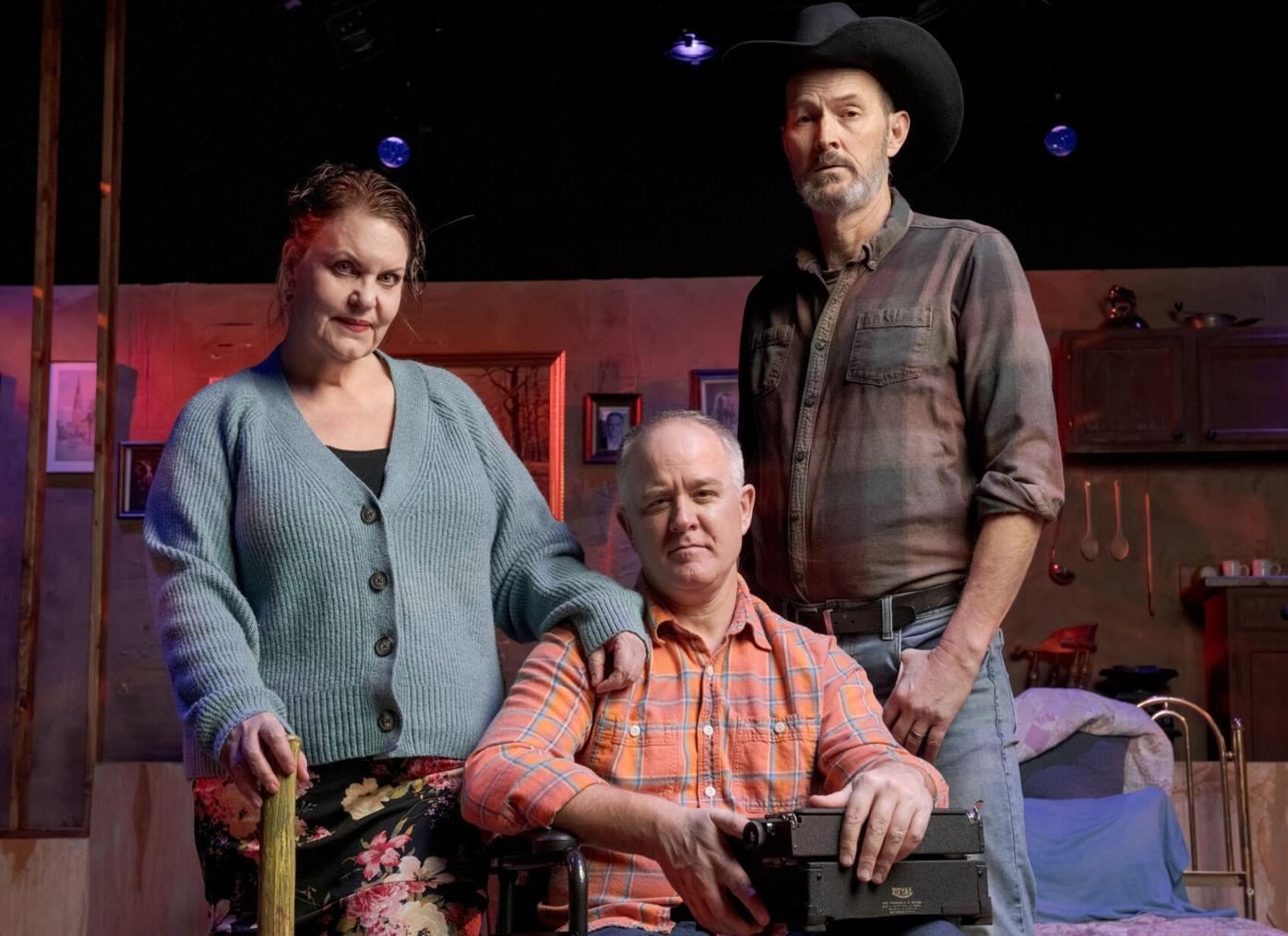
On Monday (Jan. 29), Miners Alley Playhouse will donate all proceeds from a benefit performance of "Misery" to the Denver Actors Fund. Tickers $25 at minersalley.com . From left: Emma Messenger, Torsten Hillhouse and Mark Collins.
Matthew Gale Photography


On Monday (Jan. 29), Miners Alley Playhouse will donate all proceeds from a benefit performance of “Misery” to the Denver Actors Fund. Tickers $25 at minersalley.com. From left: Emma Messenger, Torsten Hillhouse and Mark Collins.
To catch a thief
The good news is, my nonprofit was not taken for a penny. The bad news is, because we suffered no loss, no authorities are going to pursue it. But my scammers are no doubt out there trying to dupe other potential victims every day, so it might come into play in a larger investigation someday.
With that, I was given permission to go ahead and break the news to Fake Liz that she wouldn’t be getting any of our money. I was told to be very clear that we were onto her scheme from the start. That should discourage her from just trying again another way.
And that was an invitation the writer in me could not pass up. Here’s what I wrote:
Dear “Elizabeth” (Sorry, I don’t know what else to call you),
Your application for assistance from the Denver Actors Fund has been denied, for the simple reason that you are not, in fact, Elizabeth Beck. That this application is fraudulent was immediately evident to us, but we were advised by the authorities to wait to deny your claim to give them time to gather as much evidence as possible against you, and to determine your true identity.
This crime has been reported to the Federal Trade Commission, the Federal Bureau of Investigation’s Internet Crimes Complaint Center, Colorado Attorney General Phil Weiser and the Arvada Police Department. Any further communications from you in any form will be forwarded to all of those law-enforcement agencies as well.
The Denver Actors Fund is an all-volunteer, grassroots nonprofit that was created to help people in medical crises, often at the most vulnerable times of their lives. On behalf of all our qualifying artists, our donors and our Board of Directors … shame on you.
John Moore is The Denver Gazette’s senior arts journalist. He is also the founder of The Denver Actors Fund. Email him at [email protected]