








Regulatory layers turn cost of doing business in Colorado into ‘death by a thousand cuts’ | FISCAL ROCKIES

| Editor’s Note: Once among the nation’s fastest-growing economies, Colorado today confronts mounting challenges that threaten its momentum. This series reveals how a state once defined by prosperity is navigating economic cliffs and ridges. We explore the impact that increased regulations, tariffs, shifting tax policies, the high cost of living and widening urban–rural divides have on businesses, workers, and communities. The series also highlights the push to leverage Colorado’s outdoor economy — one of its most valuable assets — for renewed growth, while working to attract industries like quantum and aerospace. |

Amid recession fears, tariffs uncertainty, slowing job growth and economic uncertainty, Colorado businesses said one challenge outweighs them all – a regulatory thicket that is driving up costs, stalling investment and pushing companies to look elsewhere in the country.
For a long time, Colorado’s economic identity has benefited from the reputation that industries thrive here. But as regulatory expansion accelerates, especially in recent years, the cracks are showing, Colorado’s business community lamented.
Meant to push environmental protections, workers’ welfare and public health, the state’s rulebook for businesses to operate has ballooned into overlapping, sometimes contradictory mandates, business leaders and policymakers said. For many industries, compliance has become costly and almost impossible to keep up with.
Proponents of increased regulations, meanwhile, maintained that the new rules are essential – they help keep the environment clean and inoculate workers and consumers from harmful practices. They are needed, the proponents added, because the world is fast-evolving and policymakers often have to keep up with the rapid changes through legislation.
The latest from the Colorado Business Roundtable’s fall report is stark: More than 50 senior executives described a business climate slipping beneath the national average, shaped not by economic cycles but by state public policy. Nearly two-thirds of the executives said they anticipate conditions will worsen, warning that the very ecosystem that once attracted businesses is starting to drive them away.
“Colorado’s competitive position is eroding,” as companies look at relocation or expansion outside Colorado, the report said.
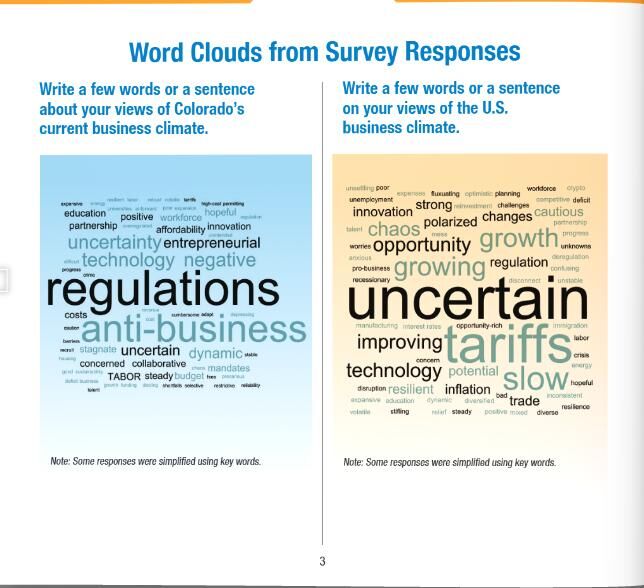
The report included a “word cloud,” reflecting views on the business climate. The word that was by far the largest and boldest in the illustration was “regulations.”
Colorado is the sixth most regulated state
The Colorado Chamber of Commerce, citing the Mercatus Center at George Mason University, defines a regulatory restriction as a command, prohibition, or obligation in regulatory statutes, with the words “shall” or “must” that mandates compliant behavior from the regulated party.
The Mercatus Center also noted that “government regulations at the federal, state and local levels may seek to protect the health, safety and well-being of the American public. Yet they can exacerbate poverty, increase opportunity inequality, raise prices and reduce economic growth.”
In 2024, the Colorado Chamber of Commerce released its third annual report, which inspected the state’s regulatory environment and ranked Colorado as the sixth most regulated state for businesses.
In a news release that accompanied the report, Chamber President and CEO Loren Furman said, “Colorado’s regulations are consistently the top concern in every business survey we’ve conducted in recent years.”
That, in turn, leads to job losses and higher consumer prices, with a disproportionate impact on low-income households, the report said, adding, “The findings further suggest that regulations contribute to greater income inequality.”
Some industries have seen much more regulation in the past several years, such as personal services and “pipeline transportation,” the study said, which saw a 100% increase in regulations between 2020 and 2023.
The report added that there are nearly 200,000 regulations in the state, and coupled with the federal rules, about 1.3 million total for businesses to follow.
In Colorado, almost 45% of those rules can be classified as duplicative or redundant, according to the chamber’s report.
The chamber said that every 10% increase in regulations leads to an estimated loss of 36,000 jobs and 9,000 firms statewide. Regulations slow economic growth by at least 2% annually, the chamber added.
Industries with the most “excessive” regulations included non-oil and gas mining at 65%, utilities at 65%, printing and related support at 71%, health and personal care stores at 85% and nonmetallic mineral product manufacturing at 87%.

The governor understands, but does his administration?
JJ Ament, president and CEO of the Denver Metro Chamber of Commerce, said that while Gov. Jared Polis has been good for business, his administration has not.
“It’s been enormously valuable for us to have a governor who understands business and who has been an entrepreneur and a tech entrepreneur,” Ament said.
But that knowledge and appreciation for the challenges of small business doesn’t always flow through his administration, particularly in the last two to three years, the chamber official said.
That also applies to the Democratic-led legislature, the source of a sheer volume of new regulations issued by the state each year.
Gov. Jared Polis told Colorado Politics that he understands the criticism coming from industries, but stressed the state is still business-friendly. He added that he is working with the legislature to roll back regulations, especially repetitive ones.
He also agreed more work needs to be done to remove costly regulations and make it “easier to do business.”
Polis, a Democrat, has at times stood up to his own party by threatening to veto bills if they are not amended or vetoing them once they come to his desk.
But he also signed many of the regulatory changes that the business community describes as the cause of Colorado’s woes.
Ament said some of the obvious areas that create obstacles for businesses center around environmental regulations on oil and gas and air quality, minimum wage, workers’ compensation, and family and medical leave. One independent study pegged the cost of FAMLI – Paid Family and Medical Leave – in 2025 alone at $670 million, equivalent to a 61% corporate income tax increase and a 6.5% individual income tax hike.
There are other regulations people don’t see or hear about, Ament said, such as energy and building decarbonization, transportation, and regulations coming from the Public Utilities Commission.
“All of those things contribute to what is rapidly being perceived as an overregulated state by the business community generally, and particularly small businesses,” Ament said. “I think sometimes our regulators and our government think that every business is multinational (company) with a whole legal and compliance department that can handle it.”
However, 85% of the chamber’s members are small businesses that don’t have legal departments, according to Ament. Instead, it’s a husband and wife team or a partner that is trying to do the best for the business and the workers, while navigating a complex regulatory environment on their own, he explained.
The Denver chamber’s membership has grown 34% in the past three years, and Ament believes it’s because small businesses are looking for someone who can help them.
Regulations cost money
With each new regulation, businesses of all sizes have to assess the cost to come into compliance. For some businesses, the costs are getting a lot higher.
In its study, the Colorado chamber cited the paid leave program, or FAMLI, as “new, extensive and costly,” with estimated claims reaching approximately $785 million per year and administrative costs around $25 million.
As lawmakers approve new regulations, their primary defense is that they are improving the workplace for employees. However, the chamber report countered that employees prioritize higher wages and greater flexibility and a business spending money to come into compliance with mandates means less for pay raises, hiring and expansion.
On the environmental side, Furman said the study showed that air quality, building code and electrification regulations are making it expensive to operate in Colorado. Even small businesses have to hire lawyers to determine whether they’re in compliance, or get a human resources person to ensure they’re navigating their sick leave or family medical leave policy.
The current regime of regulations restricts companies from providing higher benefits and limits their ability to offer flexible arrangements, the study said.
“These regulations dictate that employers cannot provide cash compensation but must instead offer in-kind benefits,” the chamber report said. “Essentially, regulations mandate the type of compensation packages employers must offer, overriding both the preferences of the firms and the choices of the employees.”
Furman noted that the chamber’s most recent study examined a decade of regulations, and being ranked as the sixth most regulated state in the nation means exerting a greater strain on the business community.
“Companies are now looking at other states to invest in, and they’re not investing in Colorado any longer,” she said.
What is now attractive are states like Texas, Florida, Utah and Tennessee, she said.
“It’s administratively impossible for us to comply with the multitude of regulations that we now are facing,” Furman said.

Site selectors start to take notice
Every year, the Denver Chamber hosts a “site selection” conference, bringing professional site selectors for businesses to Colorado for a week of discussions.
The recent conference hosted about 700 people. Ament said they told them Colorado’s reputation is always very strongly business-friendly.
“I was pleased that our national reputation for business friendliness is still better than I anticipated,” Ament said.
On the other hand, he said, “Reality is catching up with that reputation.”
Every site selector said they are hearing that Colorado is trending in the wrong direction. So, while the state’s business-friendly reputation remains intact, it is not as good as it once was.
Site selectors pointed to regulations, such as permitting timelines across a variety of areas, and not just housing woes.
The other area deals with energy. Site selectors are worried about the lack of certainty on energy, and particularly regulations involving the Public Utility Commission, which regulates energy companies.
Site selectors dig deep into communities before advising their clients on where to locate major projects and Ament said they know the challenges when a community demands an increase in base-load energy that cannot be supplied by wind and solar.
“They’ve heard the PUC is unwilling to consider those kinds of base load expansions,” Ament said, adding that raises questions about power reliability.
That, he said, is very troubling to the site selectors.
In 2026, Ament said there could be a bill to require data centers to use renewable energy. The site selectors said that if the bill passes, there will never be a new data center built in Colorado, which means the state would lose an enormous investment and tax opportunity, he said.
Ament also pointed to the “disconnect” between one set of rules for the public sector and a different set of rules for the private sector, which he said contributes to the regulatory burden and a misunderstanding or lack of appreciation by regulators of how difficult it is for businesses.
One example is building “decarbonization.”
While technically possible, it isn’t financially feasible, according to Ament. The state exempted its buildings from those regulations, he pointed out.
Building decarbonization aims to reduce human-caused greenhouse gas emissions from buildings.
Ament pointed to the state’s Regulation 28 several times, calling it a disaster. The regulation created new energy performance standards for large buildings, which, according to the state health agency, is among the top five carbon contributors.
The state’s new artificial intelligence regulation law, which is expected to go into effect next June, also drew the site selectors’ attention, Ament said.
“Just the passage of that law has cost Colorado projects and capital investment because the risk it creates was too great for the investors to bear,” he said.
Regulatory compliance also comes with legal risks, Ament added.
“Even if you try to comply with the regulation, and this is sometimes on big infrastructure projects, you’re gonna get sued,” he said, pointing to lawsuits over the Northern Integrated Supply Project and the expansion of Gross Reservoir.
“The regulatory environment is so complicated that it has given rise to litigation as a strategy,” he said.

Housing costs tied to regulatory fees
Regulations are among the most significant drivers of housing costs, according to industry experts and policymakers alike.
The Homebuilders Association of Metro Denver released a study in June, which looked at regulatory costs that will come online next year. The study said in 2024, about 10% of a home’s price is tied to fees.
That includes $25,000 to $35,000 more for a home at 5,000 square feet or more.
Ted Leighty, CEO of the Colorado Association of Homebuilders, explained that a 2,500-square-foot above-grade home with a 2,500-square-foot unfinished basement would be affected. There are additional costs under the state’s wildfire resiliency code, such as delays in inspections, materials and “cost code impacts,” which will add up to $38,000 for a single-story home and as much as $48,000 for a two-story house.
The materials cost, Leighty explained, results from the code removing 30% of the existing products used in decking and siding. That, he said, will likely make the remaining allowable materials more expensive.
Colorado’s regulatory environment is a “death by a thousand cuts.”
Sonia Riggs, president and CEO of the Colorado Restuarant Association
Environmental, labor regulations spike
The state chamber’s report said the environmental and labor regulations have the most significant impact on Colorado businesses. The report also pointed out that Colorado was among the least regulated states for labor from 2000 to 2005.
Labor market regulations included a high minimum wage, workers’ compensation, the voter-approved paid family leave program, and the state’s prevailing wage. That’s base wage plus benefits.
Labor regulations are a worry for Sonia Riggs, president and CEO of the Colorado Restaurant Association.
The association’s annual reports showed that labor costs are the biggest concern for Colorado restaurants.
In February, the association said that in just three years, Denver lost 22% of its restaurants. In 2024 alone, Denver lost 220, as wages increased statewide by 216% in the past eight years. Statewide, that number is almost 500.
Margins aren’t just thin, they’re gone, according to an independent restaurant group formed to support legislation dealing with tipped wages during the 2025 legislative session.
That bill, House Bill 25-1208, increased the amount of the tip offset from the state’s minimum wage, designed – supporters said – to help the struggling restaurant industry, particularly in areas with the highest minimum wages, such as Denver.
For her industry, Riggs described Colorado’s regulatory environment as a “death by a thousand cuts.”
If it were just one additional regulation, restaurants could probably work around it, she told Colorado Politics.
“The problem is they’re layering on one thing after another, over and over and over. And that’s what’s making it so challenging,” she said.
The challenges include the state’s 401K savings program, known as Colorado SecureSavings.
Riggs said that, while the program isn’t supposed to cost employers anything, the time it takes to register for the plan or certify an exemption by enacting their own retirement plan is significant.
Most restaurants are finding their employees prefer to opt out of the state plan, she said.
Family medical leave is another regulation that requires significant time to administer, as are meal and rest break requirements, even when employees don’t want to take them, she said. That requires employers to either pay the employees for that extra time or prove the employee took the break, she explained. Add in planning and permitting processes, with long lead times, particularly in Denver, she said.
Regulations drive up costs, and where it hurts the most, Riggs said, is for the full-service mid-range priced restaurants, such as family diners.
“They’re getting hurt the most because customers are really sensitive to price increases,” she explained.

Businesses hope for regulatory rollbacks
Furman, the state chamber’s leader, remains hopeful for some regulatory rollback, perhaps in the 2026 session, based on working with the Department of Regulatory Agencies on reviews and audits.
Those reviews are intended to assess whether the regulations are working, where there is duplication or inefficiency, or where there are excessive costs associated with the mandates.
Furman pointed to the health insurance regulations over the past 10 to 15 years. The state had mandated certain services to be covered, and she’s hoping the time has come to audit those mandates, see how many people are participating, and whether that’s driving up costs.
Furman noted she recently met with Denver Mayor Mike Johnston on housing regulations. The city is undertaking a comprehensive regulatory review of the years of additions to the building codes and identifying what can be pared down.
“I was really excited about the things that they were sharing with us,” she said. “I think there’s a lot of work to do in this space – to correct what has happened over many years.”
Thelma Grimes contributed to this story.
Read more from the Fiscal Rockies series:
Once a step ahead, Colorado’s economy cools, burdened by rising costs and regulations
Q&A: Colorado Chamber of Commerce CEO sees warning signs for state economy, despite strengths
Can you afford to live in Denver?
After years of leading the nation, Colorado’s economy shows signs of cooling


Denver council delays stadium rezoning, rejects Key Lime Air contract
Deborah Grigsby
deborah.smith@denvergazette.com
Updated 9 hours ago
Denver’s dreams of a new women’s soccer stadium will have to wait a little longer as members of the city council voted Monday to delay an ordinance rezoning the land where the stadium is proposed to be built. Council Bill...

Deborah Grigsby
Reporter

In a chilly real estate market, resorts ring in a brighter outlook
Mark Samuelson
mark-samuelson@denvergazette.com
Updated 13 hours ago
Colorado Realtors are wrapping up a dreary year marked by falling prices and grinch-like sales. But the latest numbers are showing evidence of stabilizing prices that are offering some holiday cheer, according to a new report. That’s doubly true in...

Mark Samuelson
Reporter

Xcel Energy prepares for power shutoffs to help prevent a repeat of the Marshall fire
Scott Weiser
scott-weiser@denvergazette.com
Updated 10 hours ago
Forecast high winds along the Front Range on Wednesday revive memories of the devastating 2021 Marshall fire that destroyed more than 1,000 homes when gusts downed energized power lines. Xcel Energy now weighs proactive power cuts to avoid similar ignitions...

Scott Weiser
Reporter

US tariffs are having an uneven effect on holiday prices and purchases
The Associated Press
the-associated-press@denvergazette.com
Updated 14 hours ago
NEW YORK — The Ah Louis Store in San Luis Obispo, Calif., turns into a winter wonderland every holiday season. Green garlands, giant nutcrackers, baubles and bows go up in early November on the historic downtown building that houses the gift...

The Associated Press
Reporter
White House plans more ‘historic deals’ with mining sector
Reuters
reuters@denvergazette.com
Updated 14 hours ago
The Trump administration plans more “historic deals” with the U.S. mining sector to boost production of critical minerals for the national defense and high-tech sectors, a senior official said Monday. Earlier this year, the administration took equity stakes in MP Materials, Lithium...

Reuters
Reporter

Nvidia unveils new open-source AI models amid boom in Chinese offerings
Bill Radford
bill-radford@denvergazette.com
Updated 11 hours ago
SAN FRANCISCO – Nvidia on Monday unveiled a new family of open-source artificial intelligence models that it says will be faster, cheaper and smarter than its previous offerings, as open-source offerings from Chinese AI labs proliferate. Nvidia is primarily known for providing chips...

Bill Radford
Reporter

Ford retreats from EVs, takes $19.5 billion charge
Reuters
reuters@denvergazette.com
Updated 15 hours ago
Ford Motor Co. said Monday it will take a $19.5 billion writedown and is killing several electric-vehicle models, in the most dramatic example yet of the auto industry’s retreat from battery-powered models in response to the Trump administration’s policies and weakening...
Reuters
Reporter

State of Colorado’s top industries going into 2026
Bernadette Berdychowski
bernadette.berdychowski@denvergazette.com
Updated 2 days ago
Colorado faced weak job growth throughout 2025. More than half of the 11 largest sectors are expected to have recorded job losses by the end of the year, according to the annual economic outlook from the Business Research Division at...

Bernadette Berdychowski
Reporter
Auto lobby: Keep Chinese vehicles out of U.S.
The Detroit News
the-detroit-news@gazette.com
Updated 2 days ago
WASHINGTON — The nation’s top automotive lobbying group urged lawmakers Thursday to keep Chinese automakers and battery firms out of the United States. “The Alliance for Automotive Innovation urges Congress and the Trump Administration to prevent Chinese government-backed auto and advanced battery...

The Detroit News
Reporter

Last call for Christmas tech gift ideas
Tribune News Service
tribune-news-service@gazette.com
Updated 2 days ago
By Jim Rossman Tribune News Service This last Christmas gift guide is concentrated on gifts for the person with a home office or computer desk. There are gifts here for all ages and price ranges. I especially loved trying out...

Tribune News Service
Reporter
PREV
PREVIOUS

Denver area events for Dec. 11
If you have an event taking place in the Denver area, email information to carlotta.olson@gazette.com at least two weeks in advance. All events are listed in the calendar on space availability. Thursday “Joseph and the Techno-Color Dream Coat” — An LGBTQIA+ Hanukkah Dance Party, 6:30-9:30 p.m., venue in the Highlands Neighborhood, Denver. Exact address provided upon registration. […]

Site selectors praise Colorado workforce — but flag regulatory hurdles | FISCAL ROCKIES
Editor’s Note: Once among the nation’s fastest-growing economies, Colorado today confronts mounting challenges that threaten its momentum. This series reveals how a state once defined by prosperity is navigating economic cliffs and ridges. We explore the impact that increased regulations, tariffs, shifting tax policies, the high cost of living and widening urban–rural divides have on businesses, […]