







Jeffco Schools’ shell game shuts out charters | Jimmy Sengenberger

In early 2024, Jeffco Schools carved out a special “municipal interest” process enabling Lakewood and other municipalities to bypass traditional bidding to acquire shuttered schools.
Eight months earlier, an appraisal had made it clear to the school district that competitive bidding was in fact viable for the closed Emory Elementary, meaning the district could sell the property and turn a tidy profit for taxpayers within a year.
Disregarding that appraisal, the board of Colorado’s second-largest district voted last November to sell the Emory property to the city of Lakewood for $4 million — without going through a bidding process.
Shortly before that, Lakewood’s city council had approved flipping the closed school to The Action Center, a social and homeless-services nonprofit, for just $1 million, while retaining seven acres of the 17-acre property as open space for the city.
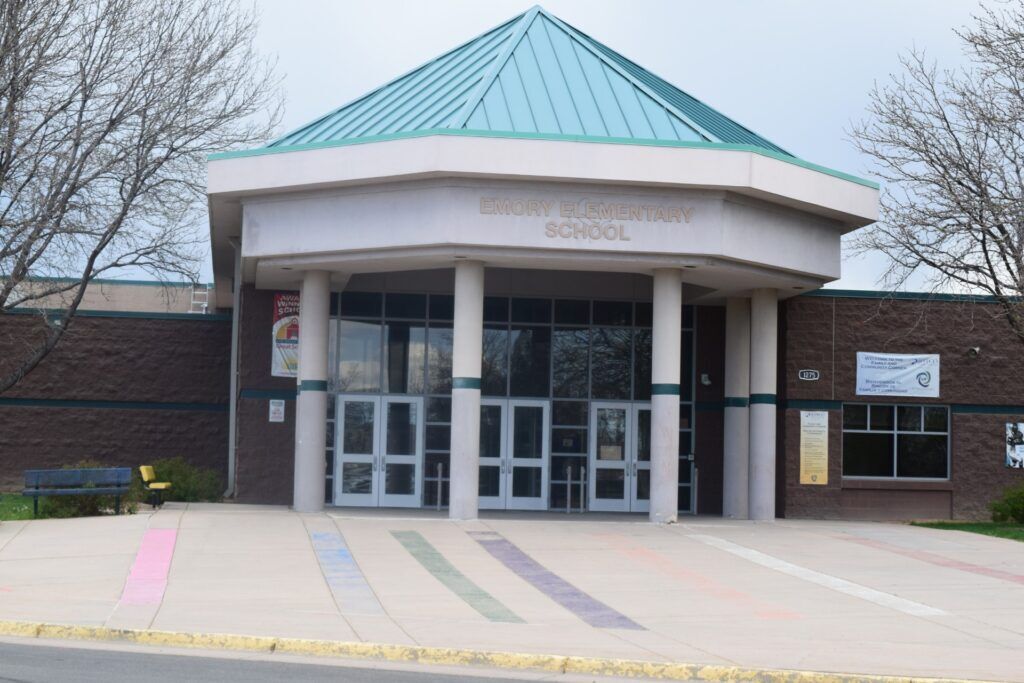
Emory Elementary School in Lakewood.
Last April, City Manager Kathy Hodgson bragged Emory’s “appraised price was much, much higher” than $4 million. Until now, the public hadn’t known just how much higher because it hadn’t been able to access the appraisal.
Through a recent open-records request, we now can see why.
A 185-page appraisal was performed for the district by Andre Suissa of Titan Commercial Valuation in June 2023 to guide “the disposition or repurposing of this asset.”
The appraisal fixed the property’s market value at a whopping $13.5 million. That was “as is,” and the property would garner $8.31 million as vacant land “as if rezoned.” Both had an estimated sale timeline of less than 12 months.
Jeffco Schools might as well have thrown it in the trash. They ignored every valuation, each one higher than Lakewood’s purchase price. They dismissed every recommended property use. And they bypassed competitive bidding altogether.
Suissa named three probable developers, noting “a regional to national developer” was the “most likely buyer” — and the “timing for development is now.”
Comparable properties in other school districts were being sold to charter schools and other buyers for $8.65 million to $22.5 million, including three closed sales to charters. Neighboring Douglas County sold a similar-sized building to Aspen View Academy, a charter school, for $12.4 million.
In a Feb. 2024 column, I asked whether the district would consider leasing or selling to district charter schools in need of new space or a developer seeking to build new housing.
Jeffco Schools didn’t need me to raise the issue. Their own appraiser already had. The building’s “highest and best use,” Suissa told his client, was still as a school — even if not a neighborhood school.
Many charter schools, including ones in Jeffco, have long waitlists. Yet, with leadership increasingly hostile to charters, I predicted the teachers’ union-backed school board would throttle that option — even when it meant keeping a school a school.
That’s exactly what happened.
Instead of even considering a charter school, special needs school/center, or a community/technical college, as the appraiser proposed, Jeffco engineered a brand-new process to justify a below-market, noncompetitive sale only to Lakewood — which would flip the building to a nonprofit for a use the appraiser never even considered.
Let’s be real: The “municipal interest” process didn’t protect the district from a risky market. Unlike the smaller Vivian Elementary, where Jeffco chose traditional bidding, this process shielded a bad deal from a good one.
Jeffco Schools didn’t just neglect its fiduciary duty to taxpayers by ignoring its own appraisal’s financial analysis. It undermined its very mission by dismissing every education-based recommendation, too.
Suissa evaluated every plausible alternative: charter schools, sober living, religious assembly, senior housing, community colleges — even community gardens and demolition with rezoning.
What he didn’t suggest was any kind of social services center, food bank or homeless services facility. That wouldn’t come close to maximizing the property’s value.
Even under the lowest-value scenario — demolishing the building and selling the land “as-is,” without rezoning — the property was still worth $5.24 million, beating Lakewood’s purchase price by over a million.
But demolition was the least likely option. Suissa concluded no “rational investor” would “demolish the existing improvements given its remaining economic life.” Emory had undergone at least $2.6 million in building upgrades before it was closed. It still has 25 years of productive life left, making it worth far more standing than the ground beneath it.
Under the appraisal’s “cost approach” — what it would cost to rebuild Emory from scratch — the building, parking lots, playgrounds and fields would cost $16.7 million after depreciation. Add in the land, and it would cost almost $22 million to replicate what Jeffco sold for $4 million.
A district facing a $65 million structural deficit — borrowing from capital funds to help cover general operations — practically gave away the property for roughly 7.4 cents on the appraised dollar.
At the $1 million purchase price, that’s effectively a $12.5 million gift to the Action Center, courtesy of unwitting Jeffco and Lakewood taxpayers.
Meanwhile, Lakewood city spokeswoman Stacey Oulton initially said the city would fund the purchase with $3 million in federal grants plus the Action Center’s $1 million — but eventually admitted to me there was “uncertainty” about using a grant.
Let’s be honest: The deal only makes sense if charter schools were always off the table — even when the district’s own appraiser calls them the property’s “highest and best use.”
Jeffco still has other shuttered schools to sell. Taxpayers deserve to know whether the others will go to the highest bidder — or to more sweetheart deals.
Jimmy Sengenberger is an investigative journalist, public speaker, and longtime local talk-radio host. Reach Jimmy online at Jimmysengenberger.com or on X (formerly Twitter) @SengCenter.


Protecting Colorado’s kids — when lawmakers won’t | Jimmy Sengenberger
Jimmy Sengenberger
jimmy-sengenberger@denvergazette.com
Updated 1 day ago
At a time when state lawmakers are pushing a radical bill to decriminalize prostitution with no regulation or restrictions, concerned Colorado parents are stepping in where our legislators fear to tread: protecting Colorado’s kids. A grassroots coalition led by the...
Jimmy Sengenberger
Reporter

Michael Bennet and the question in a campaign of small differences | Eric Sondermann
By ERIC SONDERMANN
by-eric-sondermann@denvergazette.com
Updated 1 day ago
The train usually runs only one-way. The route goes from the state capital to Washington, D.C. State legislators become congresspeople; governors become senators. See Hickenlooper, John. Including our junior senator, no matter his years, a total of 12 current U.S....

By ERIC SONDERMANN
Reporter

Proposed bill prioritizes rats over people | Rachel Gabel
Rachel Gabel
rachel-gabel@denvergazette.com
Updated 2 days ago
Democrat Sens. Lisa Cutter and Cathy Kipp, and Rep. Elizabeth Velasco have introduced a rat’s nest of a bill in SB26-062 Rodenticide Use Restrictions. The three mouseketeers are seeking to prohibit a person from selling, distributing, applying, or using certain...

Rachel Gabel
Reporter
PERSPECTIVE: Colorado’s human trafficking is getting worse
Mitch Morrissey
mitch-morrissey@denvergazette.com
Updated 2 days ago
I have seen evil in the world, and it does not go away because we as a society would prefer it to. It needs to be fought energetically. Human trafficking sounds like a Hollywood crime carried out by mafiosi and transnational cartels, but the reality...

Mitch Morrissey
Reporter

Law enforcement officers shouldn’t wear masks | Jon Caldara
Jon Caldara
jon-caldara@denvergazette.com
Updated 6 days ago
Should police wear masks? Denver’s City Council thinks no — and is even trying to outlaw it for federal agents operating in the city (because if there’s one thing municipal governments do well, it’s bossing around Washington). Like so many...

Jon Caldara
Reporter

The torture of Denver motorists is intentional | Mike Rosen
Mike Rosen
mike-rosen@denvergazette.com
Updated 2 days ago
Bicycle lanes in Denver are much more than just a nuisance for motorists; they’re a small but glaring symptom of the radical progressive mentality of Democrats that have grossly mismanaged Denver government in recent years. This is a sad reflection...

Mike Rosen
Reporter

Ken Salazar donates archives to Borderlands project, hoping history helps unify country
Vince Bzdek
vince-bzdek@denvergazette.com
Updated 1 day ago
About the same time the Pilgrims were setting up shop 400 years ago in Plymouth, Ken Salazar’s family was scratching out a toehold in what is now New Mexico, helping to establish the city of Santa Fe. The Salazars had...

Vince Bzdek
Reporter

A day in the life of the Capitol: Capitol M | Week of Feb. 14, 2026
Marianne Goodland
marianne-goodland@denvergazette.com
Updated 6 days ago
The lighter side of the Capitol, usually. If you were walking around the Capitol on Feb. 12, there was plenty to see and to be amused (or delighted) by. Let’s start with the high school kids from Greeley’s District 6....

Marianne Goodland
Reporter

GUEST COLUMN: Declining K-12 enrollment is a wake-up call
Norton Rainey
ramnorton@gmail.com
Updated 5 days ago
News reports confirm what many school districts already know: public school enrollment in Colorado is steadily declining. The state lost roughly 10,000 public school students in just the past year, part of a multi-year trend now playing out nationwide. Some...

Norton Rainey
Reporter

Colorado judges lean left – just look at the numbers | George Brauchler
George Brauchler
george-brauchler@denvergazette.com
Updated 1 week ago
Colorado’s judicial selection system is heavily skewed toward Democrats and defendants. It is time to drop the pretense that our system adequately minimizes the impact of partisan political influences on the selection of the judicial branch. In less than two...

George Brauchler
Reporter
PREV
PREVIOUS

Colorado judges lean left - just look at the numbers | George Brauchler
Colorado’s judicial selection system is heavily skewed toward Democrats and defendants. It is time to drop the pretense that our system adequately minimizes the impact of partisan political influences on the selection of the judicial branch. In less than two weeks, Gov. Jared Polis will appoint the next justice to our seven-member Colorado Supreme Court. […]

A day in the life of the Capitol: Capitol M | Week of Feb. 14, 2026
The lighter side of the Capitol, usually. If you were walking around the Capitol on Feb. 12, there was plenty to see and to be amused (or delighted) by. Let’s start with the high school kids from Greeley’s District 6. Their teachers, both old enough to remember, gave them a tour of the basement phone […]