







2022 was Mary Louise Lee’s turn in ‘Gypsy’ | John Moore
2022 TRUE WEST AWARDS: DAY 11

For six years, a nonprofit I founded was the beneficiary of a talent-show fundraiser called “Miscast,” a local variation on a 22-year Broadway tradition with a simple premise: Performers are invited to sign up to sing songs from roles “they would never … ever … get cast to play.”
They were never assigned numbers. They sang whatever they wanted to sing. One year, members of the disability-affirmative Phamaly Theatre Company performed the strip-tease number “Let It Go” from “The Full Monty.” Four students from Denver School of the Arts sang “Without Love” from “Hairspray,” with the Black students playing the white roles, and vice versa. Four young women hilariously interpreted a testosterone-fueled, profanity-laced scene from “Glengarry Glen Ross.”
It was all in good fun, and “Miscast” remains a popular annual event in New York.
In September 2018, I watched Denver legend Candy Brown fulfill a personal dream. She not only sang “With One Look” as Nora Desmond from “Sunset Boulevard” — she blew the roof off the Mizel Center doing so. The response was thunderous.
Standing alone in the back, I felt a pit in my stomach. What unintentional message might we be sending to suggest that Brown, a Black woman whose six Broadway credits include the original productions of “Chicago” and “Pippin,” would be miscast to play Nora Desmond? Or that anyone is “miscast” for anything? For all those years, the tagline for “Miscast” had been: “It may be all wrong … but it feels so right.”
It no longer felt right. After a sold-out night at the Aurora Fox in 2019, we retired the concept altogether and issued a statement explaining why.
It was around that time that Vintage Theatre Artistic Director Bernie Cardell announced a forthcoming production of “Gypsy” with musical powerhouse Mary Louise Lee playing the role of Momma Rose, the real-life stage mother from hell in the classic 1959 Broadway musical “Gypsy.” The significance of the casting was obvious. No Black woman was given the opportunity to play what has been called the greatest female role in the American musical-theater canon in a professional production of “Gypsy” for the first 55 years of its existence. Leslie Uggams became the first in 2014 at the Connecticut Repertory Theatre. Lee would become the third … until COVID came along and shut it all down.
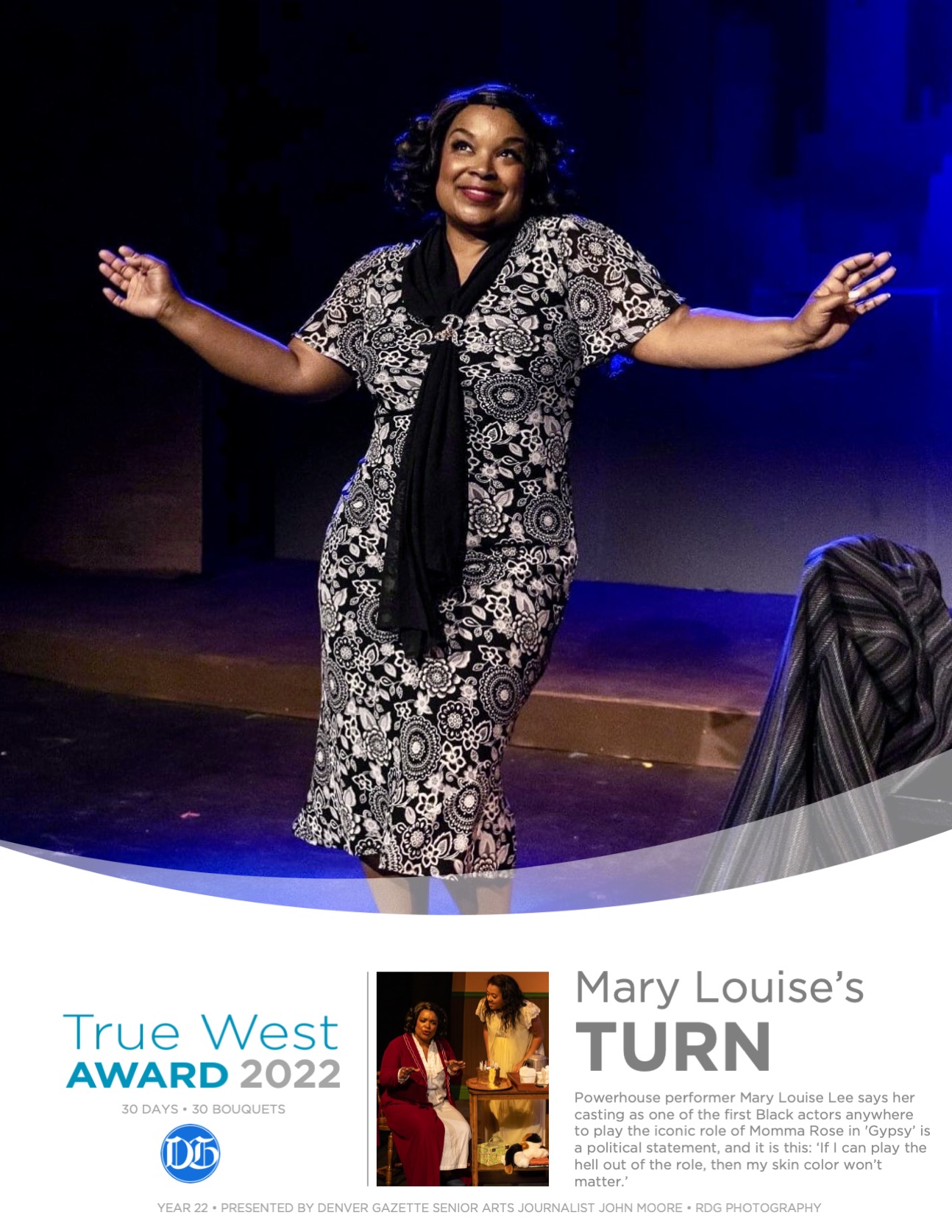
“Gypsy” finally opened at Vintage this past July. At last, it was Lee’s turn to sing “Rose’s Turn.”
There is not a theater fan out there who shouldn’t want to see Lee dig her heels into Stephen Sondheim’s signature, gut-scraping song. And not in spite of her Blackness. Because of it.
Rose Thompson Hovick was the very real, domineering WASP mother of Gypsy Rose Lee and Dainty June Hovick. And her inherent whiteness was a key weapon in how she managed to bully her way into achieving some small stardom for her daughters. In this real-life story, skin color matters. Lee told me she even went toe-to-toe with one of her own friends who asked, “Wait … isn’t that a white woman?”
Hovick was, indeed, white. And as a proud Black woman, Lee wasn’t about to sublimate any part of herself to portray her.
“I can’t play Rose as a white woman — because I am not a white woman,” she said.
In a later interview, Bernadette Peters, who played Rose on Broadway, told me, “It’s the story of a woman struggling to make a living and trying to help her children get ahead. That can be any woman.”
Cardell says he wasn’t trying to make a political statement by casting Lee.
“I just knew that she would slay the role,” he said. But Lee believes he made one, nonetheless.
“I do believe it is a political statement for me to be cast in this particular role,” she said, and it is this: “If I can play the hell out of the role, then my skin color won’t matter.”
She played the hell out of the role. And that, above all, is why she is winning her third True West Award in seven years.
Lee’s tornado-like presence on the Vintage stage gave audiences more than the opportunity to see Rose played from a completely different life experience. It also created the opportunity for a healthy and essential dialogue about the way Black people were treated in the 1920s — and are today.
If it clocked with any Vintage audience member that a Black woman of the time would not have even been allowed inside that theater — through the front door or the back — all the better. If they clocked that Black performers of the time were largely relegated to the demeaning, racially segregated Chitlin’ Circuit — all the better.
“What was that all about?” is a necessary, searching, ongoing conversation we should all be having right now. And if seeing a Black actor redefine the role of an iconic white character stimulated that dialogue, then all the better.
Because, no mistake about it: Mary Louise Lee was perfectly cast as the momma of Gypsy Rose Lee.
Note: The True West Awards, now in their 22nd year, began as the Denver Post Ovation Awards in 2001. Denver Gazette Senior Arts Journalist John Moore celebrates the Colorado theater community by revisiting 30 of the best stories from the past year without categories or nominations.