Aurora Public Library strives to reach more people through new strategies
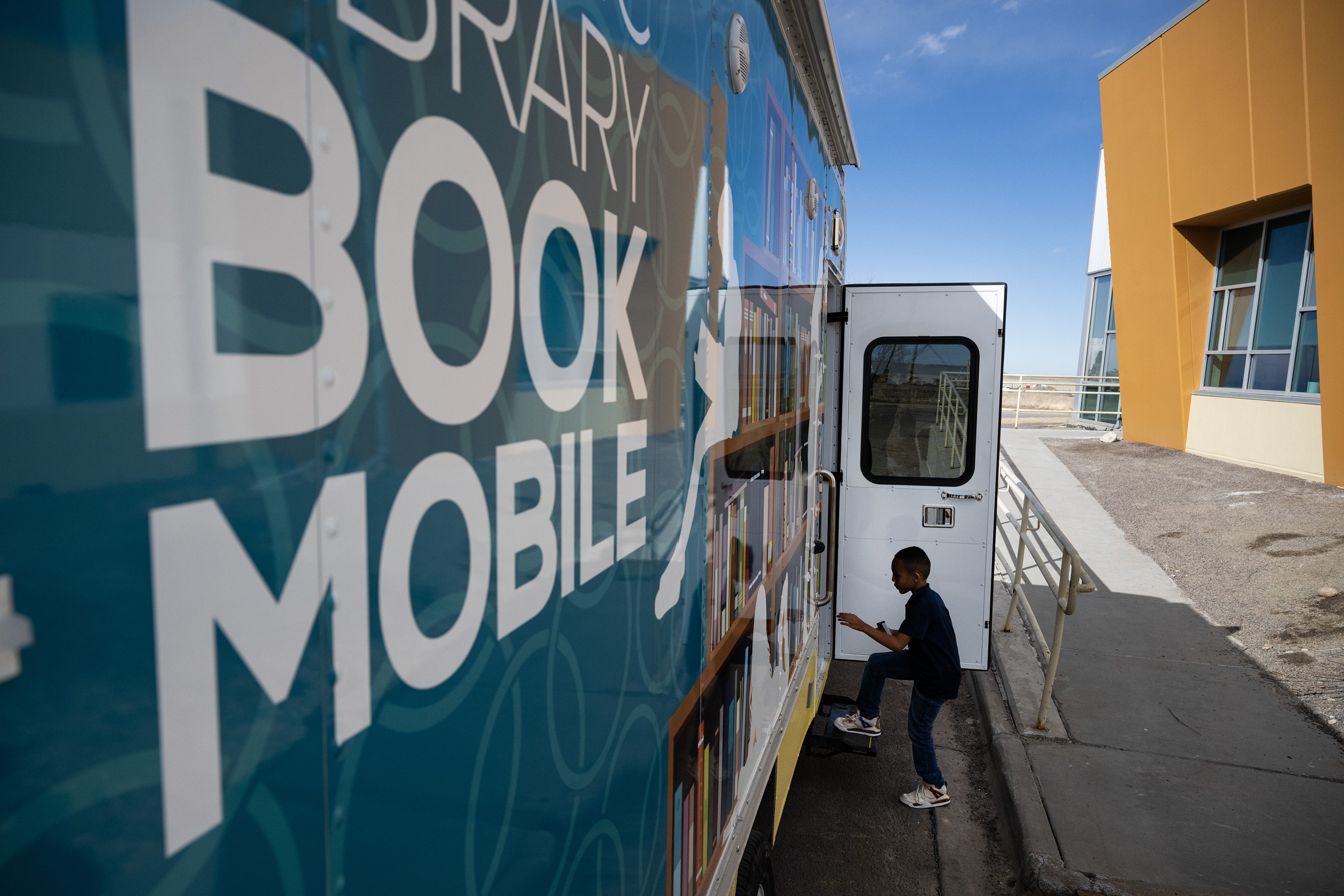
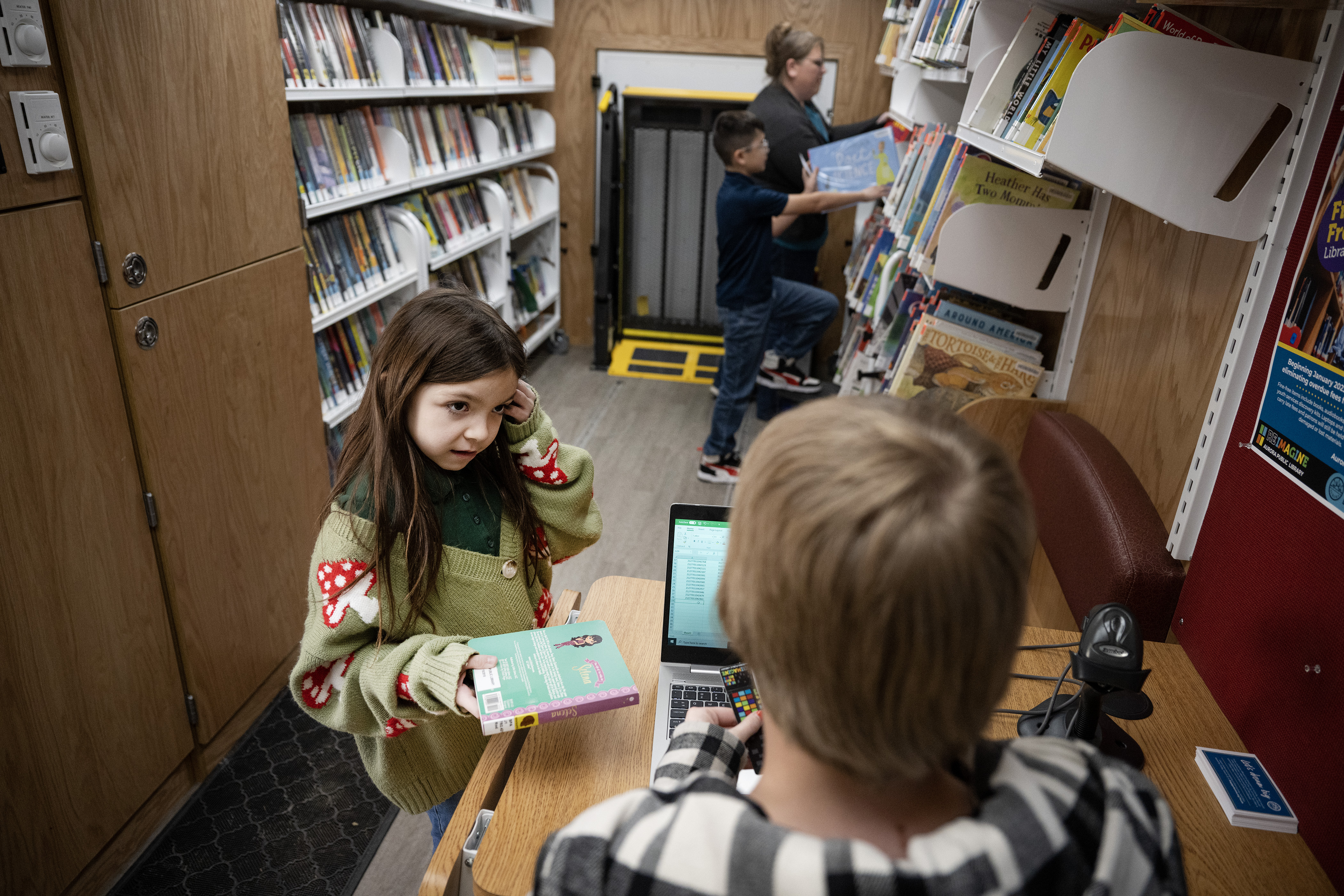
A stack of nearly 90 freshly prepared library cards sat waiting for their new owners as Aurora Public Library staff readied its bookmobile for an afternoon of young visitors.
The system’s roving miniature library, back up and running for the first time since the late 1980s, takes books and other items available for checkout wherever needed in the community. Stops have included military bases, senior centers, local businesses and schools.
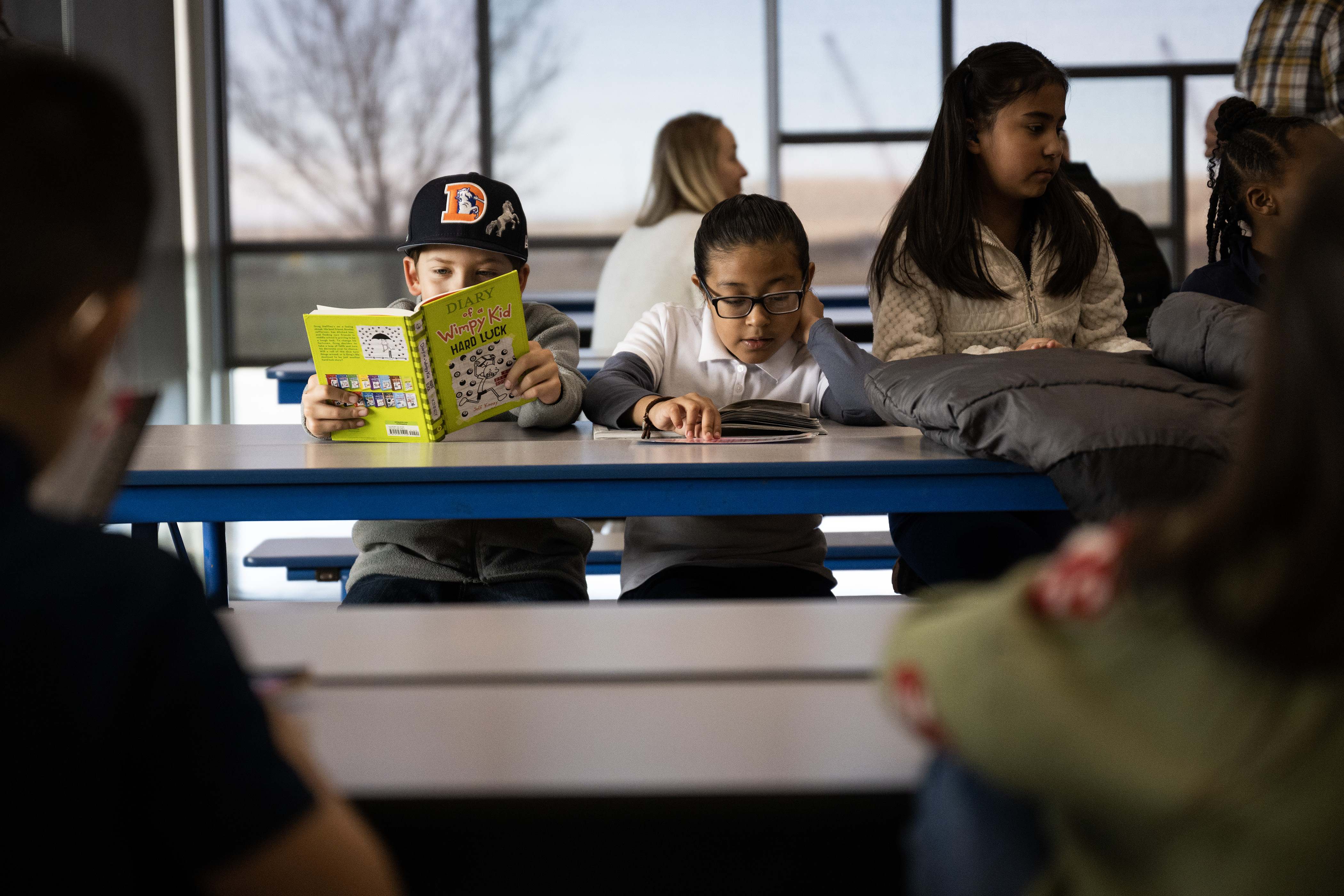
Inside High Point Academy last week, the school cafeteria buzzed with third-grade students waiting to check out a new read, and each had a library card with their name on it waiting for them inside the bookmobile.
Programming Librarian Adam Guyon said the bookmobile’s selection “varies a little bit, stop to stop.” When the bookmobile visited a senior center, staff stocked up a cart of large-print books. For High Point Academy’s third grade classes, requests included graphic novels and non-fiction books.
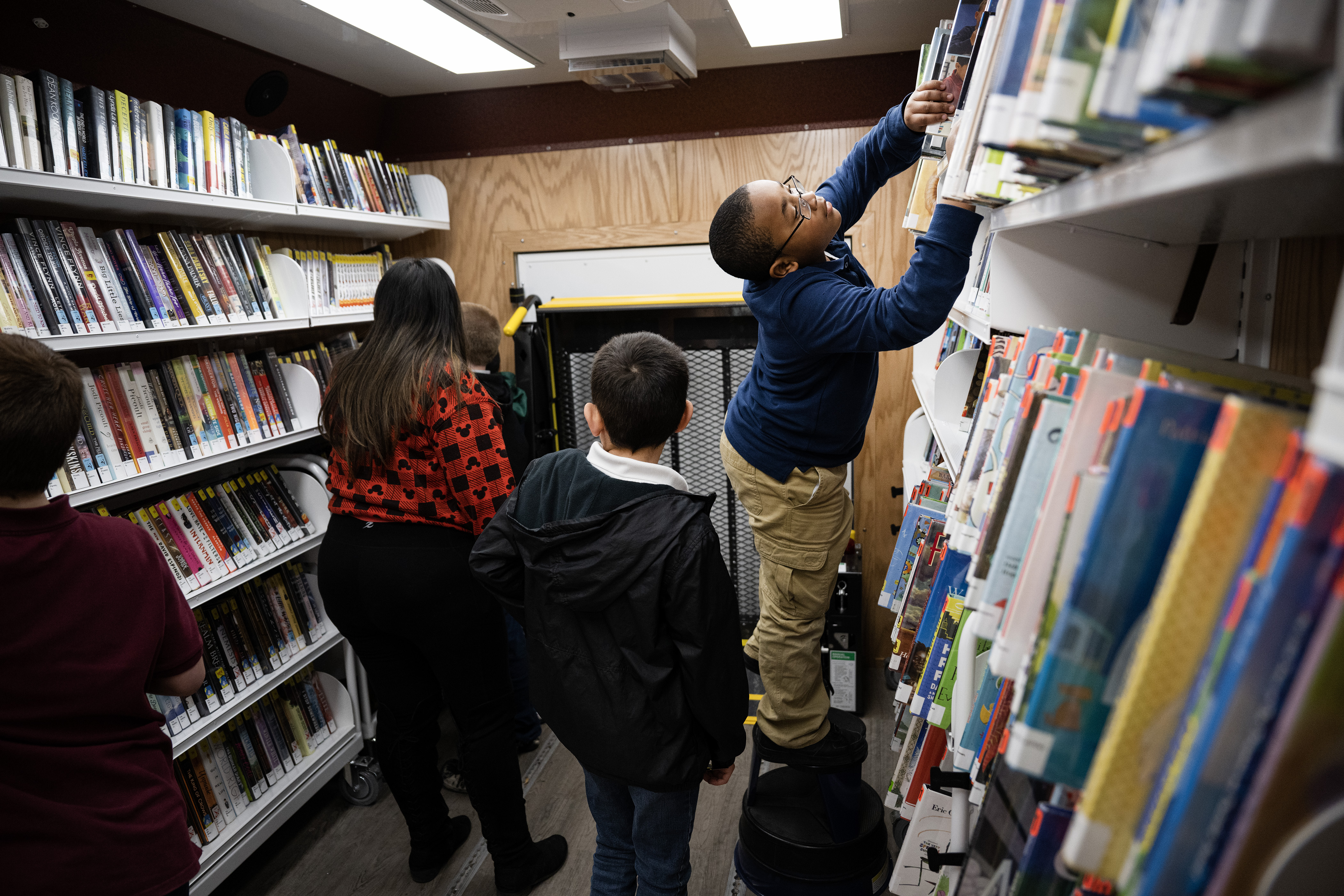
The first round of students climbed aboard and curiously looked around. Staff wrote down titles and topics the students wanted but couldn’t find, with a promise to try and bring those along when the bookmobile returns.
One by one, the students made their pick and stepped up to the checkout desk, new library card in hand.
Diary of a Wimpy Kid. Laser Moose and Rabbit Boy. Ultimate Slime.
One of the first inside was Muhanad Agali, 9. Any “Adventure Time” books? No, library staff said, jotting the request down on their list. Turning back to the shelves, Muhanad picked out a hefty volume of “Star Wars: Return of the Jedi,” boasting a black cover splashed with bold, crimson text. He’d been on the lookout for books with red covers.
“That’s my favorite color,” he said back inside the school, holding his book with a big smile.
Reaching the community
The bookmobile is one of several new strategies Aurora Public Library deployed in recent months as it beckons people back to its services amid the COVID-19 pandemic’s wake, Director of Library and Cultural Services Midori Clark said.
“It’s really about trying to create a public library that everybody can access equally,” she said.
A normal year would average between 1 million and 1.2 million visits to library branches. That plummeted to 327,466 in 2020. Despite being far below pre-pandemic visitations, the library was encouraged to see a considerable jump between 2021 and 2022. Last year the library logged more than half a million visits, compared to 365,986 in 2021.
This year, the goal is to reach 750,000 visits.
Heading into 2023, Aurora Public Library adjusted branch hours in hopes more people could visit the libraries. Once the libraries reopened after initial COVID-19 shutdowns, hours were mostly 9 a.m. to 6 p.m., Monday through Friday.
Now library officials have added hours on to another day of operation, Sundays, at its two largest branches. Certain branches also began opening earlier or staying open later into the evening to better accommodate people’s work and school schedules.
So far, the new hours seem to both be receiving positive feedback and moving the needle, Clark said. In comparing January 2022 with January 2023 visitation, the library recorded 32,888 visits for January 2022 and 46,704 in January 2023.
“We are seeing big bumps in the numbers,” she said.
The library is reacting to other changes spurred by the pandemic too, Clark said. Despite a drop in visitation, circulation numbers stayed relatively flat throughout the pandemic.
The way people accessed library materials changed. Electronic checkouts nearly doubled. People who used to pick up a physical book switched to e-books, she said, and some didn’t switch back. Last year the library saw roughly 1.3 million checkouts. Among those there were a record number of e-checkouts, she said.
The easiest path toward getting people back into libraries or using library resources is to chip away at barriers people might face in accessing them, Clark said.
Aside from the pandemic’s blow to in-person visitation trends, Aurora’s public library system faces accessibility challenges in many communities, she said.
“We have challenges, you know, when it comes to socioeconomic levels. We have challenges when it comes to transportation. We have challenges, gosh, even like language. There’s a lot of different languages spoken,” she said.
The biggest step in reimagining the library this year was removing fines for overdue items, Clark said.
Beginning in January, the library stopped charging overdue fines for books, audiobooks, DVDs, Blu-rays, and youth services discovery kits. The library still charges late fees for laptops and wi-fi hotspots. Replacement fees, which are not the same as overdue fees, are still in place for lost or damaged items as well.
One woman at the Mission Viejo branch returned items that were due in 2018. That was exciting to Clark, who hoped the woman not only felt comfortable returning the items but checking out new ones.
“We don’t want people to be living in fear for their overdue fines,” she said.
For the average library user, a $1 or $5 fine might not be troublesome, “but for a lot of people even just $1 can be a huge barrier to using the library.”
The Colorado State Library has also recommended libraries eliminate fees for children’s materials and published a white paper highlighting inequities the fines pose to low-income families.
Relaunching the bookmobile was another huge step for the library because it, too, is about removing barriers, she said. The bookmobile can help residents without good access to transportation use the library, as one example, she said.
“We want to say, ‘Hey, we want to bring our books to you,’” she said.
The vehicle was purchased in 2020, but its buildout as a bookmobile was delayed when the pandemic hit, a library spokesman said. The $150,000 project wrapped up late last year. A private donation covered roughly $80,000 and library allocations within the city budget funded the rest.
The community’s first bookmobile launched in 1959 at a cost of $13,196, the equivalent of about $135,000 today, according to APL.
Clarissa Barnett, a K-4 assistant principal at High Point Academy, said in addition to bringing library services to High Point’s services, the bookmobile offered a unique educational experience.
High Point Academy is piloting a new curriculum that teaches third graders about overcoming challenges. The lessons include studying people from around the world who encountered roadblocks accessing books but did not give up in getting those resources for their community, Barnett said.
“That inspired us to invite the bookmobile,” she said, explaining the program connected students with a real-world example of how some residents access reading materials, while also connecting the school to the community.
Getting a library card of their own was an empowering experience for students too, she said.
“A love for books is in the air right now,” she said.
The national picture
Lessa Kanani’opua Pelayo-Lozada, president of the American Library Association, was excited to learn about the strategies being employed by Aurora Public Library. The mission of public libraries is to ensure everyone has access to information.
“It sounds to me like they are doing everything within their power to do that,” she said.
She was particularly glad to hear the Aurora Public Library is reviving its bookmobile program, because bookmobiles “can reach so many different populations who may not be able to make it to the library.”
The association’s perspective on bookmobiles is straightforward: They have been, and continue to be, “an integral, vital part of libraries around the country,” according to the association’s website. Their history began roughly a century ago — the first was a horse-drawn buggy in 1905 — serving as a way to reach rural areas without libraries. Bookmobiles have been carting library resources to rural, urban, suburban and tribal areas ever since, according to the ALA.
The many different forms of bookmobiles tend to be popular within communities, Pelayo-Lozada said. At her branch in L.A., the library operates a “book bike” that tours the city.
About 6% of public libraries were estimated to have at least one bookmobile, or about 671 total, as of 2019 data. The early 1990s were particularly good years for bookmobiles, as their numbers exceeded 1,000 in the U.S., although they gradually declined back to about 668 in 2018, according to annual Public Library Survey findings.
Eliminating fines for overdue items has been gaining popularity among libraries in the past five-to-10 years, she said. Libraries large and small have found taking away fines increases access for marginalized populations, who may not be able to afford the fine or fines that have accrued. Reports have shown circulation goes up after enacting the policies, she said.
The fine policies also don’t work, Pelayo-Lozada said.
“It’s been proven that fines and fees do not actually deter folks from returning” items past their due date, she said. Fines aren’t significant revenue generators either, she added, saying they account for usually 1% of a library’s revenue.
Another reason to support stopping fines is the understanding that it’s not the library’s role to moralize and teach people to return books, she said. People sometimes ask how children especially will learn to return items on time, and Pelayo-Lozada said that lesson falls to parents.
From bookmobiles to going fine-free, libraries are changing, she said. And while checkouts and door statistics remain down for many libraries in the U.S., e-checkout statistics “tells the bigger story of where we are headed.”
“We are not static institutions,” she said. “We are no longer just buildings of books.”