







An eighth-grader gives us a glimpse of a brighter politics ahead | Vince Bzdek
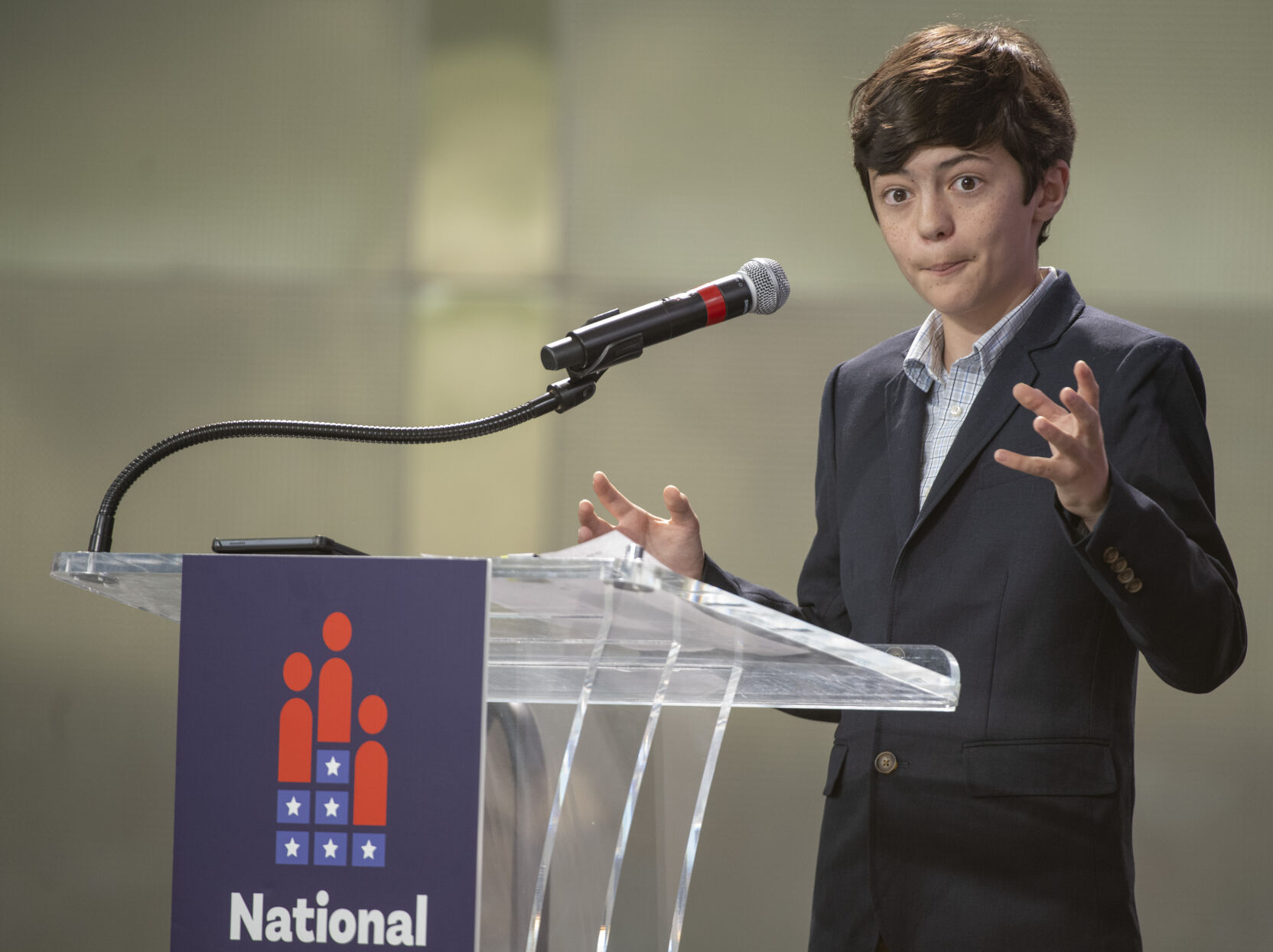
I saw the best speech of the 2024 election season so far last week, and it was given by a pint-sized eighth-grader from a tiny school in Buena Vista.
“A huge problem in the state of Colorado is that students are unenthusiastic about their education, as shown by the fact that 31% of students are chronically absent,” the impish Joseph Drexler, student at Patterson Christian Academy, announced during the National Civics Bee competition at the University of Denver. “However, we can fix this looming problem by helping students know that they can make a difference in their own lives and the lives of others.” Joseph made this claim with such enthusiasm and joy — he was actually bouncing on the balls of his feet — it gave me a true moment of hope in an otherwise dreary election year.
“We can help students know they can make a difference with two things,” the tousled-haired future governor told the rapt crowd. “The first is teaching them more civics. The second is giving them more choice in their education. At its core, civics is about helping people learn how to use their government to accomplish their goals and make a difference. And that’s why it’s so vital for this process of empowering students.”
Paraphrasing Thomas Jefferson, he added, “The student is strongest when he feels himself a part of the government. The process of giving students more choice in their education is vital for this idea of helping them make a difference because it gives them a way to engage in their community. Further, it creates more engaged students, and more engaged students have more vision, responsibility and ownership!”
Joseph was preaching to the choir Friday. Civics boosters of all sorts were gathered for the Colorado leg of the National Civics Bee, sponsored by the Colorado Chamber Foundation and the U.S. Chamber of Commerce Foundation in partnership with the Daniels Fund. The event, modeled on traditional spelling and geography bees, brought together 27 middle schoolers who’d won local bees across the state for a fierce battle to see who would go to the first-ever National Civics Bee in Washington, D.C., this fall.
Colorado and The Daniels Fund are really the driving force behind the whole national effort, part of a long-overdue recognition that we need to rebuild respect for our political institutions, increase political participation and maybe, just maybe, build back a little love for our country as well. It was great to see political heavyweights like John Suthers, Phil Weiser, Tim Geitner, the Chamber and the folks at The Daniels Fund coming together in support of reinvigorating how we practice and teach politics.
Participating students are asked to write an essay about a community issue, then prepare for months before competing in local competitions. Twenty-eight states now participate in the Bee and the goal is to host local competitions in all 50 states by 2030 with hopes of reaching at least 1 million people. Make no mistake: The Bee is a fledging crusade to reinvigorate political discourse nationwide.
Former Colorado Springs Mayor Suthers was one of the judges last Friday. He told me more than one-third of U.S. adults cannot name the three branches of government, and 1 in 5 Americans cannot name a single branch of government. Last year a national report card found that nearly 80% of eighth graders were not proficient in civics.
“Unfortunately, civics is disappearing in so many of our schools,” said Hanna Skandera, president and CEO of The Daniels Fund.
Attorney General Phil Weiser, the keynote speaker at the Bee, agreed. “The celebration here is one that we need a lot more of. Civic engagement, civic literacy, learning about the rule of law is not something every middle schooler encounters.”
To explain why we desperately need better civics education, Weiser quoted a “philosopher” that many of us parents there grew up with. “His name is Fred Rogers,” Weiser told the kids.
“In a movie called ‘It’s a Wonderful Day in the Neighborhood,’ Tom Junod, a journalist, describes Fred Rogers’ vision of how the public square works. He says: ‘Fred was a man with vision, and his vision was of the public square, a place full of strangers transformed by love and kindness into something like a neighborhood. That vision depended on civility, on strangers feeling welcomed in the public square. And so civility couldn’t be the subject of politics, but rather the basis of politics, along with everything else worthwhile.”
Way back in 1991, my father attended a Colorado education conference to campaign for the idea that schools needed to get back to teaching civics as the foundation of education. He’d written a book on the subject, taught classes on political participation, and made it his lifelong quest to help create better citizens.
He was hooted out of the room by teachers who said they needed to teach fundamentals and life skills and had no time for civics. My dad’s argument back then: there is nothing more fundamental than civics. Our public schools were created to educate citizens so they could run our by-the-people government.
George Washington once urged Congress that no “duty (is) more pressing on (the national) legislature” than “the common education of a portion of our youth from every quarter.” The very “prospect of (a) permanent union” depends on their education.
Thirty years ago, my dad was worried about a day when our politics would stop functioning well because we hadn’t taught our kids enough about the Bill of Rights and the Constitution and an appreciation of the great deeds of our nation.
A day like today, in other words.
Fast-forward to last Friday, which gave all of us who were there a small glimpse of a possible brighter future.
On that sunny day in a glass-walled auditorium, eager-eyed Joseph couldn’t have modeled the ideal young citizen Washington had in mind any better. He showed us how, by acting with empathy and kindness and a real zeal for a civic life, we can all become, as Weiser put it, stabilizing forces in our communities.
Joseph ended up winning first place and $1,000 in the Colorado Bee and a trip to Washington to compete for $50,000 in prizes at the National Civics Bee.
“If our future resembles the students we see here today, it promises to be bright,” Skandera said at the end.
On our way home after hearing all those inspiring preteens, my dad was musing about his grandfather Jacob, who had come to America from Poland in the early 1900s and managed to bring many other Poles over one by one to a new life of liberty. Many other immigrant Poles did the same. America was where they came to build a new life and create a shining city on a hill.
Dad recalled attending his grandfather’s funeral when he was an 11-year-old kid, and he remembered an elderly women walking by the casket in the church his grandfather had helped build. She had tears in her eyes.
“You helped me become a citizen,” she said to Jacob.
Is there any higher calling?