







Denver City Council approves Ball Arena rezoning, giving green light to development
The project's biggest obstacle to exempt protections of mountain views for skyscrapers in exchange for affordable housing also passed.

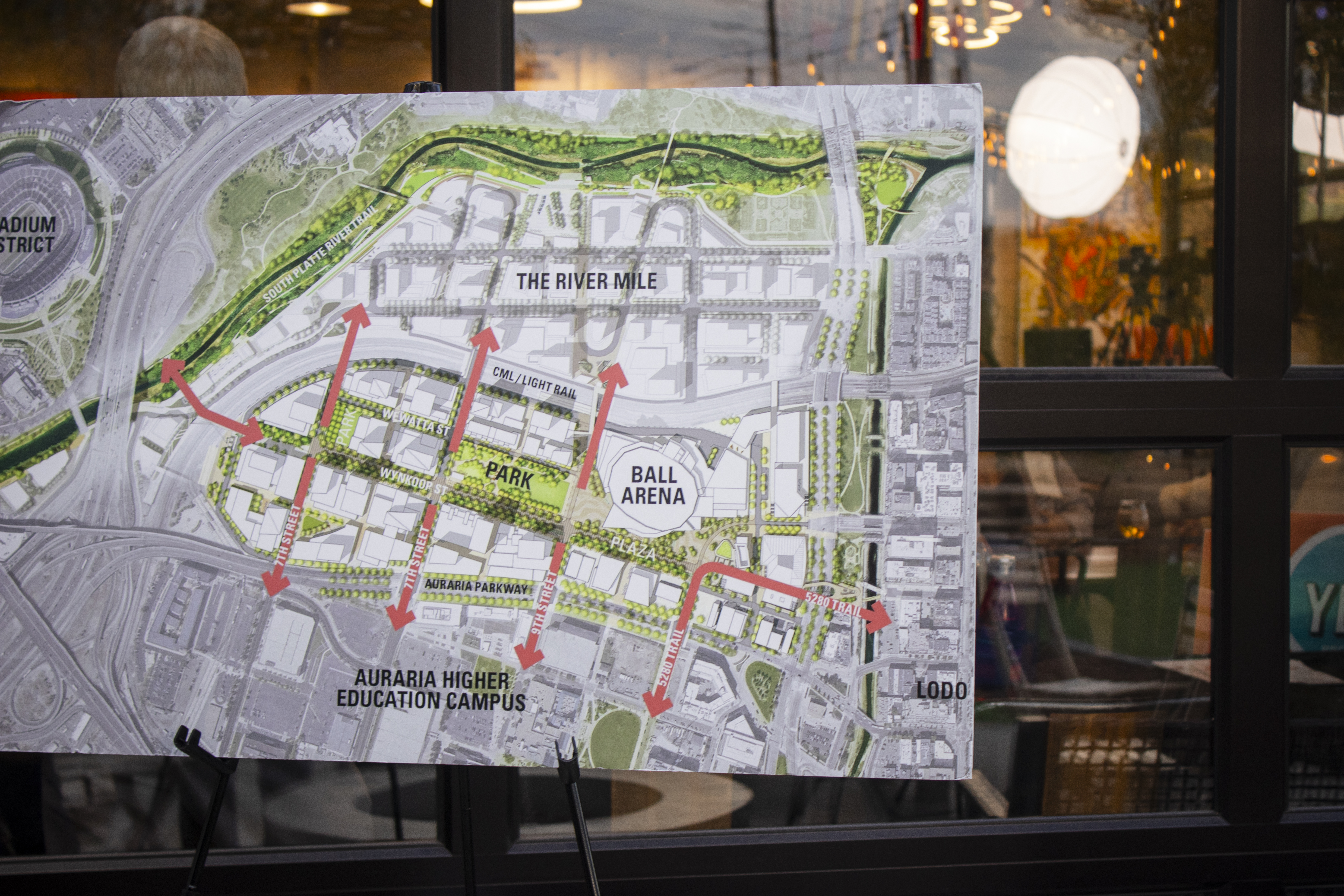
The Denver City Council voted unanimously Monday to rezone approximately 70 acres of land around Ball Arena to allow development of housing, shops, restaurants, office space and parks.
The council waived parts of a view plane city planners found to be “obsolete.”
City officials looked at six separate measures which included rezoning the land for mixed-use development, extending agreements to keep the Colorado Avalanche and Denver Nuggets in the city until 2050, and waiving the Old City Hall view plane designed to preserve Rocky Mountain views in exchange for affordable housing.
One councilmember, Amanda Sawyer, voted against making changes to the view plane, saying she didn’t want the city to set a precedent for “piercing” the mountain views in exchange for concessions.
Ball Arena is owned by Kroenke Sports and Entertainment and home to the Avalanche and Nuggets.
The sports venue has 55 acres of parking lots where most of the development would take place. It could take more than a quarter of a century for the project to be fully built, said Councilmember Chris Hinds, and could break ground in 2026.
Representatives for Kroenke Sports did not immediately respond to a request for comment about next steps.
Kroenke Sports Senior Vice President Matt Mahoney told The Denver Gazette last week the project would likely begin on the side closest to Lower Downtown with a pedestrian and bike bridge over Speer Boulevard and several buildings around it.
Mahoney told the City Council on Monday that 2050 is the “big date” of the night.
“This is the date we’re asking for all of our entitlement vesting for both River Mile and Ball Arena to be protected,” Mahoney said. “And in return, we’ve committed to keeping our teams at Ball Arena through 2050.”
The project proposes to transform the parking lots with thin skyscrapers holding apartments and condominiums, 18% of which will be set aside for affordable housing. The developers promise to build connections between downtown and the South Platte River and a large park that also functions as an event and concert space.
The Ball Arena redevelopment’s largest obstacle was concern over a measure to change one of 14 view planes in the city designed to protect panoramic views of the Rocky Mountains originating from the Old City Hall Bell Plaza.
Councilmember Kevin Flynn, who said he was struggling with his decision, likened Monday’s vote on the amendment to the day the City Council voted in 1999 to exempt Empower Field from the view plane before it was built.
He showed a photo of a downtown building on Larimer Street where the mountains were still visible from the 25th floor with drawings of potential skyscrapers coming from the Ball Arena site, though he added the views would no longer be seen on the 10th floor.
Flynn said he wished the city’s planning department asked to repeal the entire view plane since it was “obsolete” due to the Auraria campus (a state property not beholden to the code) already blocking the mountains from Old City Hall and the Broncos stadium, which is exempted.
“If the primary benefit of this view plane is no longer justified, how can there be a secondary benefit?” Flynn asked.
Hinds, who represents downtown, said he lost his mountain views from his home twice because of other developments – but added no one is entitled to the views.
“I’d rather lose my view than have more people in tents in District 10,” Hinds said.
Sawyer pointed out that another major rezoning for Cherry Creek West, which is in her district, had to obey the view plane restrictions.
“Is it the right thing to do for generations ahead for us to be setting a precedent to pierce a view plane when we know many of us have view planes in our district, that if anyone came and wanted to pierce those view planes, people would lose their minds,” Sawyer asked.
With the view plane change passed, Kroenke Sports can build as tall as they’d like but are restricted by width.

The taller the tower, the thinner the building needs to be, which could leave parts of the mountain view visible in between skyscrapers.
Denver targeted the Central Platte Valley/Auraria area as a key place to decrease parking and make the neighborhood more dense, according to Denver’s 20-year downtown plan created in 2007.
During a South Platte River committee meeting about a new City Council initiative to focus on development along the winding waterway, Senior City Planner Tony Lechuga said the project falls in line with the city’s vision and helps Denver push downtown’s mixed-use goals.
Mahoney said the project would encourage more light rail use, walking and ridesharing to get to games, though there would be parking within buildings.
Kroenke Sports plans to build about 6,000 units of apartments or condos, of which 1,080 would be designated as affordable housing.
The 18% affordable housing commitment for the Ball Arena neighborhood is higher than the 8% to 12% city requirement for any new multifamily building with more than 10 units.
Two buildings would be “fully-affordable,” per the development agreement approved Monday, and would be among the first three structures constructed in the center of the project.
An exception in the agreement would allow Kroenke Sports to waive Denver’s affordable housing requirements for up to five market-rate buildings.
Matthew Larson, a YIMBY Denver leader and a Regional Transit Department candidate for District 10, said during public comment the project’s 6,000 units would make a large dent in the housing deficit Denver currently has, about 10%
A majority of public comments voiced support for the project, though some residents voiced concerns it prioritized corporate interests and isn’t sufficient for helping the city’s affordable housing problems.
Hinds said he heard concerns from downtown residents about whether large developments like Ball Arena and Cherry Creek West would distract from the city core, but said he sees them as benefits.
“I sure would love to get rid of surface parking lots,” Hinds said.
Kroenke Sports signed a community benefits agreement ahead of the public hearing with nearby neighborhood organizations representing downtown, Sun Valley, La Alma/Lincoln Park and the Auraria campus.
Ball Arena’s owner promised to use 1% of retail and hotel sales to create a $16 million fund to support job development, local artists and descendants of displaced communities such as the Aurarians and Native Americans.
“The city did not displace 900 residents in the 1970s for us to turn around and build a shiny new neighborhood that is inaccessible to them,” said Councilmember Jamie Torres, a displaced Aurarian descendent.
“I could not be a part of something like that,” she said, voicing her support of the rezoning. Torres noted she was “impressed” with the community benefits agreement.
Then Torres teased that another project similar to Ball Arena’s plan within the area she represents could be on the horizon, though there are reports a Broncos stadium development has stalled indefinitely.
“This isn’t the last major sports arena development in District 3,” Torres said.
