







Denver’s first 2 cases of omicron variant identified, city says
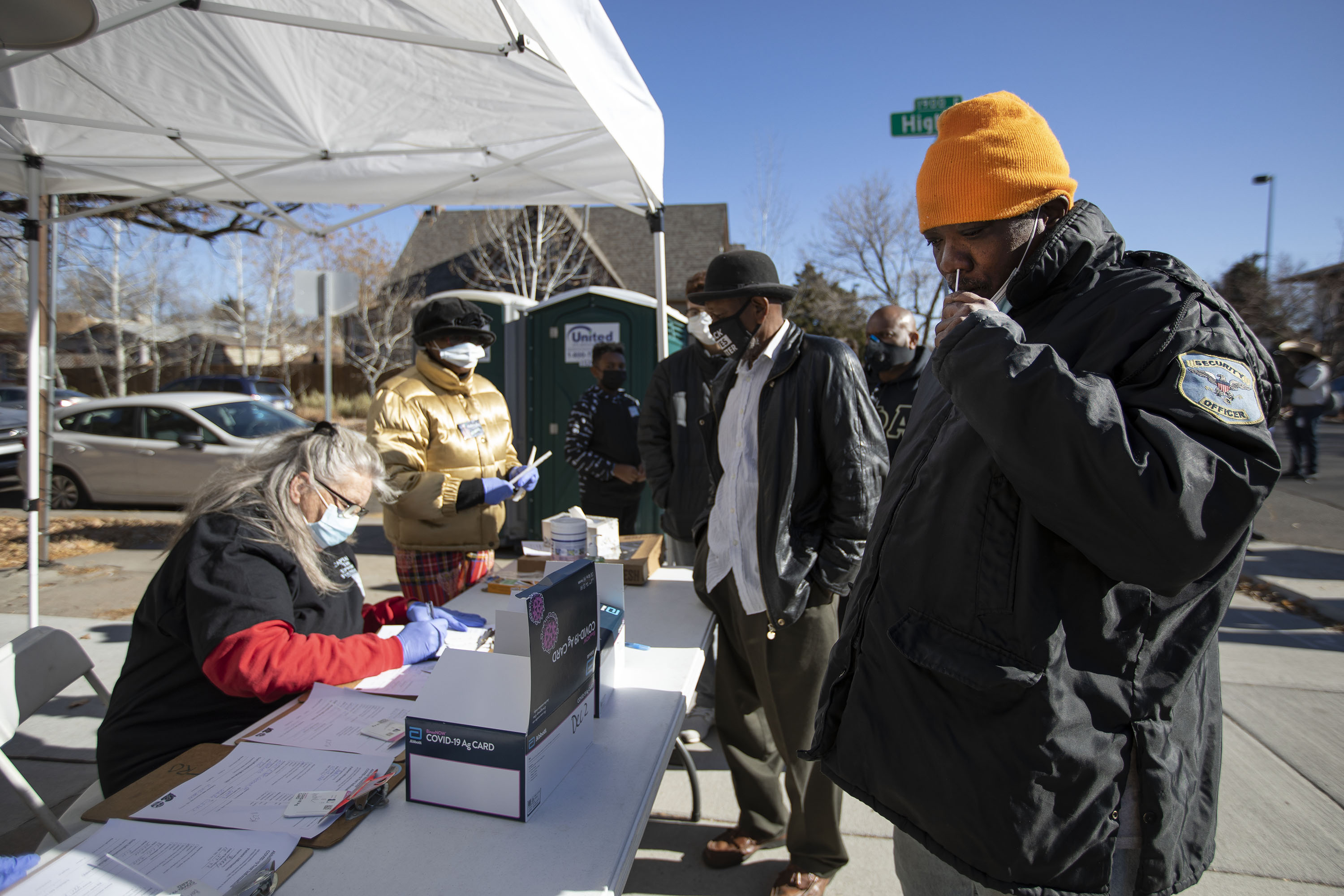
Denver has confirmed its first two cases of the omicron variant, the city’s Department of Public Health and Environment said Monday.
Shortly after that news broke, the Centers for Disease Control and Prevention announced that omicron is now the dominant variant in the United States, a sixfold increase in the strain’s presence in the span of a week.
Both Denver cases are the result of community transmission, the agency said in a statement, meaning they came from a local source as opposed to international travel. The two people — a man and a woman — both have mild symptoms. The man was fully vaccinated and had received a booster; the woman was fully inoculated but had not yet received a third dose.
“At this time, no known close contacts associated with either case have tested positive for the variant,” the agency said. The cases were confirmed as positive for omicron by the state Department of Public Health and Environment on Friday.
Denver is the latest Colorado county to report a case of the new variant, which was first identified in the state a month ago. Boulder, Jefferson, Arapahoe and Garfield counties all previously reported cases. Gov. Jared Polis said last week it was “only a matter of time” before omicron “becomes the prevalent variant here in Colorado as it has in every other place it’s been.”
Rachel Herlihy, the state’s epidemiologist, told reporters Thursday that state officials “fully expect that we are going to continue to see increasing rates of the omicron variant here in Colorado.”
Herlihy said traces of the variant had been identified in wastewater samples from several areas of Colorado, including Boulder, Aurora and Commerce City. The state also detected the variant in the wastewater system shared between Lakewood and Denver.
The first few cases of omicron in Colorado — those in Arapahoe, Boulder and Jefferson counties — were all the result of recent international travel to parts of Africa, where the strain was first officially identified. But the Garfield and now Denver infections have been confirmed as the result of community transmission.
State officials have said the strategies used to combat the delta variant and other previously dominant iterations of the virus will remain crucial against omicron: vaccinations, boosters, masking, social distancing and good hygiene.
Denver, along with a handful of other metro-area counties, has a mask order in place for all public indoor settings. More than 500 businesses in the area have elected to require proof of vaccination for patrons. As written, that order will be in place through the beginning of 2021.
Researchers are still learning more about the variant, though it’s increasingly clear that it is more transmissible than the initial strain of the virus that emerged in March 2020. The variant accounted for 73% of new infections last week, according to the CDC. In some places, it’s even higher: It’s responsible for an estimated 90% of new infections in the New York area, the Southeast, the industrial Midwest and the Pacific Northwest. The national rate suggests that more than 650,000 omicron infections occurred in the U.S. last week.
COVID-19 cases are now doubling in one and a half to three days in areas with community transmission, the World Health Organization said on Saturday. Lines for COVID-19 tests wrapped around the block in New York, Washington, D.C., and other U.S. cities over the weekend as people clamored to find out if they were infected before celebrating the holidays with family.
“It is a predictor of what the rest of the country will see soon, and the minimum — since NYC is highly vaccinated — of what other parts of the country will experience in under-vaccinated cities and states,” said Georges Benjamin, executive director of the American Public Health Association.
In Colorado and across the United States, the delta variant has long been the dominant strain. Nationwide, it accounted for more than 99% of cases at the end of November. Though delta is still responsible for virtually every infection in Colorado, it has already been dethroned by omicron nationally.
Much about the omicron variant remains unknown, including whether it causes more or less severe illness. Early studies suggest the vaccinated will need a booster shot for the best chance at preventing omicron infection but even without the extra dose, vaccination still should offer strong protection against severe illness and death.
“All of us have a date with omicron,” said Dr. Amesh Adalja, a senior scholar at the Johns Hopkins Center for Health Security. “If you’re going to interact with society, if you’re going to have any type of life, omicron will be something you encounter, and the best way you can encounter this is to be fully vaccinated.”
Reuters and The Associated Press contributed to this report.
