




Prosecutors: Suspect purchased from liquor store 5 times the day of fatal crash that killed a Golden officer
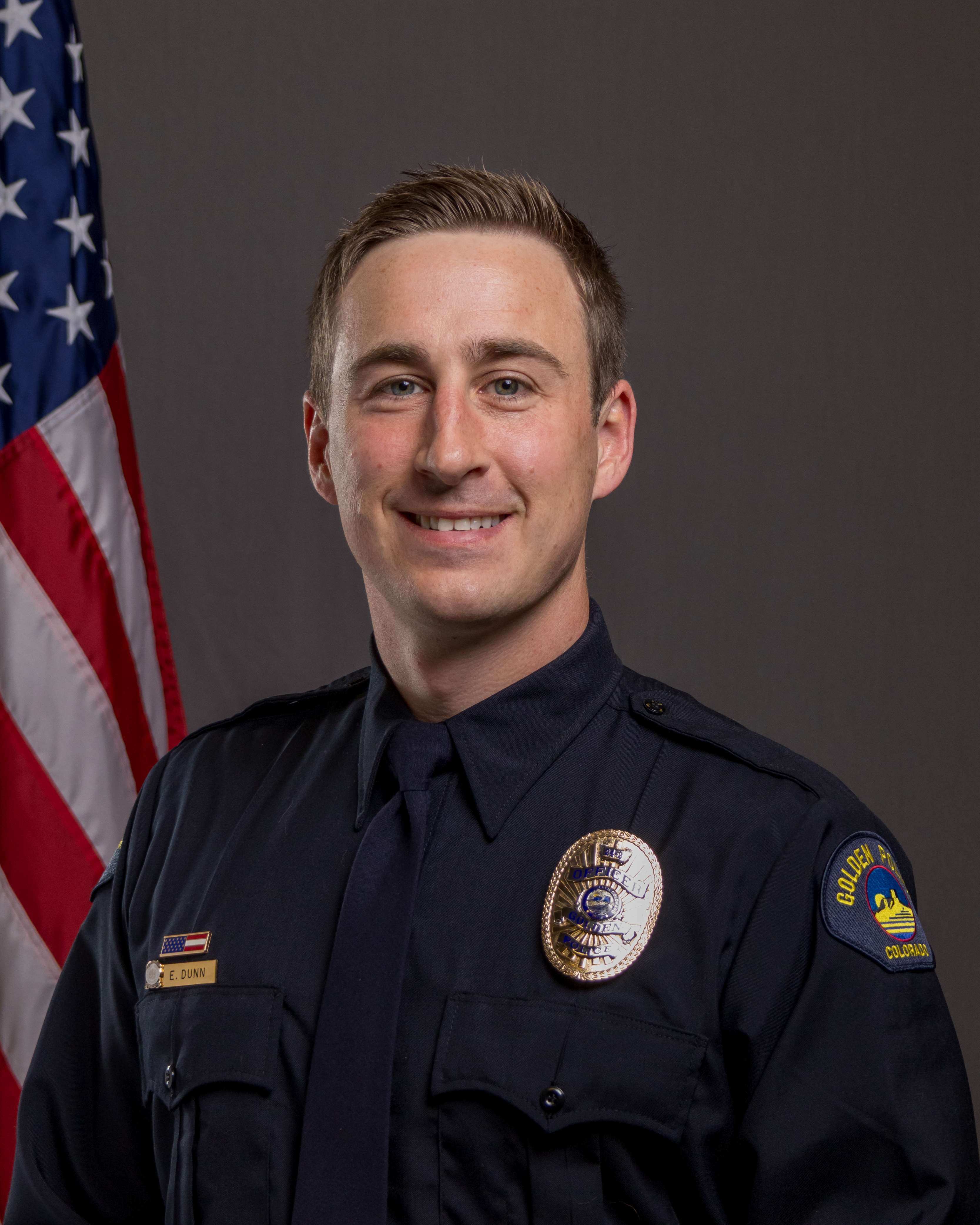
Stephen Geer, 43, was charged with vehicular homicide in connection to the death of Evan Dunn, 33

A Jefferson County deputy district attorney claimed Wednesday that 43-year-old Stephen Geer visited multiple liquor stores hours before he allegedly crashed into two Golden Police Department officers, killing one.
Prosecutor Brian Domingues said investigators found that Geer had visits to liquor stores throughout the metro Denver area and Golden multiple times before the fatal crash on Nov. 6 and that there was evidence to show “five transactions with respect to those liquor stores at that time, on the date of violation.”
Geer, out on a $250,000 bond with the condition of pretrial supervision, stood in a Jefferson County courtroom Wednesday morning in a suit, an alcohol monitoring device strapped to his ankle.
The suspect is charged with one count of vehicular homicide, two counts of vehicular assault, one count of third-degree assault and one count of driving under the influence in connection to the fatal Golden crash that killed 33-year-old Golden Police Department Officer Evan Dunn and injured three others.
Dunn’s on-duty death was the first of an officer in the history of the Golden Police Department.
Domingues also said there were daily purchases leading up to Nov. 6.
“Public transportation is not a significant means here in the Denver Metro area. The light rail services are limited things of that nature. So, how the defendant was getting to those locations to make those purchase, it’s evident he was driving,” Domingues said.
Geer and his defense attorney, Megan Downing, appeared before First Judicial District Judge Russell Klein Wednesday morning on a bond hearing. The defense argued that Geer’s Secure Continuous Remote Alcohol Monitor (SCRAM) unit was causing blisters on his ankles, despite being switched between legs by pretrial officers.
Downing said the unit was causing Geer “tremendous pain, discomfort and tenderness.”
The SCRAM unit monitors alcohol consumption by testing the wearer’s sweat every 30 minutes. The defense argued that Geer has been compliant to the order to stop drinking and could be switched to a less invasive device, like a breathalyzer required to be blown into during set intervals.
“An ankle monitor, while inconvenient to him, is a minimal burden compared to the irreversible loss caused by drunk driving,” Annalise Dunn, the widow of Evan Dunn, told the court.
It was the first time she has spoken publicly since the fatal crash.
She continued: “It serves as a constant reminder of accountability for him and a safeguard to the community. Removing it prior to conviction sends a troubling message.”
Annalise Dunn went on to call Evan Dunn the love of her life, saying that he “selflessly served in our country in the United States Army and planned to do so for the rest of his life.”
Geer allegedly crashed into a vehicle parked at another crash on Highway 58 on the night of Nov. 6. His vehicle pinned two officers under the first crashed vehicle — Dunn and Ofc. Bethany Grusing.
Geer’s blood alcohol concentration came back at a .168, according to Domingues, more than twice the legal limit.
Dunn died on impact and Grusing sustained a cheekbone injury. The two drivers who were involved in the earlier crash were also injured. Both were thrown by the impact and one sustained a skull fracture and brain bleed, according to arrest documents.
Evan Dunn’s brother, Tyler Dunn, also spoke against the changing of alcohol-monitoring devices, saying that the SCRAM unit was the most efficient and reliable way to monitor the suspect prior to trial.
Ultimately, Judge Klein agreed, declining the shift of alcohol monitoring, saying that periodical monitoring, like a breathalyzer, could give Geer the chance to drink in the evening before the next day’s test.
“It’s not that the court is opposed to the idea of a different continuous alcohol monitoring. It’s just that what is being proposed is not equipped to, at least as far as the court can tell, address the specific concern that’s raised here,” he said.
Geer is due back in court for another hearing on June 22. He recently waived his right to a preliminary hearing in March — in effect admitting prosecutors have enough evidence to send the case to trial —moving the case directly to an arraignment and potential plea negotiations.
Get OutThere
Signup today for free and be the first to get notified on new updates.