A city on a ‘knife’s edge’: Businesses decry drug use along Denver’s south Broadway
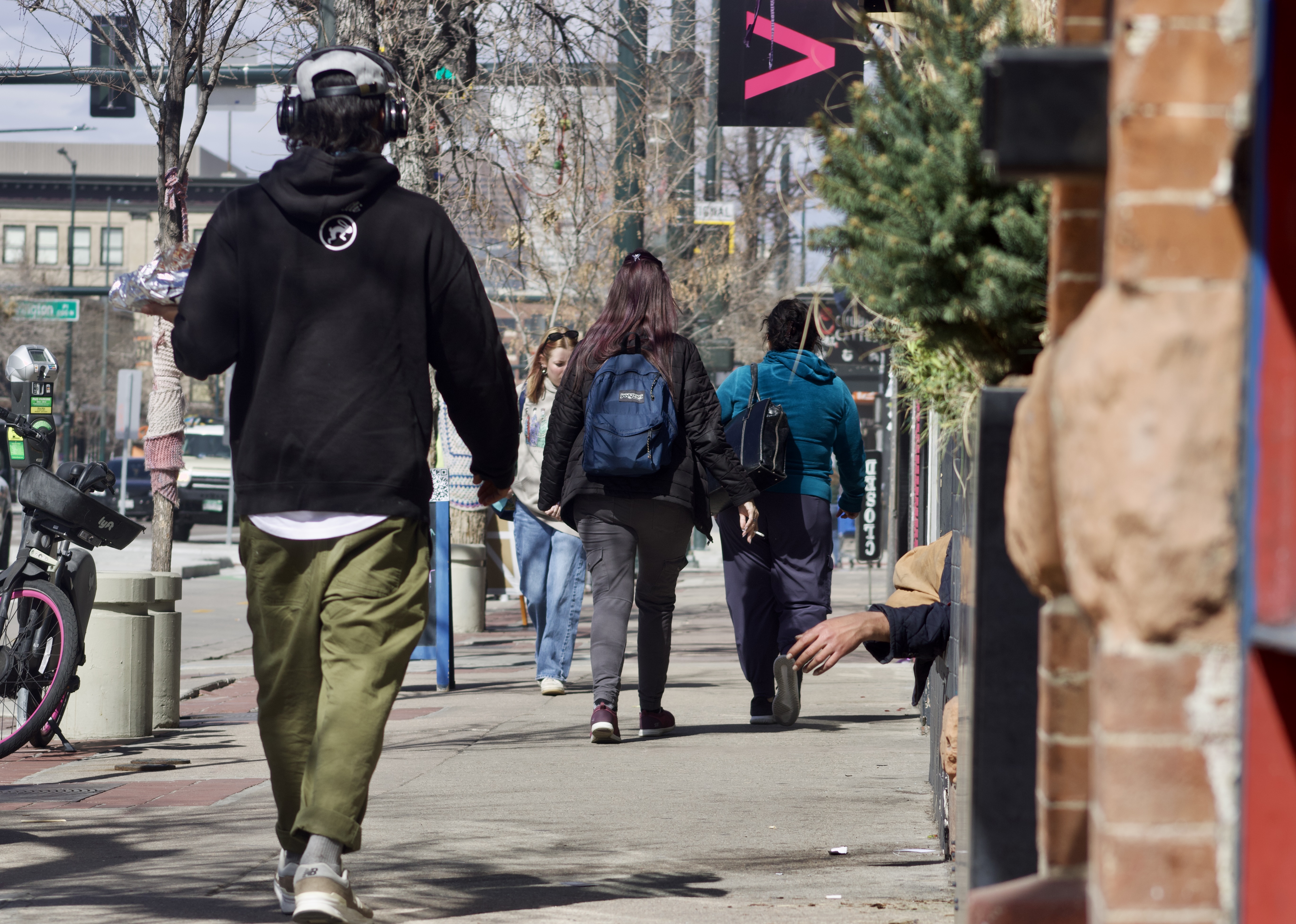
On a sunny Tuesday afternoon on south Broadway in Denver, people strolled, shopped and dined as children walked home from school.
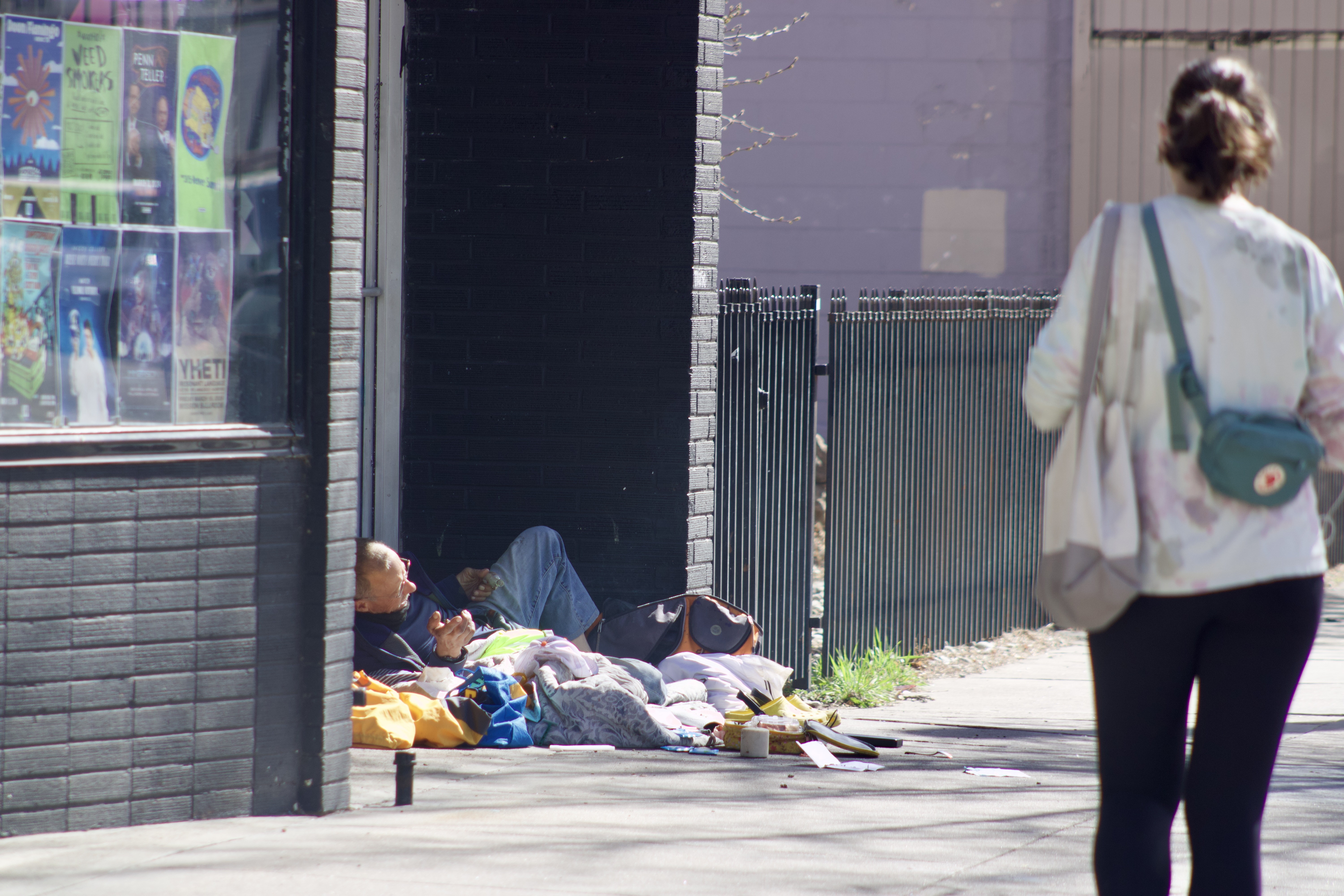
At the same time along the same stretch of road in the heart of Colorado’s most populous city, several homeless people openly used drugs.
“Whether it be drug use, fecal matter, or piss on my door — I’m fed up,” said Clayton Kelley, owner of the store Vape Loft, where multiple homeless people were passed out in front of the business on Tuesday and Wednesday.
“It happens every day,” Kelley said.
The scene in front of Kelley’s store has been playing out in downtown Denver, where drug use — which some describe as “open-air” — and homelessness appear most visible, despite hundreds of millions of dollars being spent on housing and homelessness programs.
On those two days last week, people who appeared to be homeless lay unconscious along the sidewalks and occupied the alleyways, smoking pipes and visibly dealing drugs at the corner of intersections.
Some area business owners, who agreed to speak to The Denver Gazette on condition of anonymity, said despite the ongoing open-air drug use and homeless people, it’s still the best the south Broadway corridor has ever looked.
Or, at least, this past year has been quieter, they said.
Critics: ‘Harm reduction’ centers attract drug dealing
The south Broadway corridor encompasses much of south Denver from 6th Avenue to Interstate 25. The corridor draws many from around the city for shopping, food and entertainment.
The open-air drug use is most pronounced surrounding the Denver Public Libraries’ Ross-Broadway branch. Located near the corner of East Bayaud Avenue and Broadway, it intersects three different neighborhoods including Baker, Lincoln-Broadway and West Washington Park.
The intense use of drugs has prompted fear among nearby residents.
The Ross-Broadway library, situated within two miles of four Denver public schools, is meant to “foster education,” said Dawn McNulty, a local advocate for a concept called “safe routes to schools.”
“Our community has proven the Ross-Broadway Branch is, in fact, detrimental to our neighboring communities,” she added.
But by providing “harm reduction” resources, the library is “disproportionately serving the needs of Denver’s most acute populations of mentally ill and shelter resistant with substance misuse disorders,” McNulty said.
The library provides homeless people with “harm reduction” resources to cope with drug addiction. Harm reduction centers often provide Narcan, for example, to fight off fentanyl-induced overdoses.
McNulty has asked Mayor Mike Johnston to consider restricting “harm reduction” resources in public libraries.
The argument made by McNulty and others is that illicit drug markets congregate in areas around “harm reduction” resource centers — because that’s where the drug users go.
Safe routes to school?
The Ross-Broadway library sits on the Bayaud Bike Path, which Denver has identified as a “safe route to schools.” The program is meant to improve safety for students and others who walk, bike or roll to school and back to home.
In unveiling the city’s action plan in 2021, the city noted that the public’s No. 1 priority — identified by 74% of survey respondents — is student safety.
The Bayaud Bike Path is a route that serves disadvantaged youth, McNulty said.
“I’m supportive with the city having resource centers, but they cannot be placed among vulnerable populations, including schools, rec centers, seniors, and community parks,” she said. “It’s a recipe for disaster.”
McNulty added the library is an open drug use “epicenter” on south Broadway.
During a visit along the school route on Wednesday, some students told The Denver Gazette they feel unsafe walking in the area on certain days.
Recently, the Denver Police Department has conducted extra patrol and narcotics-focused operations in the south Broadway area, according to the mayor’s office.
Ross-Broadway and Denver Public Library authorities did not respond to multiple requests for comment.
Business owners ‘disheartened’ by open-air drug abuse
Business operators along the Broadway corridor said the chronic, open-air drug use is not only an eyesore, but it has also directly affected them.
Many of the businesses have decided to keep a stock of Narcan, those who spoke with The Denver Gazette said.
Kelley’s business once used Narcan to help a person who was overdosing.
And each week in the alley behind Vape Loft, Kelley said he needs to clean what he describes as “the worst things” he’s ever had to pick up.
“Every week I clean it, and every week my alleys are trashed again,” Kelley said.
Kelley said he has found needles, blood and drug remnants behind his store.
“I’ve seen people overdose, some guy came in for Narcan,” Kelley said. “We didn’t sign up for that.”
“At some point,” he said, “it’s got to stop.”
Just around the corner from the Ross-Broadway library, some people set Vesper Holly’s “ReFillanthropy” store door on fire. The store offers “zero-waste” products, such as “sustainable housewares” and bulk refills of “eco-friendly cleaning products and natural personal care items.”
“It was really disheartening,” Holly said. “I honestly talked to my partner about potentially closing.”
“The sense of community that I feel in this neighborhood, in particular, between the business owners and the residents, is why I live here,” Holly said.
Next to the Ross-Broadway library, she said homeless people use and exchange in drug deals in adjacent alley ways.
“I do think fentanyl and meth use is probably the top issue,” Holly said. “There have been many instances where people are yelling at people going into the library and it’s just not fostering a feeling of safety.”
While some business owners talked openly, others asked to remain anonymous. They said they are worried about aggravating the negative reputation of the area, even as many emphasized that the Broadway corridor offers a lot more.
Jennifer Lens, owner of antique shop “A Chip Off The Old Rock,” believes in the potential of the Broadway corridor.
Broadway will “inevitably change for the better,” Lens said.
Elijah Baker, who is recovering from homelessness and drug use, said homeless people are drawn to south Broadway because “it’s where people go shop, so they can ask for money.”
“There’s places for them to sleep in the doorways,” Baker added.
As a homeless person, Baker said, “you start not really thinking about anybody else. Things that they’re doing out here — like kids could see it — they don’t think about that at all because they’re numb to the drugs that they’re using.”
Today, Baker said he helps homeless people on the south Broadway strip to “make them feel loved, make them feel like a person.”
The Oregon experience
Denver is currently experiencing its worst overdose crisis “with the most unregulated drug supply,” said Lisa Raville, executive director of the Denver-based Harm Reduction Action Center.
The group is “trying to push forward with reducing public drug use and reducing overdose deaths with an overdose prevention center,” Raville said. “We’ve been working on this for years.”
Colorado’s overdose crisis has spiraled out of control in the last few years. Last year alone, Denver witnessed 582 overdose deaths, 129 more than the previous year, according to Denver’s medical examiner data. It’s the worst since the city began keeping overdose records a century ago.
The open-air drug use around south Broadway’s central library is a product of law enforcement “moving folks around,” Raville claimed.
Raville and others have lobbied against tougher penalties for drug-related offenses at the state Capitol, saying the approach has not — and will not — work. On the opposite of the philosophical aisle, advocates said policies that lessened penalties for crime and tied the hands of law enforcement have exacerbated Colorado’s drug crisis.
Former Denver Police Chief Paul Pazen, who retired in 2022 and is now a Common Sense Institute fellow, said “harm reduction” strategies have resulted in “fewer people are receiving treatment.”
The former police chief cited Oregon’s decision to decriminalize drug use as an example.
Fully embracing the “harm reduction” strategy, Oregon in 2020 passed a measure that gave those found possessing hard drugs a $100 citation or a health assessment. The law became effective in 2021, under which drug offenses may only be punished by a fine — no jail, supervision or any other criminal penalty.
Behind the measure is the belief that a “health-based approach to addiction and overdose is more effective, humane and cost-effective than criminal punishments.”
State data later showed that few opted for health assessments and paid the fine. More consequently, overdose deaths skyrocketed in Oregon — from 472 in 2020 to 738 in 2021, the year decriminalization law took effect.
By 2022, the state saw 956 overdose deaths. Last year, Oregon recorded 628 deaths by June, which means 1,250 people are on track to die from overdoses, assuming the trend holds.
Oregon’s lawmakers — some of whom recounted having family members who have died of overdoses, have since decided to recriminalize drugs.
Raville from the Harm Reduction Action Center insisted that Oregon’s original intention was to “reduce criminalization and incarceration.”
“They didn’t give it enough time to be able to put the money into treatment,” she said.
To Pazen, Oregon’s legislation is “an epic failure.”
“They thought that they would get a lot more people in treatment,” he said. “They got seven people total into treatments. They realized they screwed up, and they had the wisdom to change course.”
Colorado lawmakers, on the other hand, “are continuing to go down the same path,” Pazen said.
A city on a ‘knife’s edge’
Tom Wolf, a recovery advocate who once roamed the streets of San Francisco as a homeless person hooked on drugs, said his city passed an ordinance similar to what Oregon embraced, though not to decriminalize drugs. San Francisco, he said, offered services to people struggling with drug addiction.
“The problem is that about 95% of the people turned down any services whatsoever,” he said. “Denver is facing the same dilemma.”
Wolf said Denver is on a “knife’s edge” when it comes to its homeless crisis.
“Is it good that we’re offering services to people experiencing homelessness and addiction and untreated mental illness? Of course it is,” he said.
But a centralized location offering services, Wolf said, attracts drug users, and “with that comes the chaos and disorder of homelessness.”
Johnston’s office said that “public safety and investing in intervention and treatment options to prevent open drug use and substance misuse issues among Denverites is a top priority.”
Narcotics violations in Denver have been growing each year since 2021, when the city’s police department recorded nearly 1,900 crimes related to the cultivation, manufacture, distribution, sale, purchase, use, possession, transportation, or importation of illicit drugs.
By 2022, that number grew to 2,168. In 2023, it reached 2,530.
For some, a direct correlation exists between drug use and homelessness, arguing addiction is among the root causes of homelessness.
In any case, Denver’s overdose crisis has hammered its homeless population hard — of the 581 overdose deaths recorded by the city last year, 216 were homeless individuals.
A critical part of Johnston’s strategy is clearing large downtown encampments, while offering inhabitants temporary housing.
District 7 Councilmember Flor Alvidrez, who represents the south Broadway corridor, said that many people left out of those housing opportunities have moved elsewhere in the city, notably to south Broadway.
The area, Alvidrez said, has had “a really hard time.”
“We’ve experienced a lot of deaths and a lot of theft,” she said.
She added: “I think people need more than just a roof. I think people need substance abuse support, and I think people need mental health support and that’s the hardest thing to get. And I think coming into the office, I thought they just needed a roof over their head.”