Colorado test scores affirm daunting task to overcome COVID-era learning loss
Annual CMAS scores show Denver Public Schools (DPS) saw even smaller gains
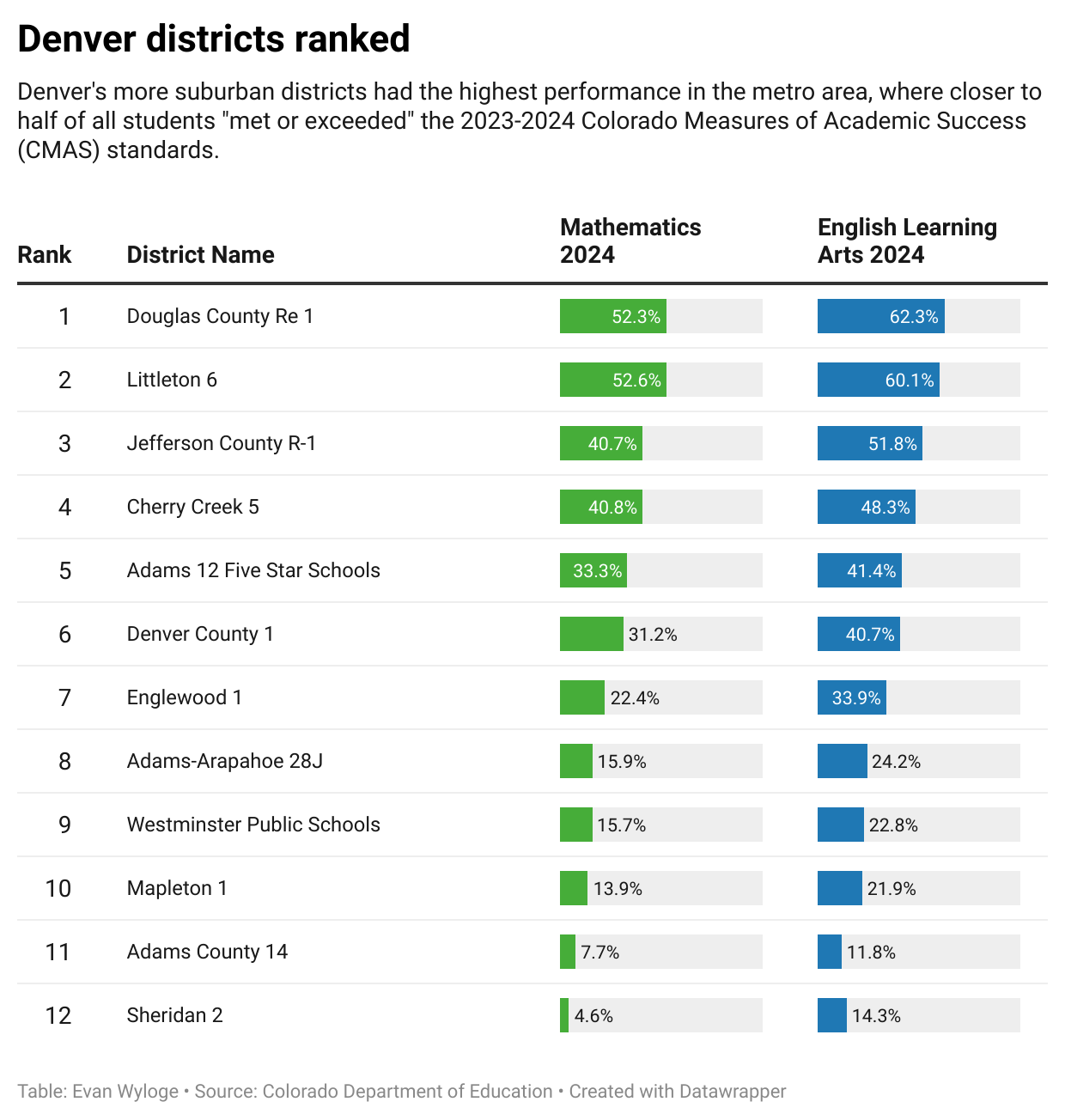
The latest academic achievement data demonstrates the daunting task schools face in overcoming student learning loss across the state, including the Denver metro area, even as the COVID-19 pandemic is now in the rearview mirror.
The modest gains in math and English are remarkably similar to last year, when state officials described the results as a “stair step” improvement and local educators called the scores disappointing.
Colorado students showed a 1.3-point improvement in math and 0.4 points in English.
Denver Public Schools (DPS) saw even smaller gains.
The overall picture, however, showed that students’ performance remains below pre-pandemic levels. Four years after the virus spread globally, Colorado students have not yet caught up.
Just 31.2% of DPS students meet or exceeded expectations in math, a 0.9-point gain over last year, while 40.7% of students did so in English, a 0.4-point increase.
Superintendent Alex Marrero touted the district’s scores in an email to parents Wednesday.
“We are excited about the hard work that our students and educators, both at schools and centrally, continue to do to ensure quality learning experiences that yield increased achievement and growth,” Marrero said.
“We acknowledge that there is still work to be done to get our scholars to where we want them to be.”
With 207 schools and more than 88,000 students, DPS is the state’s largest school district.
In the 2018-2019 school year, 32.7% of DPS students met or exceeded expectations in math and 42.7% in English. That means the district is within 1.5 points of hitting pre-pandemic levels in math and 2 points in English.
Even returning to pre-pandemic testing levels also means the majority of students are not meeting academic standards in math or English.
“These aren’t put-a-man-on-the moon expectations,” said Steve Katsaros, co-founder of the Parents Safety Advocacy Group, or P-SAG.
P-SAG is a grassroots organization with more than 1,500 members that formed in the aftermath of the East High School shooting last year that injured two administrators.
Parents, Katsaros said, should expect more.
“At best, it says we’re stagnant,” Katsaros said. “Don’t tell me its growth.”
‘Pre-pandemic levels’
On Thursday, the state board of education released school and district level results for the Colorado Measures of Academic Success, or CMAS, an annual measure of student success.
Each spring, the state administers the CMAS test for reading and math for third through eighth graders. Students are also tested, to a lesser extent, in science and social studies.
High schoolers take the SAT and PSAT administered by the College Board to measure college readiness.
CMAS testing was not conducted in the 2019-2020 academic year.
Officials have wrung their hands over the learning losses during the pandemic, when they shuttered schools over COVID-19 precautions that lead to a reliance on parents and remote learning during the first stages of the global pandemic.
“Our goal, ultimately, is to get to pre-pandemic levels,” said Cesar Cedillo, DPS chief of schools.
Rob Gould, president of the Denver Classroom Teachers Association, maintained that will be difficult with larger classroom sizes, spurred, in part, he said, by the influx of immigrant students and teacher cuts.
“It kind of had a ripple effect,” Gould said.
The teachers’ union represents nearly 4,000 educators throughout Denver Public Schools.
“The learning environment continues to be a challenge,” Gould said.
Educators now consider 2019 scores a benchmark year.
That — education advocates say — isn’t good enough.
“This is our annual wake up call,” said Brenda Dickhoner, president and CEO of Ready Colorado, which advocates for the ability of parents to send their children to which ever school or form of education they prefer. “It’s sad that this is where it is every year.”
Among the highlights from this year’s assessment:
• While participation during the pandemic dropped to an all-time low four years ago, it has been bouncing back, albeit slowly. Participation levels still trail the levels in 2019 when 69.4% of students took the test. Just 88.3% of students statewide participated, compared to 89.0% the previous school year.
• Colorado students hit a new high for meeting or exceeding expectations in math.
• English Language Arts scores showed continued improvement, nearing highs reached in 2017 and 2018.
Statewide test data released last week revealed a mixed bag, with incremental gains — compared to pre-pandemic scores — among elementary students and big drops in high school math.
Colorado’s sixth and seventh graders caught up in English and Language Arts, while grades third and fifth graders surpassed math scores compared to 2019.
In Denver, while 20.9% of students in Spanish Language Arts met or exceeded expectations, 40.7% of their English Language Arts counterparts did so.
While immigrant students buoyed Denver’s enrollment numbers last school year, they are largely excluded from the testing data because of learning disruptions.
“A majority did not take the test,” said Simone Wright, the DPS chief of academics.
‘Part of our work’
Because of shifts in assessments — fewer math problems and shorter reading and writing passages on the tests — state officials did not assess student recovery from the pandemic as in previous years.
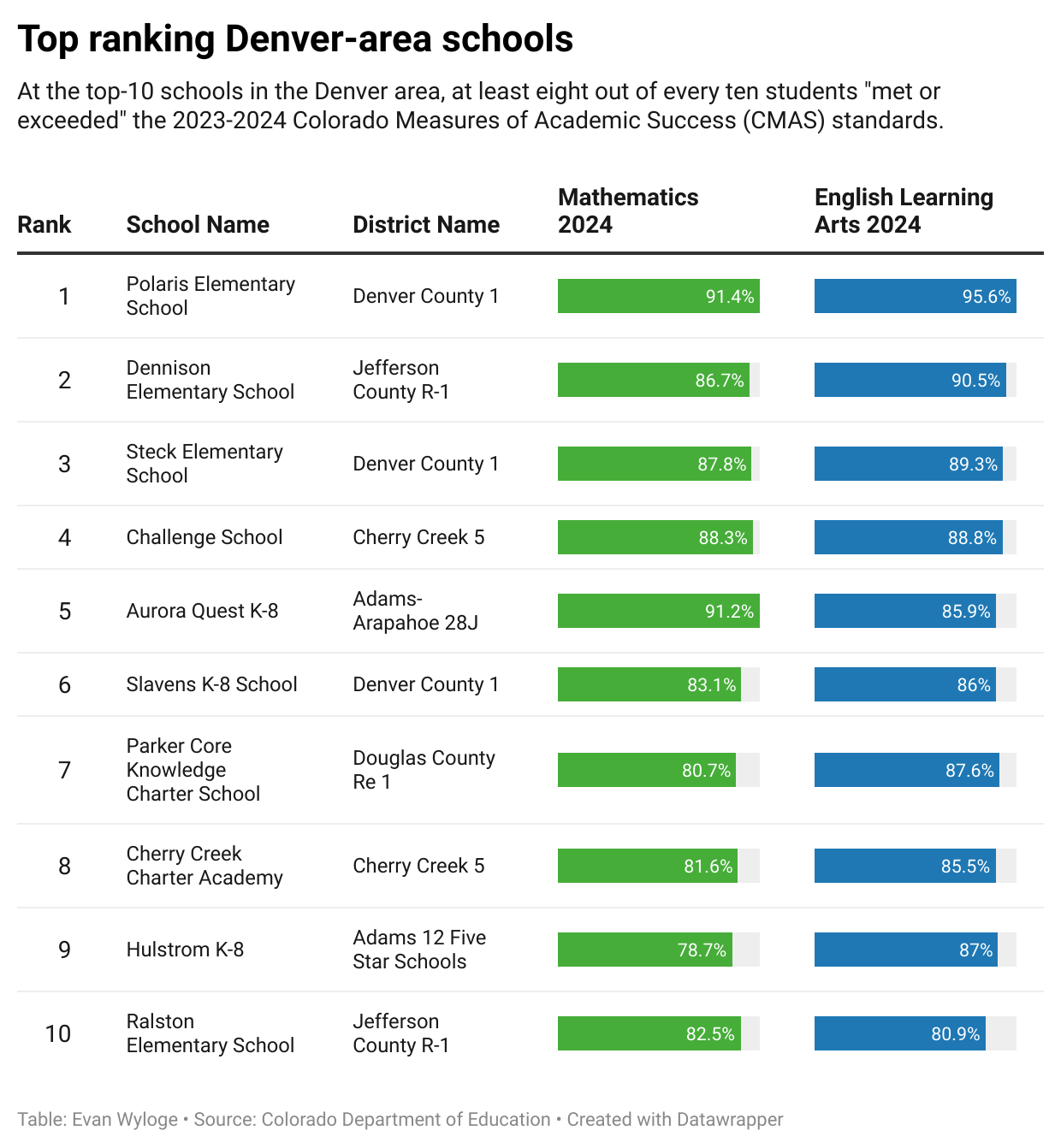
To better understand — and compare — these CMAS scores, The Denver Gazette created a ranking by calculating “a grand total” by averaging math and literacy results.
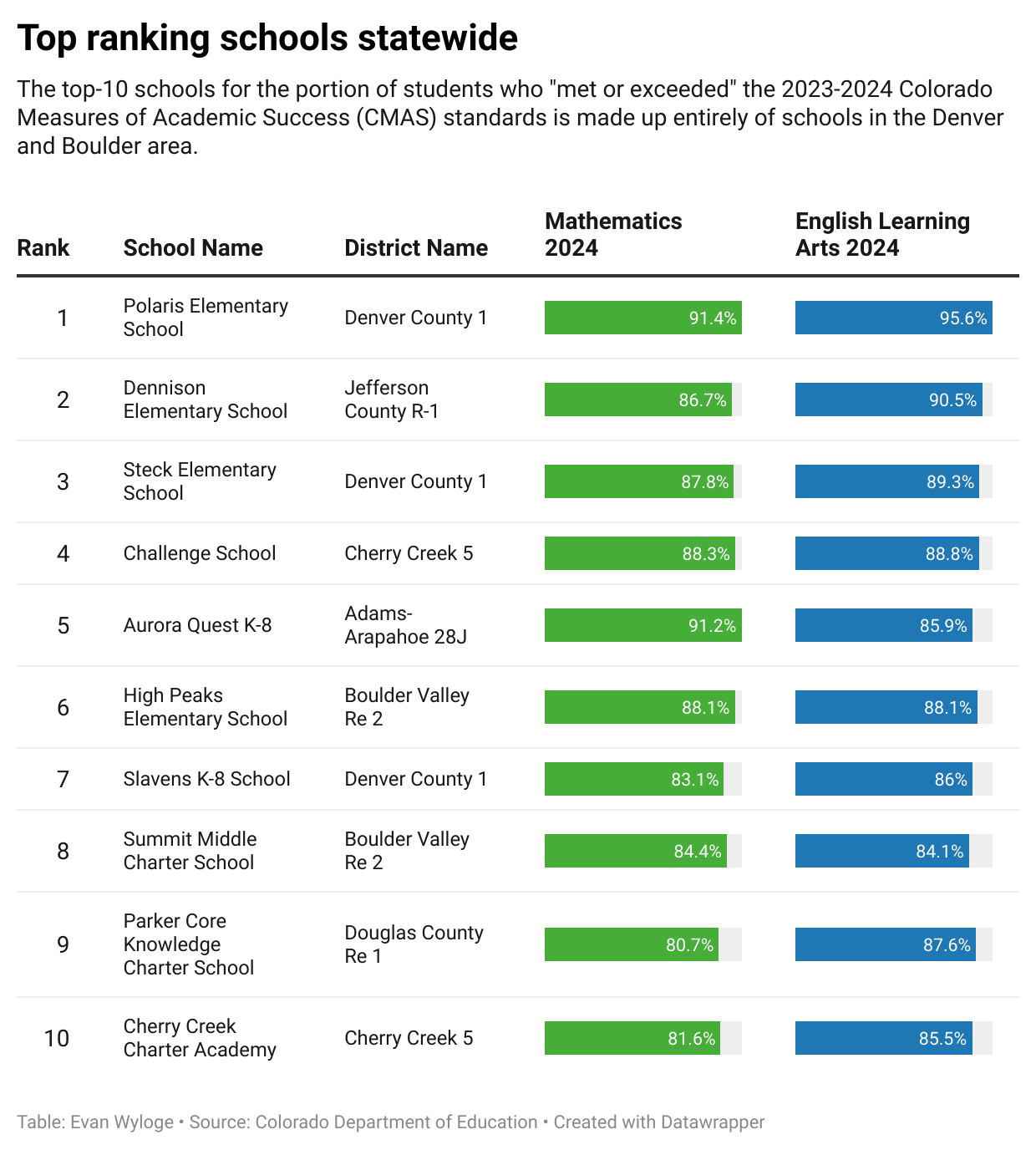
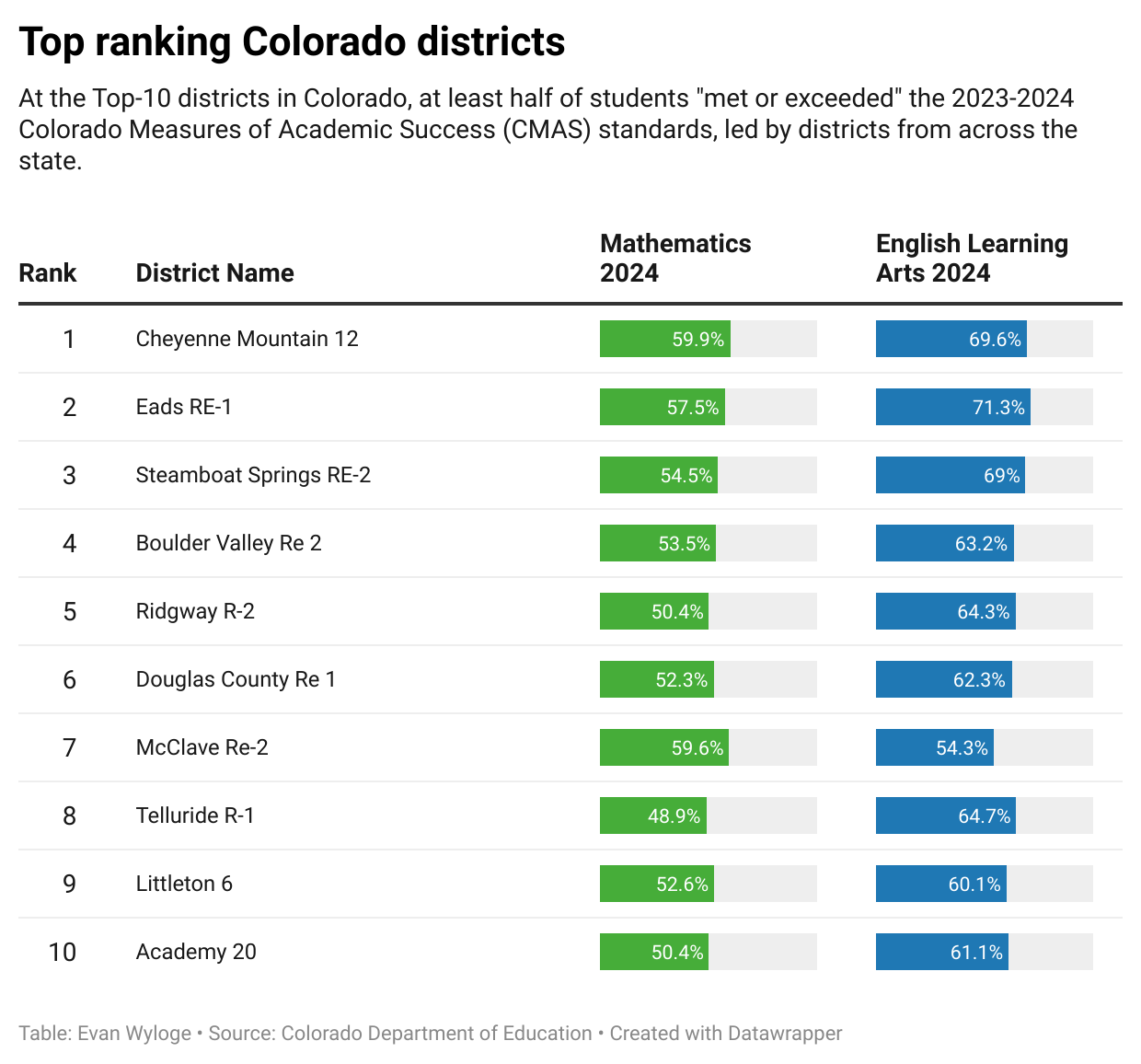
Of the 1,387 schools with sufficient enough data to rank, eight across the Denver metro region were among the state’s Top 10 performers.
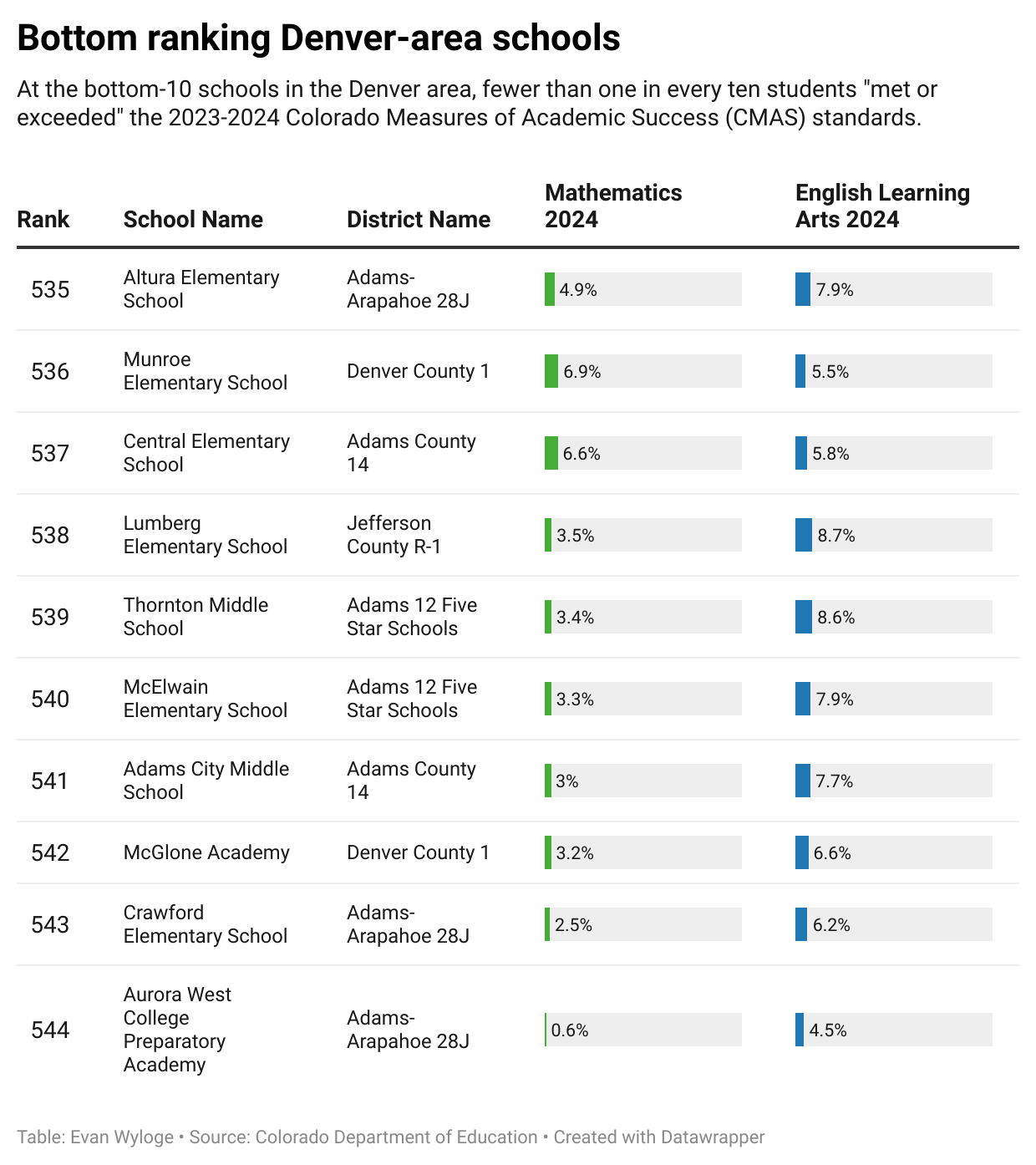
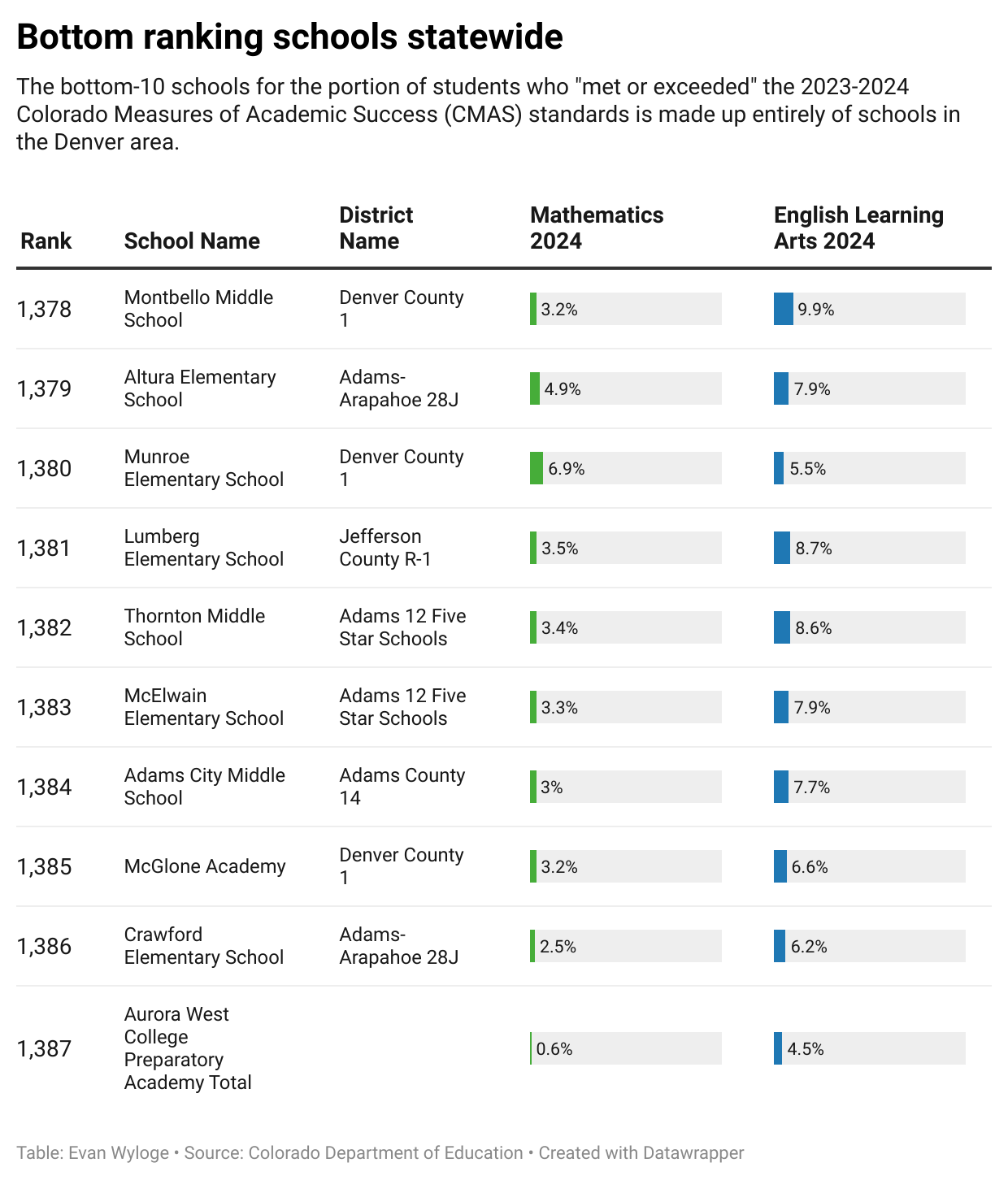
Schools in the Denver metro area also showed up in the 10 worst performing schools.
Aurora Public Schools had the unenviable distinction of having the most schools in the bottom 10 performers with three campuses: Altura Elementary, ranked No. 1,378; Crawford Elementary No. 1,386; and, Aurora West College Preparatory Academy No. 1,387.
Aurora school leaders said financial support, new curriculum and monthly academic appraisals have been implemented to help struggling schools.
“They are not the only schools that we’re lifting,” said Nia Campbell, chief academic officer of Aurora Public Schools.
Campbell added: “There are different challenges and different ways we have to support, but that’s just all part of our work.”
The state does not have a metric to rank the academic performances of districts or individual schools.
In addition to ranking the academic performance of schools, The Denver Gazette also ranked Colorado school districts using the same metric.
Out of 169 school districts across the state, Cheyenne Mountain 12 ranked No. 1.
Located in southwestern Colorado Springs, Cheyenne Mountain has an enrollment of roughly 3,800 students.
An average of 69.6% students met or exceeded expectations in English, which represents a 1.5-point increase over last year’s scores. In math, the average was 59.9%, a 0.6% bump over the previous school year.
DPS fell in the top third.
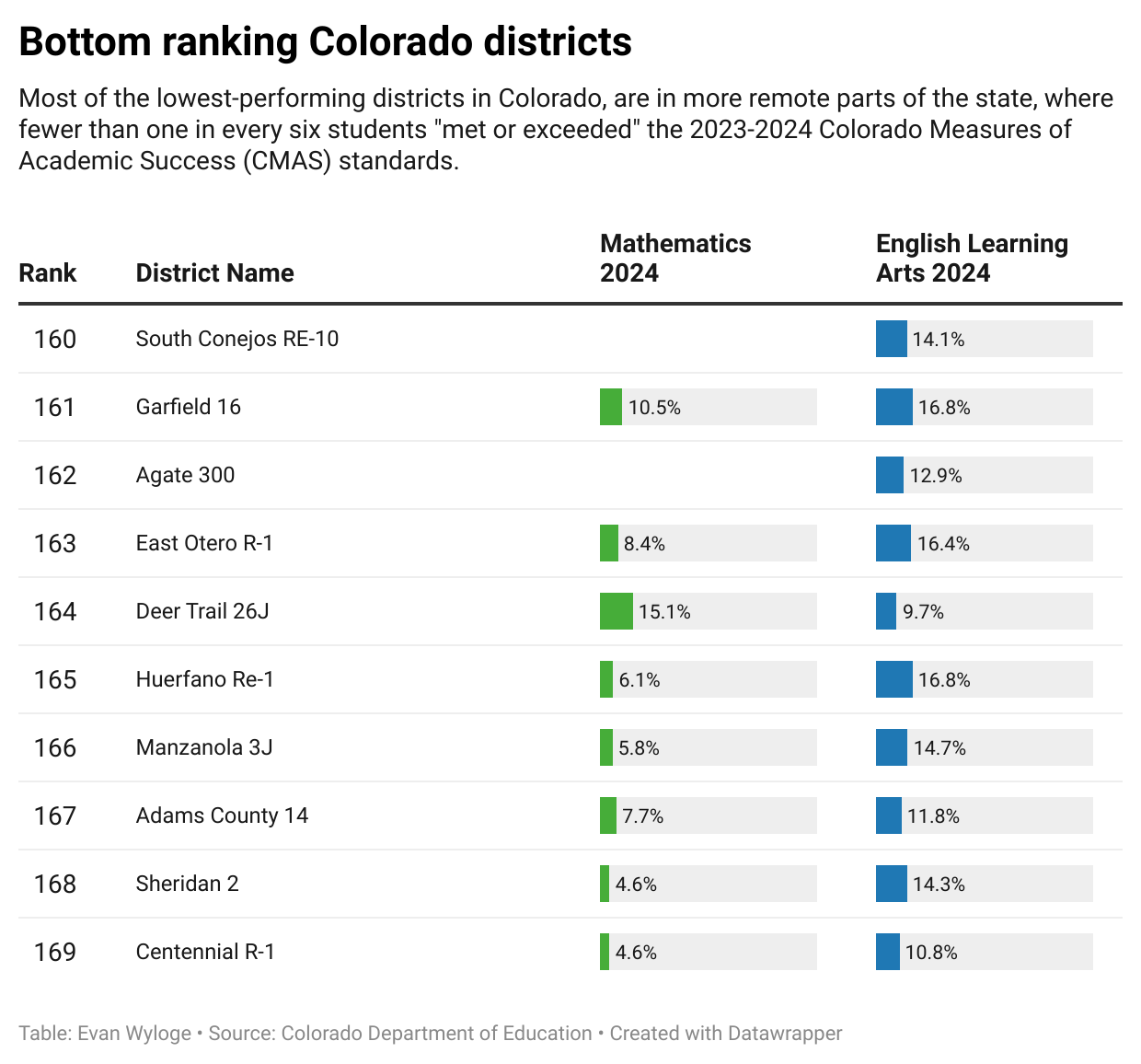
Adams County 14 School District — which has struggled for more than a decade with low academic performance — remains among the state’s bottom 10 performing school districts. With just 7.7% of students meeting or exceeding expectations in math and 11.8% in English, Adams 14 is ranked No. 167 out of 169 school districts.
Those scores are significantly below how students across the state performed.
Statewide, 44.1% of students met or exceeded expectations in English and 34.2% in math.
Diego Romero, an Adams 14 spokesperson, declined to comment.
‘Data isn’t a definer’
The testing data — officials said — should inform educators on how best to identify strategies that are working.
But those strategies can be limiting for rural school districts with budgets that cannot afford to fund a curriculum director or data specialists.
Take Centennial R-1 School District in San Luis.
The school district is ranked dead last at 169.
Centennial serves fewer than 200 students who are largely economically disadvantaged minority students, where fewer than 5% met or exceeded expectations in math and 10.8% in English.
Superintendent Joe Garcia, who took the helm last month, said he came out of retirement to address the district’s challenges.
The way Garcia sees it, the problem is that education funding enjoys an economy of scale to the detriment of schools in rural communities.
“Funding for rural schools is not the top of the funding list,” Garcia said. “They take care of the I-25 corridor.”
Garcia added: “In Colorado, we sit at the bottom. Until we change this (the funding), that’s where we’ll remain.”
What can get lost in all of the percentages — DPS officials said — is that one percentage point can represent thousands of students.
“We’re not satisfied with our achievement results,” said Wright, the academics chief.
DPS ranked No. 59 in academic achievement among Colorado’s 169 school districts. That means DPS performed better than two-thirds of the state’s school districts.
While state testing is common across the United States — Nebraska is the only state without a mandate — an anti-test sentiment resistant to “teaching to the test” has been simmering for at least the past decade.
Some advocates assert that “teaching to the test” drains the professionalism out of the system and the joy of learning. Others argue the assessments offer an objective metric to measure whether children are, in fact, learning and educators are doing their job.
Having recently received the CMAS scores, school leaders across the region are digesting the results and scanning the data for outliers, particularly those areas of improvement that can be replicated.
The testing data — officials said — should inform educators on how best to identify strategies that are working.
“I think anything under 100% is disappointing,” said Anthony Smith, deputy superintendent of schools. “It is really an opportunity for us to look at our system.”
Smith added: “Data isn’t a definer. It’s an opportunity to do better.”