







Activists want to defund Denver’s camping ban outreach team
Proponents of Denver Basic Income Project, which gives homeless people money with no questions asked, asked for it to be funded again in 2025.
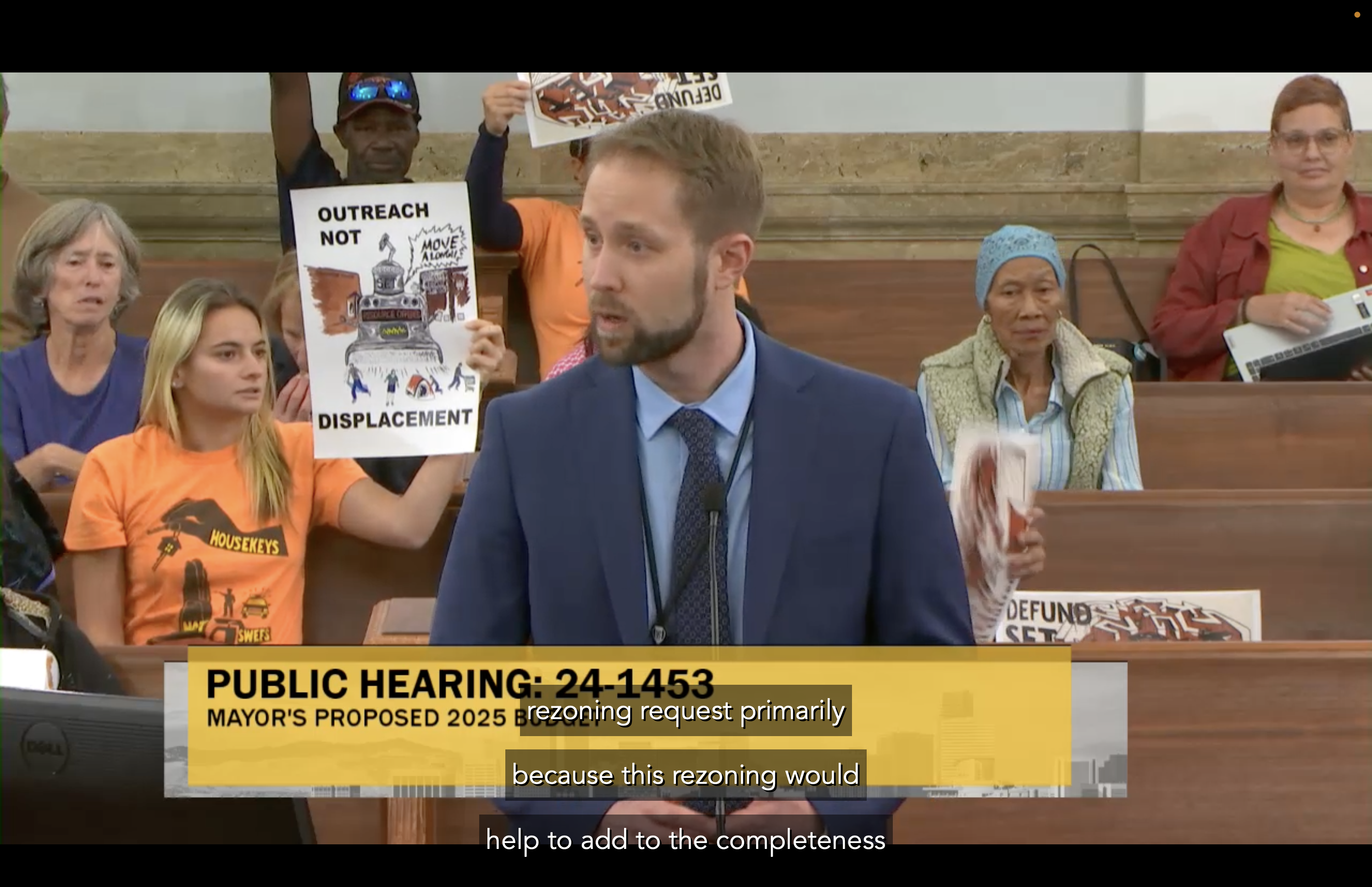
Some activists want the entire budget of the Denver team responsible for reaching out to homeless people allocated elsewhere.
Housekeys Action Network, an advocacy group, criticized the Department of Public Safety’s Street Engagement Team, accusing the group of only being interested in moving people along and not connecting them with actual services.
Councilmember Sarah Parady also called for the team’s budget to be moved into the Department of Housing Stability.
Ana Miller, who was formerly homeless, cited “logs” received by Housekeys Action Network for 2023 and 2024 showing that the vast majority of the team’s contacts involved a “tent, structure or RV.”
And out of the 2,134 contacts, only 41 show resources offered, she said.
“I’ve personally witnessed SET team members acting rudely or making up reasons to force people to move,” she said.
This is not the first time that SET or Johnston has come under fire from the group. In June, the group criticized Johnston’s administration for enforcing the urban camping ban Denver has had in place since 2012. The group claimed Johnston had no endgame in mind for Denver’s homeless population.
The most recent point in time count showed that, despite Johnston’s efforts in moving people off the streets, the city’s population of “unsheltered” homeless people — a category that refers to individuals who sleep in public spaces, such as under bridges or in parks — only dropped by 150. Furthermore, the overall population of homeless people in Denver increased by 721.
Johnston attributed the increase in Denver’s homeless population to more people losing their homes because of rising home prices and other factors. The mayor has insisted that Denver is a national leader in addressing homelessness.
Some Denver residents who spoke on Monday also complained that a program called the Denver Basic Income Project did not get any funding.
In the last three years, Denver provided $2 million to the program, using American Rescue Plan Act money that is set to expire at the end of this year.
Members of the program asked the City Council to override the mayor’s decision.
“As a service provider in Denver for the last three decades, it has been the most rewarding part of my career to be a part of this project,” said Maria Sierra, the community engagement manager of the Basic Income Project. “I’ve seen a real impact in the unhoused community over the last couple of years. … I want to ask that you all continue, and most importantly trust our participants and make a bold move to continue to fund this project.”
Denver is in the national spotlight because of the work done by the Denver Basic Income Project, she said.
The Johnston administration made its decision after concluding the data yielded “limited results.”
“The data in the year-one report from the DBIP did not show a statistically significant difference in homelessness resolution between the groups that received large cash transfers and those who did not,” said Jordan Fuja, the mayor’s spokesperson. “Because the data showed limited results in the first year, (the Department of Housing Stability’s) proposed budget does not recommend funding in 2025 for this program.”
The Denver Basic Income Project offers participants, depending on which group they belong to, a total of $12,000 over a year. A third group gets $50 a month for a year.
Of the more than 800 people who participated in the program, 400 continued to respond to questions, according to an analysis of the project released in June. Of that group, about 45% found housing, whether through rent or ownership, up from 10% when the project first started.
Denver’s councilmembers have until Nov. 4 to offer and approve any amendments to the proposed budget, according to the city’s charter. After those amendments are discussed and voted on, the Mayor has until noon on Nov. 8 to approve or reject those amendments.
After this round of amendments, the council will meet on Nov. 12 for a final review of the budget. Here, they can override any mayoral vetoes provided they have a supermajority of nine votes.
Once amendments are approved, the council will vote to adopt the budget.
If the council does not vote on the budget by Nov. 12, the proposed budget will become the adopted budget.
Johnston is proposing to spend $1.76 billion, a slight increase over this year’s $1.74 billion budget.
Johnston previously added just over $7 million to the 2025 budget based on recommendations from the City Council.