







Even very recent homeowner policies leave victims of Marshall fire drastically underinsured
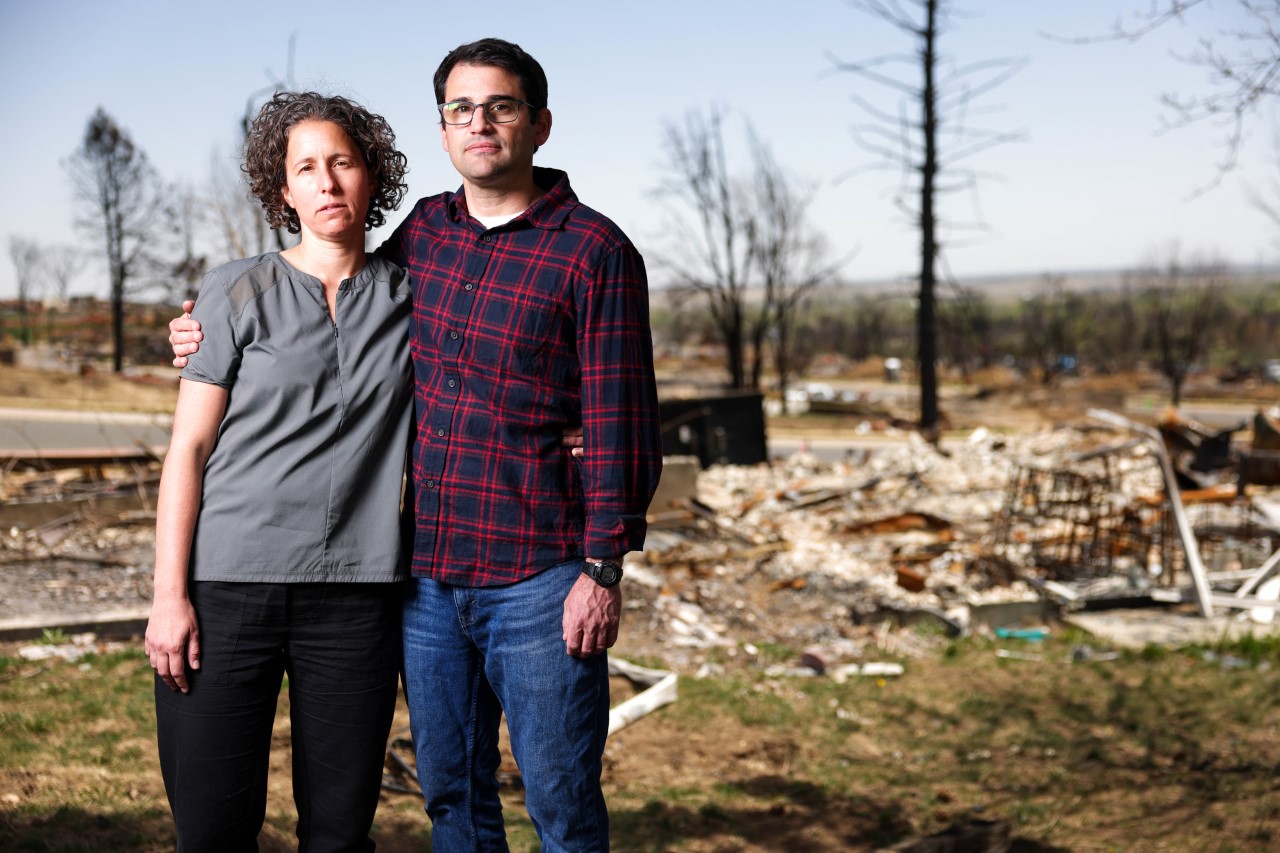
On New Year’s Eve, Amit Ginsburg, Rona Schank and their two daughters got the shock of their lives after spending a night in a motel in Longmont: A drone photo from one of their neighbors showed beyond doubt that their 4-bedroom house in Louisville had burned to the ground, along with hundreds of others.
But a bigger shock was to come.
After three months of on-again, off-again conversations with their home insurer, it has become increasingly obvious that the family has nowhere near enough insurance to replace their house near Harper Lake, a half mile from a fire station.
That puts the Ginsburgs among 92% of homeowners who are coming up short of what it costs to rebuild from the Dec. 30 fire that roared through Louisville, Superior and unincorporated areas of Boulder County, according to an April 26 report released by the Colorado Division of Insurance. The report included data from 61 companies that represent nearly a thousand owners of homes lost in the inferno.
The state estimates that only 76 homeowners of the 951 total losses it analyzed had enough coverage to replace their homes of similar size, quality and finishes — just 8% of the total. (Around 83% of homes had carried some form of “extended benefits coverage,” meaning some additional consideration if rebuilding costs exceed the limit of the policy.)
The math on whether a policy will cover replacement is entirely dependent on the cost-per-square-foot that builders charge to replace the properties.
“The challenge now and going forward will be nailing down reliable rebuilding costs,” Colorado Insurance Commissioner Michael Conway said in the report.
The state estimates that if rebuilding comes in at $250 per foot, some 344 of the 951 policies would be underinsured, with the average shortfall being around $99,000. However, if costs are $350 per foot, the number of underinsured owners jumps to 639, short an average of $242,670.
But even that sounds optimistic to what the Ginsburgs, who are now renting a home in Broomfield while trying to find one closer to their kids’ Louisville school, are hearing about their loss and their outlook for recovery.
The couple bought the 1992 4-bedroom, 4-bath multilevel on Arapahoe Circle, 2,600 finished square feet, for $625,000 in 2019. Last spring, the pair moved their policy over to a different insurer after receiving an offer for better coverage at a lower rate. The couple requested that The Denver Gazette not publish the name of the company, since negotiations are ongoing.
Schank recalls the company was initially responsive following the loss. But she saw signs of trouble when the agent questioned whether the home actually had 2,600 square feet. “I had 2,000 written down here,” she recalls the agent saying.
The Ginsburgs said the agent suggested that issue could be fixed. But the compensation numbers they’re now being provided — $428,000 (with the size corrected) plus some added coverage for a total of around $550,000 — would still be way short of what it would cost to rebuild. If the building estimates they’re now hearing, closer to $350 per square foot, turn out to be realistic, that would put replacement at around $910,000.
“Builders are quoting $250 to $400 per foot,” said attorney Bradley A. Levin with Levin Sitcoff Waneka in Denver, who has talked with dozens of homeowners who suffered losses in the fire. “Everybody’s story is different, depending on what discussions they’ve had with agents and when those took place.”
But the limits of many of these policies in most instances is closer to $150 per foot.
“Limits are grossly under what it will cost to rebuild,” Levin says.
Meanwhile, owners are stuck in a wait-and-see situation. Agents, those owners report, have in some cases promised to work with policyholders. The insured range from families who have had the same policy with the same carrier for decades, to others like the Ginsburgs with newer policies that should have reflected rapidly accelerating building costs. (One couple, Levin says, had met with their agent just five weeks before the fire to assure they had enough coverage.)
“There will be court filings,” Levin added, noting that he expects the process to play out over a few years.
Some homeowners have discussed fears of having to relocate or of having to rebuild smaller. While some insurers are offering flexibility to policyholders, Levin doubts that many companies will readily write checks above the amount of their policies’ stated limits.
Boulder County has identified 1,084 homes lost in the billion-dollar fire. The difference between that loss estimate and the Division of Insurance’s 951 losses in its report reflects some incomplete reports, as well as some differences in policy types that cover rentals or luxury homes not tallied in the state’s analysis.
The state estimates that at $350 per foot, the total amount of underinsurance could total $179 million.
The 61 insurance companies that reported data include some that are part of larger collectives represented under major insurers such as Allstate, the report said. The state reported that as of a month ago, the U.S. Small Business Administration had approved $91.2 million for families affected, much of which could be used to close the coverage gap.
Builder Greg Ressler, who was a partner at Sheffield Homes and a sales director at Ryland Homes, both prominent builders along the Denver-Boulder turnpike corridor, warns that homeowners in other areas should contact their insurers to verify that they have sufficient coverage, after a number of recent fires and a period of rapidly rising costs.
“Values went up so fast that many people are far behind,” he said. “You need to be proactive.”
Ressler estimates that around 25% of owners in the burn area will end up selling their lots rather than rebuilding.
Meanwhile, Schank says the experience has made her feel more, not less, connected to her neighborhood.
“We want to stay here,” she said.
