Colorado School of Mines grad students who hope to power the moon collect $500K NASA prize
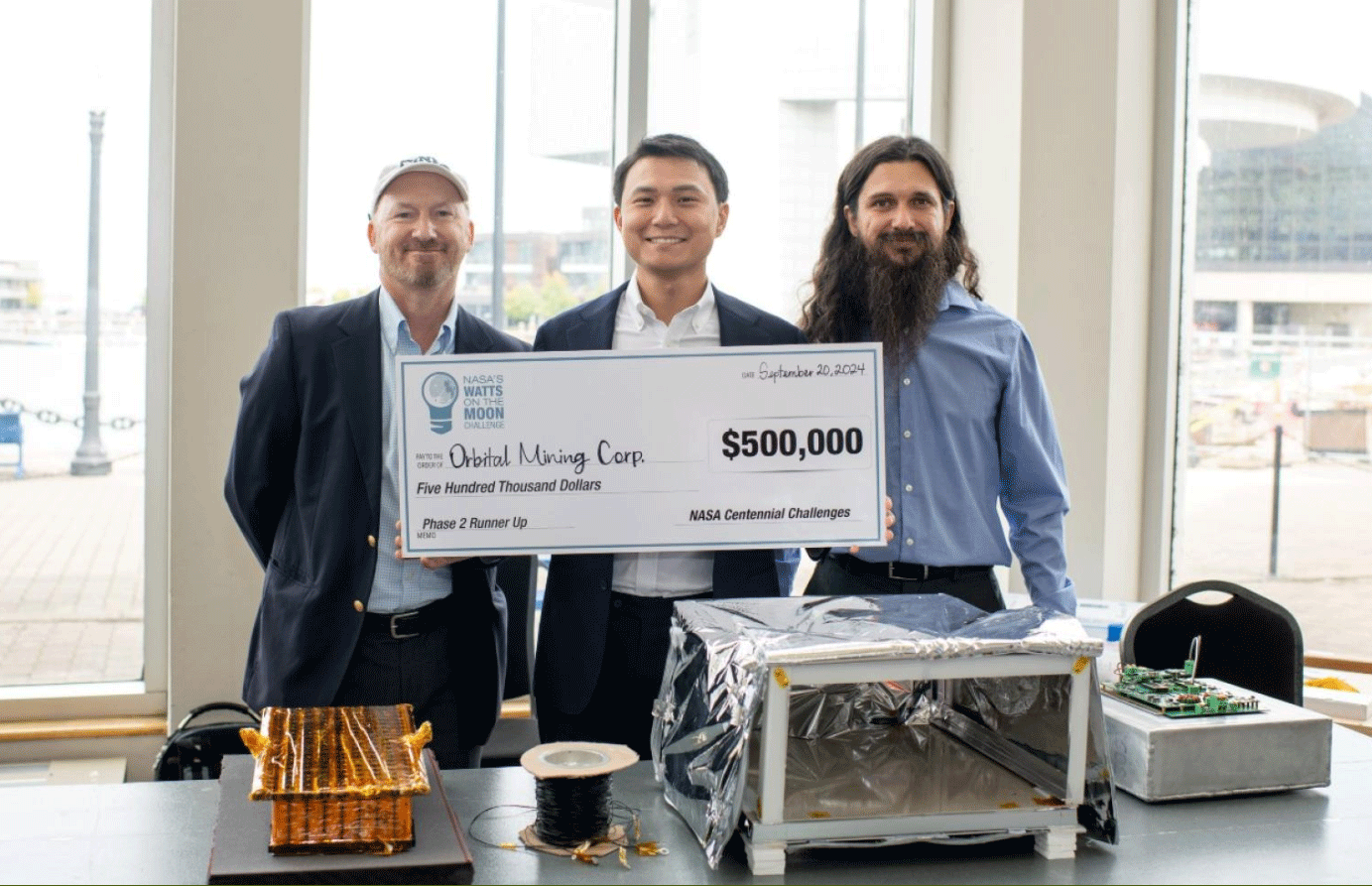
Orbital Mining Corporation, a Golden-based space mining startup founded by two Colorado School of Mines graduate students, has landed a $500,000 award from NASA’s Watts on the Moon Challenge for their lunar power transmission and storage system technology.
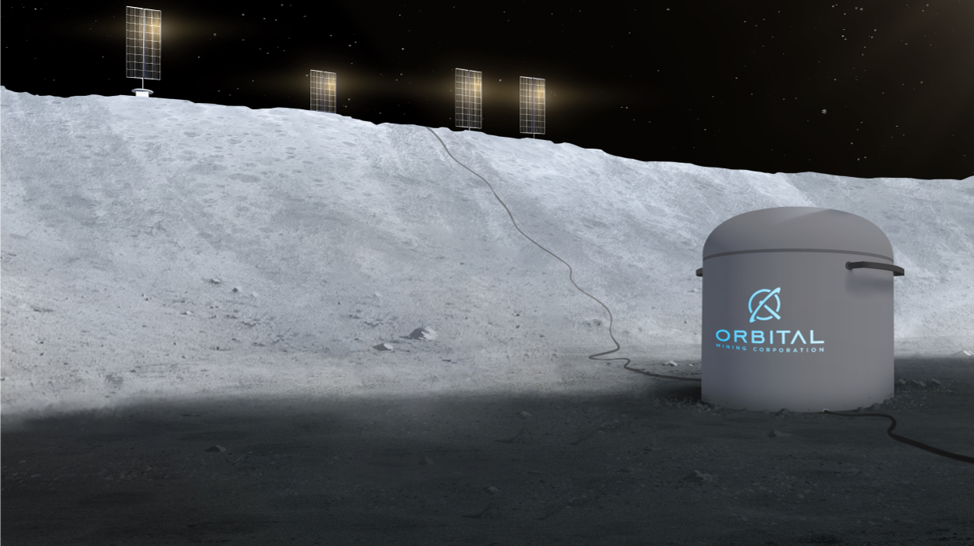
Co-founders Chris Tolton and Ken Liang, who are both pursuing a master of science degree in space resources, hope to build the first lunar power plant and microgrid, enabling more permanent settlement and eventual mining on the moon, according to their company website.
“This initial electrical grid will recharge Lunar Terrain Vehicles (LTV)/rovers, provide shore power for landers, and enable the first long-term habitation of a celestial body,” said Chris Tolton, who serves as the company’s CEO.
Tolton and Liang’s team spent two years developing a system that could bring energy distribution to the moon with a specialized power converter system capable of surviving the cold and darkness of a sunless lunar night.
The system uses high-voltage cables for transmission, advanced electronics, and a large lithium-ion battery bank for storage.
It also employs a passive thermal management solution to handle the moon’s extreme temperatures without using extra energy. This keeps the equipment from getting too hot or too cold so the system can work longer.
While the prize was awarded for a transmission and storage system only, similar to overhead power lines and large-scale grid-tied batteries here on Earth, Tolton said there’s a much bigger picture.
“We plan to integrate with solar providers because we expect lunar power generation to be solar initially, but in the long run, nuclear electric would be desired, especially for mining,” Tolton said. “Lunar mining will need a lot of thermal energy. Ultimately, a grid capable of supporting all kinds of power generation and users is preferred to ensure max availability and to survive the lunar night.”
A small-scale powerplant and microgrid could be on the moon by 2029, Tolton added.
As envisioned, a larger system will likely arrive after 2030, with industrial-scale lunar mining shortly after that.
Of the four finalists, Orbital Mining Corporation was one of only two systems to successfully operate in NASA’s simulated lunar environment at the Glenn Research Center in Cleveland, Ohio. The fledgling space company provided continuous power across two cycles, each with six hours of daylight and 18 hours of darkness, to a user located three kilometers from the power source — and under extreme conditions, with temperatures dropping as low as -190°C.
“The success of Orbital Mining Corporation is a result and perfect example of the multi-talented and strong entrepreneurial nature of our students in the interdisciplinary field of space resources,” said Angel Abbud-Madrid, professor of practice in mechanical engineering and director of the Center for Space Resources at Mines.
Watts on the Moon is part of the NASA Centennial Challenges Program, which is designed to engage the public in advanced technology development directly. The program offers “incentive prizes to generate revolutionary solutions to problems of interest to NASA and the nation.”
“The energy solutions developed by the challenge teams are poised to address NASA’s space technology priorities,” Amy Kaminski — program executive for Prizes, Challenges, and Crowdsourcing in NASA’s Space Technology Mission Directorate at NASA Headquarters in Washington — said in a news release. “These solutions support NASA’s recently ranked civil space shortfalls, including in the top category of surviving and operating through the lunar night.”
Orbital Mining was the runner-up behind the University of California Santa Barbara’s Space Research Laboratory. However, both winning teams successfully conducted the first-ever demonstrations of high-voltage power transmission within a cryogenically cooled vacuum at a NASA facility.
Orbital Mining was awarded an additional $600K in earlier stages of the competition. That, along with the final prize, brings the team’s total total winnings to $1.1 million, which Tolton said will be used for further research and development.
Tolton and Liang met through a shared class at Mines, where they chose to create their startup. They leveraged the university’s entrepreneurial resources, including the newly opened Beck Venture Center, which helped launch Orbital Mining.
“As one of the founding members of the Beck Venture Center , Orbital Mining Corporation is a shining example of what is possible for student and alumni entrepreneurs here at Mines,” said Zack Bennett, director of the Beck Venture Center. “We are proud that we have been able to support their success, and we are excited to see how they inspire even more Mines students to build amazing companies that, literally, shoot for the moon.”
The next step for Orbital Mining is fundraising, according to Tolton.
“OMC will need to build out a microgrid prototype and develop some key mining technology,” he said. “Back here, locally, we are commercializing the power converters we built for NASA to be used in aviation. We’re also offering space-related testing services.”
In short, “We want to power the moon to enable the new space economy,” Liang said.