




How La Niña could impact Colorado’s winter, drought conditions this season
NOAA released its U.S. winter outlook for 2024-25 on Thursday.

A slowly-developing and weak La Niña, wetter-than-average conditions in northern tier states and potentially drier-than-average conditions in the southwest are all forecast for winter 2024-25.
The National Oceanic and Atmospheric Administration (NOAA) released its US Winter Outlook for the winter period from November to February on Thursday.
The agency said the October ENSO outlook calls for a 60% chance of La Niña emerging in the September, October, November time frame, and by November, December, January, the chance of La Niña increases to near 75%.
Here’s what the agency also said about it and how it could impact Colorado.
Effects on Colorado
As reported earlier this month, on average, northern Colorado receives more precipitation in La Niña years than southern and central Colorado due to more northwest flowing storms.
But also in La Niña years, drier conditions can exist in northern Colorado and along the Front Range and Denver area. Although it will snow throughout the winter, one effect Colorado might experience heading into the spring is a higher risk of drought.
“At this time we are going into the late fall and early winter and the likelihood of impacts associated with that, are obviously, low,” Jon Gottschalck, chief of the Operational Prediction Branch of the Climate Prediction Center, said. “But as we saw with the drought outlook that was prepared by Brad Pugh, we expect drought to persist through the winter and develop further to the south, including parts of the central Rockies in Colorado.”
Depending on how winter precipitation pans out heading into spring, Gottschalck said “if dry conditions remain there and drought persists, yes, it’s going to favor or hedge towards more potential extreme heat events going into the early summer months.”
Precipitation outlook
“This winter, an emerging La Niña is anticipated to influence the upcoming winter patterns, especially our precipitation predictions,” Gottschalck said. “The highest likelihood for below normal precipitation is indicated for parts of the Southwest, southern Georgia, and much of the Florida Peninsula.”
Drier than average conditions for the southern U.S., including the Southwest and southwestern Colorado, is also forecast.
Gottschalck did say wetter-than-average conditions are more likely to occur in the northern Rockies, which include parts of northern Colorado, Great Lakes region and Pacific Northwest.
Temperature outlook
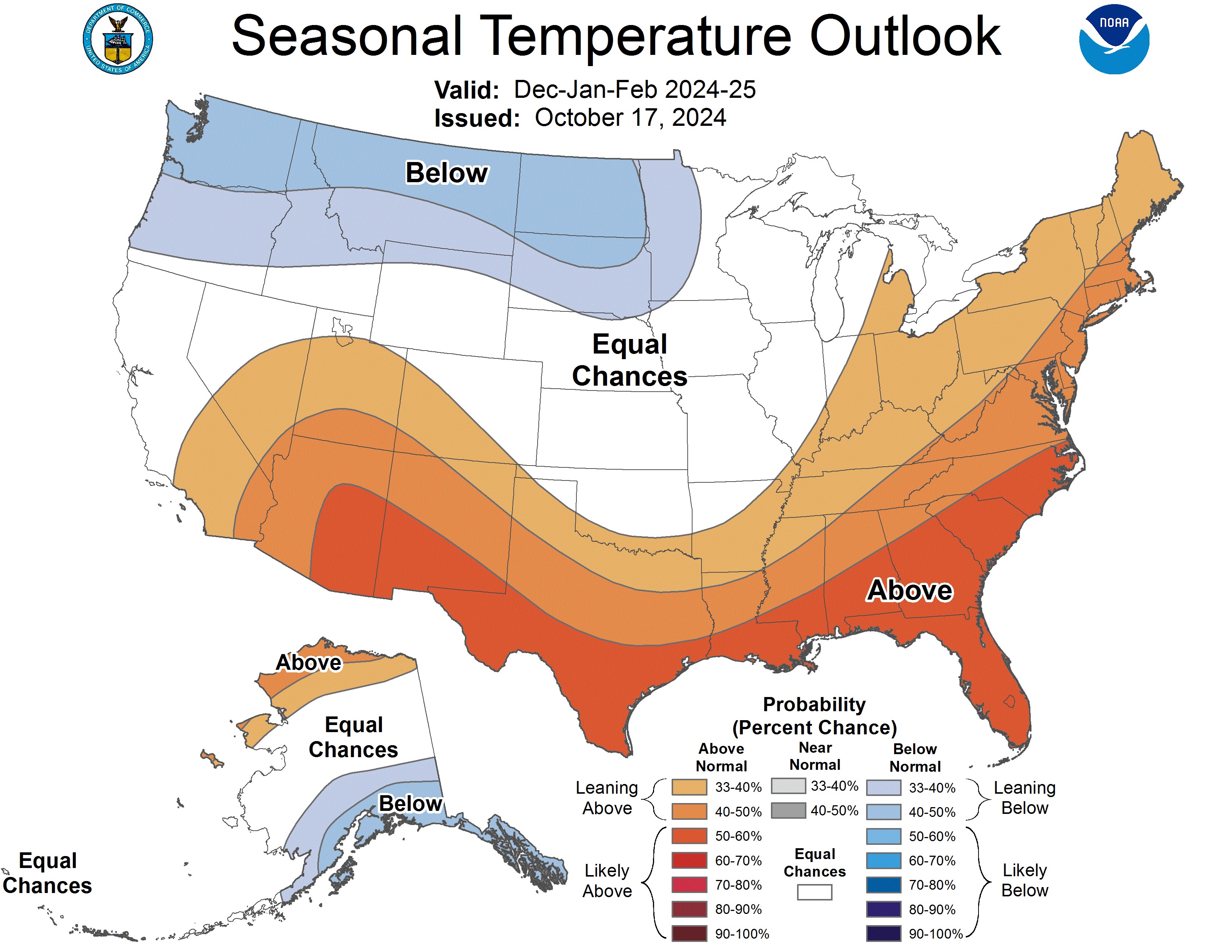
Winter 2024-25 temperatures are forecast to be warmer than average for the southern tier of the U.S. northward, to include the eastern Great Lakes, eastern seaboard, and New England, as well as northern Alaska.
“These odds are strongest for parts of the southwest, southern Texas, and along the Gulf and southern Atlantic region,” Gottschalck said. “Cooler than average temperatures are most likely in southern Alaska and from the Pacific Northwest eastward to the northern Great Plains.”
Drought outlook

Drought is most likely to develop for many areas of the southwest, southern plains, and parts of the southeast.
Meanwhile, drought conditions are expected to improve or end for the mid Atlantic, New England, central Appalachians, Ohio Valley, Pacific Northwest, and Hawaii.
Get OutThere
Signup today for free and be the first to get notified on new updates.
PREV
PREVIOUS

Denver expands composting service to another 13,400 households
Park Hill, Central Park and parts of East Colfax neighborhoods to get composting carts.
Gov. Tim Walz to appear on The View and The Daily Show
Gov. Tim Walz (D-MN) will appear on ABC’s The View and Comedy Central’s The Daily Show on Monday, Oct. 21. The governor will join the hosts live in-studio to discuss the Democratic ticket’s agenda in the final weeks of the presidential election. Walz became the vice president’s running mate in August. This will be his […]