







Colorado AG Weiser, FTC chair hold town hall on proposed Kroger-Albertsons merger
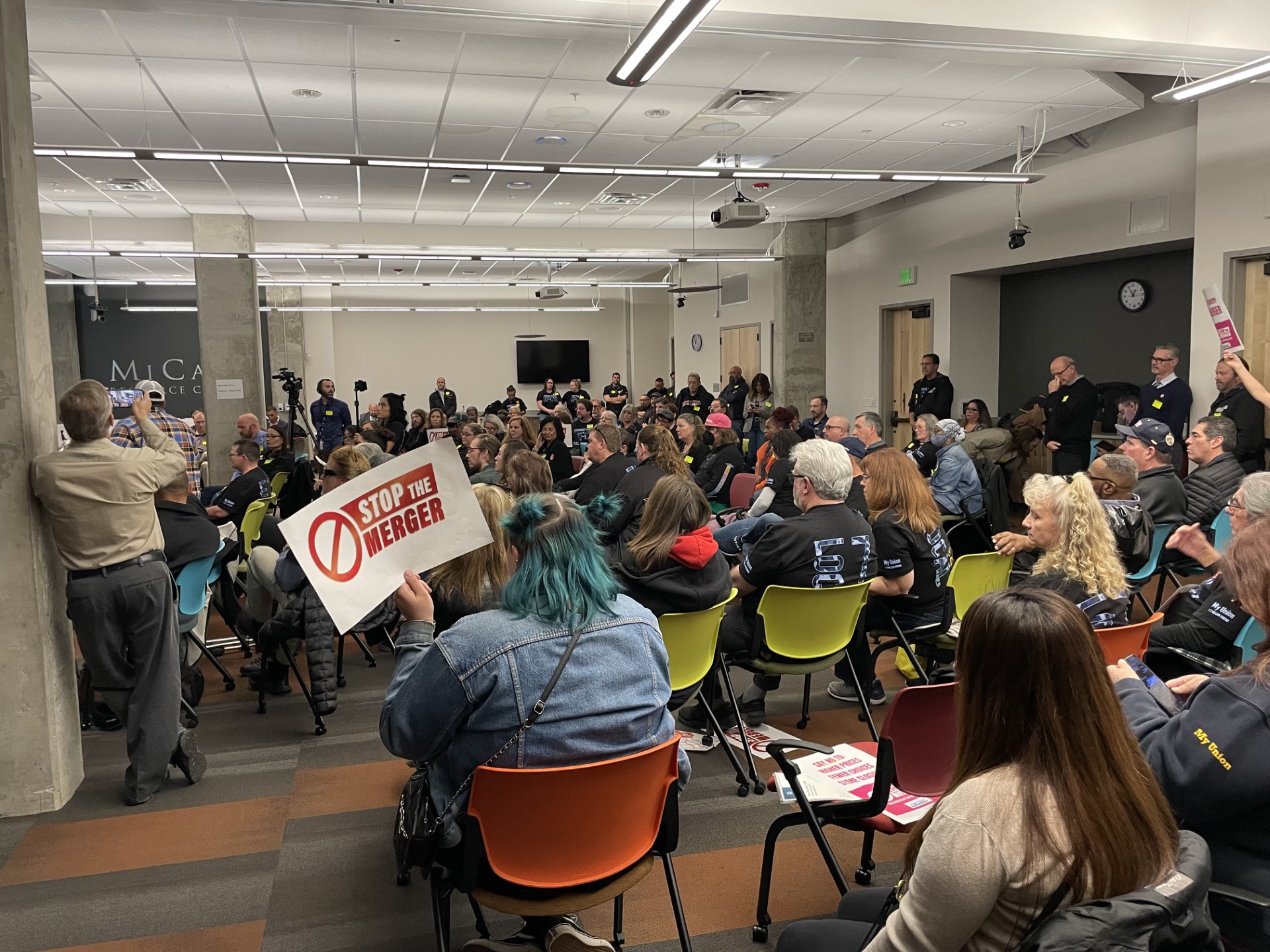
The crowd packed in, filling chairs and standing along the back walls as they made their appeal, recounting personal experiences facing layoffs, near-homelessness and food deserts. Sitting at the front of the room were Federal Trade Commission Chair Lina Khan and Colorado Attorney General Phil Weiser.
During the one hour allotted for the Denver town hall, the majority of the crowd made their case: Stop the Kroger-Albertsons merger. No one spoke in favor of it.
The proposed merger between Kroger and Albertsons has sparked widespread brushback as critics say it will decimate competition in the industry and raise prices for consumers. The merger is the subject of a multi-state investigation being led by Weiser and is currently under FTC review.
Kroger owns King Soopers, while Albertsons owns Safeway. The $24.6 billion deal announced last year would merge two of the largest grocery chains in the U.S. The two companies plan to divest more than 400 stores and other assets as a way to propel the merger, the Associated Press reported last month, which is moving toward reaching finalization next year.
In a news release, Kroger said divesting the stores to C&S Wholesale Grocers will ensure that no stores will close through the merger, that frontline associates will keep their jobs, that collective bargaining agreements will continue and that employees will continue receiving benefits.
“Following the announcement of our proposed merger with Albertsons Cos., we embarked on a robust and thoughtful process to identify a well-capitalized buyer who will operate as a fierce competitor and ensure divested stores and their associates will continue serving their communities in the ways they do today. C&S achieves all these objectives,” The Kroger Co. CEO Rodney McMullen said in a September news release.
Weiser has held 18 town halls on the merger this year as his office continues evaluating its impact on competition, consumers, workers and the agriculture industry.
Kroger and Albertsons have defended the proposal as one that will lead to lower prices, more choice for customers, higher wages, better employee benefits, and growing union jobs.
In an emailed statement, a spokesperson for King Soopers reiterated the company’s stance that “only non-unionized retailers, like Walmart and Amazon, will benefit if this merger is blocked,” and that the merger will usher in lower prices, protect union jobs, and provide hungry families with better access to food “with 10 billion meals committed to people in need across America by 2030.”
“To call this a ‘public listening session’ is disingenuous and disheartening. It must have been disappointing to Attorney General Weiser to see his attempt at a public forum co-opted and turned into an anti-merger rally instead of a true public forum representing a broad cross-section of citizens. Even representatives of groups that support King Soopers were silenced by a raucous crowd of out of state interests,” the statement said.
Dozens of people at the Wednesday town hall wore UFCW Local 7 t-shirts and held signs urging “Stop the Merger.” The United Food and Commercial Workers union represents employees at both grocery store chains and has adamantly opposed the merger.
Those who spoke Wednesday are concerned for numerous reasons and said that because of their experience with past mergers, they are skeptical of the promises being made now.
They worry about grocery stores closing, and people who are already living paycheck-to-paycheck losing their jobs, they said. Neighborhoods cannot lose an anchor business. Grocery stores do not just provide critical access to nutritious food but also support the local economy, opponents said.
The merger would be detrimental to industry competition, which has many ramifications, including making it more difficult for unions and employees to negotiate better pay and conditions for workers, opponents said.
The merger could be harmful to community health as well if it cuts down the number of grocery stores in a community, and particularly so for low-income areas. Residents should not have to traverse a complicated bus system to access food or be forced to rely on convenience stores for groceries, others said.
Carol McMillian, an Aurora resident who works for King Soopers as a bakery manager, told Weiser and Khan she lost her job at a former Safeway during the Albertsons-Safeway merger of 2015. Her store was ultimately closed and transformed into a warehouse for grocery stores.
“I just saw how the coworkers, how they dealt with the uncertainty,” McMillian said. “It’s like a heart-pounding situation you don’t know if you are going to have a job the next day.”
Patience Kabwasa, executive director of the Colorado Springs nonprofit Food to Power, said the issue is not just about food insecurity but the long-term health effects food deserts can have on a community and residents’ physical well-being.
Kabwasa urged attendees to picture the produce options available for people whose nearest store is a 7-Eleven, and the higher prices they have to pay for those items.
“It’s a war on the bodies of the working class,” she said.
The event, which was attended by a coalition of UFCW chapters from multiple states, drew people from outside of Colorado.
Monique Hightower traveled to Denver from her home in south Los Angeles, where she has worked for Albertsons for 17 years.
Hightower lost her job in 2015 when Albertsons bought Safeway, forcing her to live with her mother and accept any work she could.
For roughly a year she cleaned houses and did other odd jobs until she found another grocery store position.
Working again at an Albertsons, Hightower still struggles to make ends meet amid California’s high cost of living, she said. If the merger leads to more stores, or her store, closing, she would face hard times again.
“We are the workers, but we are going to suffer the most,” Hightower said. “People are going to be homeless if this merger goes through.”
As the town hall came to a close, Khan asked if anyone had come in support of the merger. None came forward.
Khan thanked those who attended for sharing personal stories and laid out next steps. The FTC’s investigation is on-going, and its teams are still gathering evidence, she said. Khan reminded the crowd the FTC cannot approve or reject the merger. If it determines the merger violates anti-trust laws, the agency would file a complaint in a court and a judge would decide the issue. That would be another opportunity for the public to weigh in, she said.
“I particularly feel a special obligation to make sure we get this right,” Khan said. “I know anti-trust enforcers have not always gotten it right.”
Editor’s note: This story has been updated with a statement from King Soopers.