Perspective: Dissecting Proposition 131

This year, Proposition 131 gives voters the opportunity to change our election system, adopting an all-candidate primary and potentially establishing ranked voting for some covered elections. I explain below how this proposition would work — and examine some of its challenges.
In 2008, the Colorado General Assembly passed legislation permitting certain local governments in Colorado to use a “ranked voting method.” CRS § 1-7-1002. The law also provided that the secretary of state “shall adopt rules . . . on the conduct of elections using ranked voting methods.” CRS § 1-7-1004.
When I became secretary of state seven years (and three secretaries) later, this legislative mandate still was unmet. Believing we should do what the law said, I oversaw the preparation and adoption of Rule 26, providing the required rules for a “Ranked Voting Method.” In doing this, we looked at a host of issues, received public comment (including a public hearing) and ultimately tried to create rules that were clear and fair.
While I don’t claim to know everything about ranked voting methods, I understand some of the complexities involved.
Colorado’s elections process
Colorado’s primary election model permits unaffiliated voters to select either party’s primary to participate in, but requires Republicans and Democrats to each vote in their own party’s primary. The candidate in each party’s primary who receives the most votes is advanced to the general election.
Only one candidate from each party appears on the November general election ballot, and whoever receives the most votes wins.
131 guarantees a primary
Colorado law permits a few hundred members of the party’s leadership to opt the entire party out of the primary, allowing a small number of voters sole control of determining the nominees of the party and eliminating the right to vote in the primary for millions of Coloradans. Proposition 131 changes the law and prevents this from occurring.
Proposition 131 does not change the eligibility requirements to appear on the primary ballot, so most candidates who appear still will be selected by closed party assemblies, or by petitions.
131 establishes an all-candidate 2026 primary for certain offices
If 131 passes, in 2026 most Colorado voters will receive two separate primary election ballots. They will receive an all-candidate ballot for certain state and federal offices (called “covered offices”) and a separate traditional primary ballot for county and district offices.
On the primary ballot for the covered offices, all candidates will be listed with their name and party. Voters will be able to select one candidate for each office and will be able to do so regardless of the candidate’s party and regardless of the voter’s party affiliation — and regardless of which party’s candidate they select for other races. Unlike present law, Democrats will be able to vote for Republicans in the primary, and Republicans will be able to vote for Democrats.
131 changes the 2026 general election
As is the case now, for county and district offices, only one candidate from each party can appear on the general election ballot.
What changes is that for covered offices, the four candidates who receive the most votes in the all-candidate primary will advance to the general election. In 2022, Alaska used a similar system, and 22% of the contested races had candidates from only one party on the general election ballot.
Voters could vote for only one of the candidates, and whoever gets the most votes wins. In a Republican-leaning district like El Paso County, this could result in a general election with three Republicans and one Democrat. With the Republicans splitting the vote, the Democrat likely would be elected even if most voters preferred a Republican.
For example in this year’s open 3rd Congressional District (generally Pueblo, San Luis Valley, and the Western Slope) there were 88,524 votes for Republicans in the primary and 51,719 votes in the Democratic primary. Had 131’s proposed system been in place, the top four candidates advancing would have been three Republicans and one Democrat, with three other Republicans eliminated.
In the general election, even if Jeff Hurd, leader of the Republican primary, were to receive 80% of the votes of the three eliminated Republicans, the Republican-preferring voters would split their votes three-ways and elect a Democrat — even though 71% more voters preferred a Republican.
Recognizing the absurdity of this result, the drafters of 131 created a ranked voting method to prevent this from occurring. Under ranked voting, voters have the opportunity to select second and third choices that are counted if their first choice has the fewest votes of the four who advanced.
Because voters are able to select second and third choices, 131’s authors contend, the ultimate winner is likelier to be amenable to most of them. So, in the aforementioned example, Hurd theoretically still would be able to win by being selected as the second or third choice by the voters whose first choice was one of the other two GOP candidates.
Without a change in law, ranked voting could not occur in 2026
But Colorado law, particularly Senate Bill 24-210 signed by Gov. Jared Polis earlier this year, prohibits ranked voting from occurring in 2026 and may never allow it to occur.
The new Colorado law prohibits ranked voting for federal or state offices until after 12 municipalities have chosen to run ranked voting elections and 12 counties agreeing to do so. Among other requirements, the counties have to include three of the seven very large counties, three of the seven large counties, three of the 19 small counties, and three of the 31 very small counties.
Whether this will occur is questionable, so it could be decades before the ranked voting aspects of 131 occur. This means that the effective actual change of 131 creates a completely unrepresentative system. And while the theory behind 131 is that it will result in fewer extreme candidates being elected, without ranked voting the exact opposite may occur.
Proposition 131 increases costs
According to the Blue Book mailed to voters (https://leg.colorado.gov/sites/default/files/2024-blue-book-english-accessible.pdf), implementing Proposition 131 would cost taxpayers $21 million each election cycle.
In addition to these costs, candidates must raise and spend more money to reach additional voters seeking to be their second or third choice. Government limits on third-party donations mean that wealthy candidates who can self-fund their campaigns will have an even greater electoral advantage.
Ranked voting adds complexity and increases the possibility of errors
Proposition 131 only applies to certain offices while other races will use the existing system. This means most voters will need to receive two separate primary ballots and will use different voting methods for the general election.
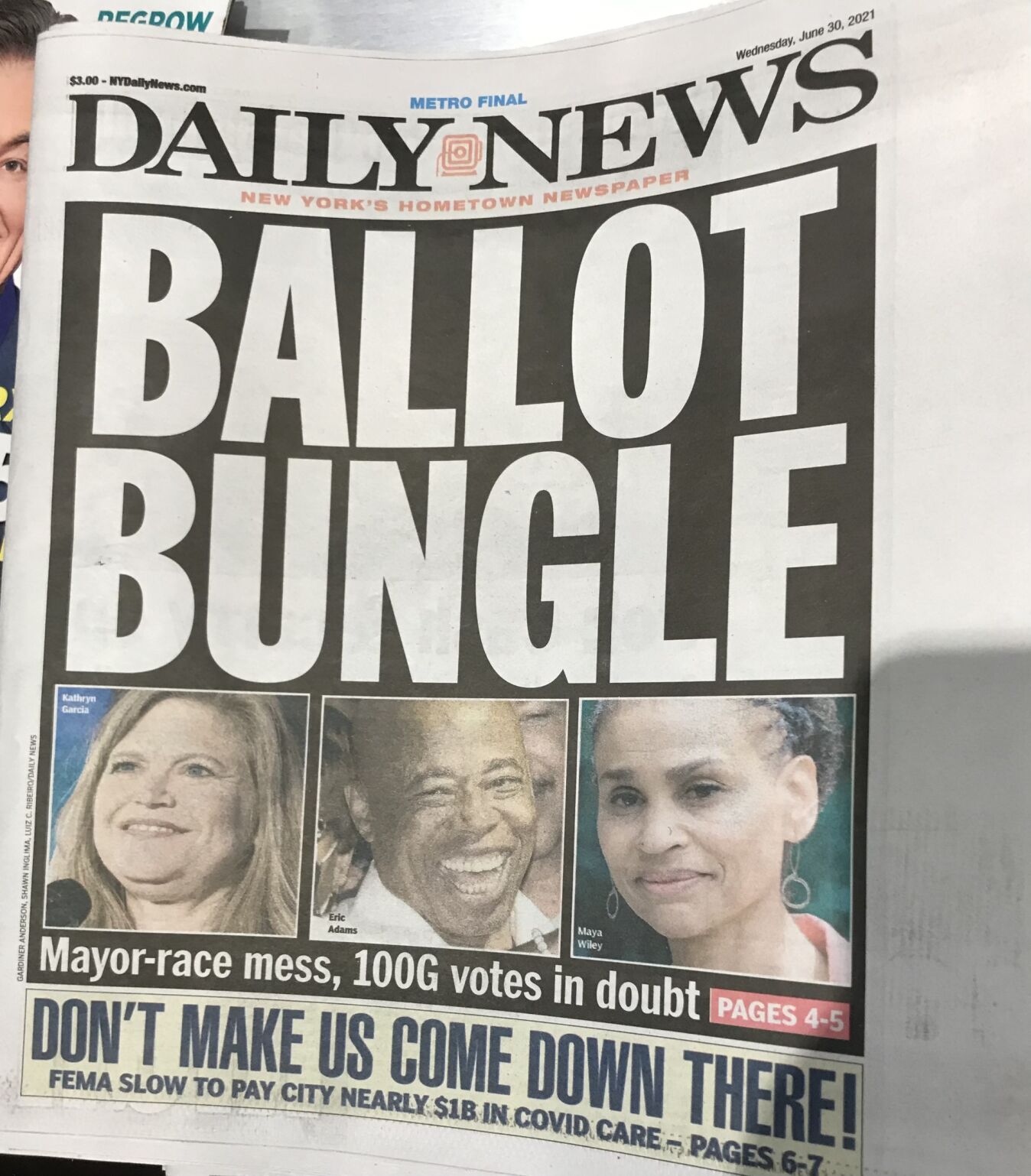
The increased complexity increases the possibility of errors for both voters and election administrators. In 2021, when New York City used ranked voting (when now-indicted Eric Adams won the Democratic primary), errors by election officials triggered headlines of “BALLOT BUNGLE: Mayor-race mess, 100G votes in doubt” (Daily News, June 30, 2021) and “MAYOR RACE MAYHEM: Board of Elections messes up initial ranked-vote count” (New York Post, June 30, 2021).
Colorado election administrators are among the best in the country, and they’ve successfully implemented many changes to Colorado elections, but 131’s requirements will strain local and state resources, making it more likely that errors will occur.
Ranked voting will delay election results
Delays in reporting results undermine voter confidence in elections. In Colorado the deadline for signature cures to be made and ballots to arrive from military and overseas voters is eight days after the election, but the victor in most races is apparent on election night.
With four major candidates in the general election, it’s a lot less likely someone will achieve 50.1% on election night. Instead many races will require reallocating the votes of the 4th place candidate’s supporters to their second choice pick and you can’t do that until you know which candidate actually took 4th place – and that can’t be determined until all ballots have been processed and tabulated in all 64 counties which won’t occur until a week and a half after election day.
Ranked voting is less transparent
As secretary of state, I adopted a requirement for paper ballots and a statewide forensic audit – actual paper ballots are compared to cast vote records to ensure the tabulations are correct. Ranked voting requires a more complex auditing process which is not as readily transparent.
Ranked voting doesn’t guarantee majority votes
Proponents assert that ranked voting means that the candidates are chosen by majority vote, but that’s not been the track record. Because many voters don’t know enough about the candidates to rank all of them, many choose not to make subsequent rankings. One study shows that in races using the rankings, most of the time (60%) the winner didn’t reach 50% of the vote. For example, Maine U.S. Rep. Jared Golden’s 49.18% of the vote was enough to elect him because 8,253 ballots were “exhausted” — meaning thousands of voters didn’t rank all of the candidates.
While Congressman Golden at least got close, there’s no guarantee even of that. In a 21-candidate San Francisco election Malia Cohen (now California’s state controller) was elected with just 21% (4,321 votes out of 20,550 ballots cast) after eliminating other candidates in 20 rounds of voting. With 20 chances, 79% of the voters never voted for her. And while Proposition 131’s four-candidate limit does guarantee the winner gets at least 25%, it certainly doesn’t guarantee a majority of those voting for the office.
131 misinterprets skipped rankings
The rules we adopted when I was secretary of state provided that a “skipped ranking and any lower ranking must be ignored,” but Proposition 131 takes the wrong approach.
The top four candidates on the November 2022 general election ballot were Jared Polis — Democrat (incumbent), Heidi Ganahl — Republican, Kevin Ruskusky — Libertarian, and Danielle Neuschwanger — American Constitution. If a voter wanted a change in the governorship, the nonincumbent who they likely had heard about was Heidi Ganahl, so the voter ranked her No. 1. Neither Ruskusky nor Neuschwanger ran much of a campaign, so the voter didn’t know who to rank No. 2 or No. 3 and skipped these rankings, but they knew they wanted a change and so ranked the incumbent last (No. 4).
But under Proposition 131, the voter’s last pick would be counted as their second choice, rather than their last — a law that certainly doesn’t reflect the voter’s intent, which penalizes voters who don’t know enough about the candidates to rank them all.
Wayne Williams is an award-winning elections official who served as Colorado’s 38th secretary of state, where he fulfilled the legislative mandate to develop Colorado’s first rules for ranked voting. He also served as El Paso County clerk and recorder and has been appointed by counties and courts to serve as a designated election official.