Colorado’s blue-collar workers of color bore highest COVID-19 death rates, data shows
Blue-collar laborers in Colorado, particularly those of color, had higher rates of COVID-19 death than workers who could work from home, state and federal data shows. The findings are further evidence, experts said, of the disproportionate risk of serious illness and death borne by minority communities throughout the pandemic.
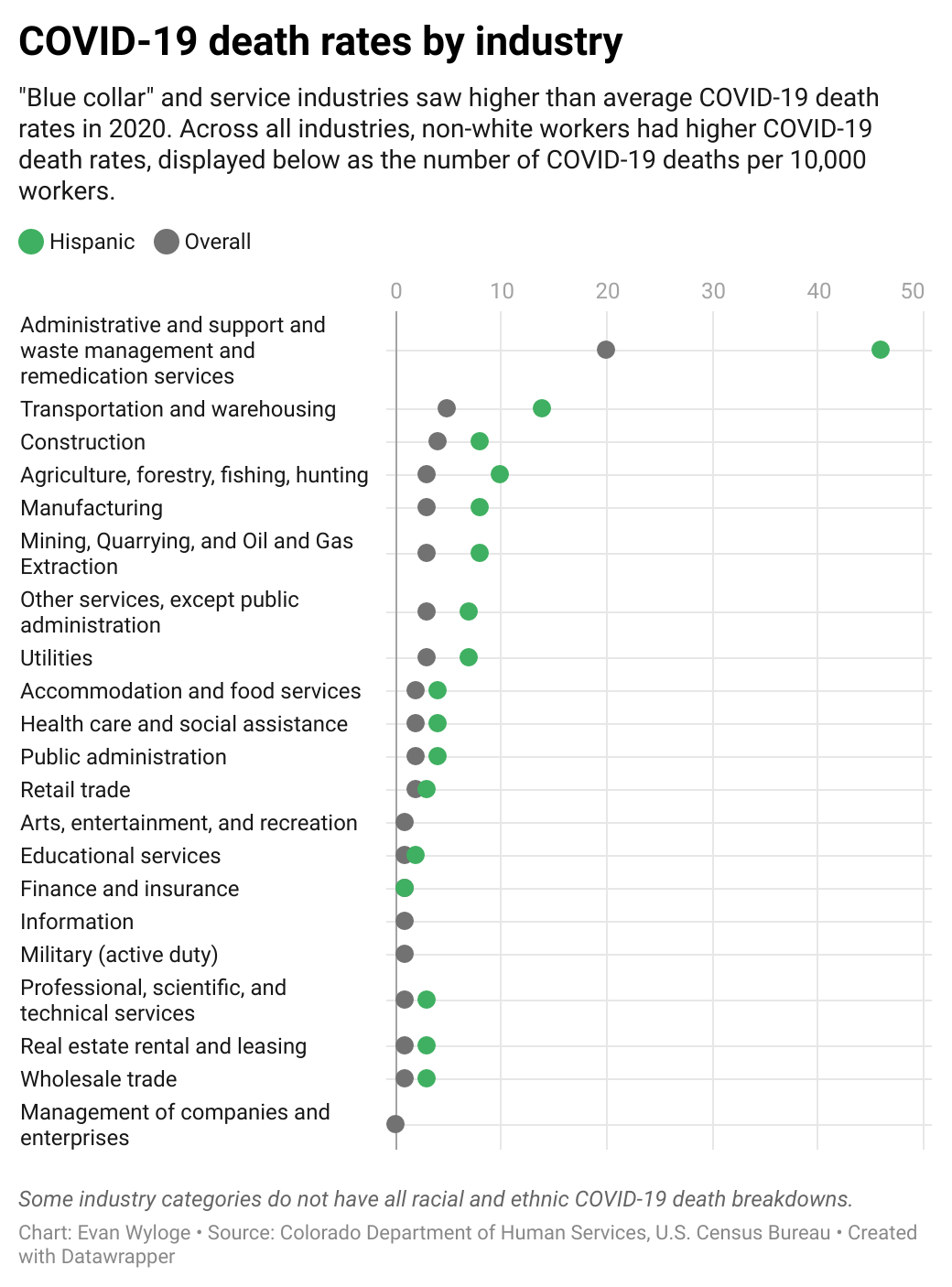
Jobs in transportation and warehousing, construction and waste management led other industries in COVID-19 death rates, according to data collected by the Colorado Department of Human Services. Those were followed by agriculture, manufacturing, mining, utilities and services. Across all industries, federal data show, disproportionate numbers of Latino workers in the labor force relative to their share of Colorado’s population.
Roughly one out every 2,000 construction workers in the state died of COVID-19, the data shows. Many of these deaths could’ve been avoided, experts told the Gazette, had more been done to address risks facing certain workers in the early stages of the pandemic.
Within those industries, Black and Hispanic workers had COVID-19 death rates four-to-five times that of the white workers in the same industries. In construction, for example, the COVID-19 death rate for white workers was around one out of every 4,000; for Black and Hispanic construction workers, it was closer to one out of every 1,000.
The disparities were even larger in some industries. Within the transportation and warehousing industry, COVID-19 death rates among Black and Hispanic workers were five-to-ten times that of white workers.
The findings further emphasize the risks faced by workers deemed essential, especially in the early days of the pandemic when testing and protective equipment were particularly limited. While other Coloradans could transition to remote work, essential workers on job sites, in meatpacking facilities and in other blue-collar industries continued to work in person, experts said, often with no on-site testing or other COVID-19 mitigation measures.
“For Latino Americans, only one in six has a job for which they can tele-commute,” said Christopher Beyrer, a professor at Johns Hopkins Bloomberg School of Public Health, who specializes in public health and human rights. “For Black Americans, it’s one in five. They are much more likely, as your data shows, to be in occupations where they have higher occupational exposure.”
Researchers have known since the early months of the pandemic that minority communities were getting sick and dying at higher rates than their white peers. There are several reasons for that, experts told the Gazette: They make up large shares of occupations with poor benefits, if they have benefits at all, and low pay. Latinos and Native Americans, Beyrer said, often live in multi-generational households, which can in turn put older members of a family at risk should the virus find its way into the home. Testing sites were concentrated early on in middle class communities and often needed vehicles, let alone time off, to access.
“When you combine this greater risk of exposure rates and underlying health conditions and disparities to access to medical care,” you get higher, disproportionate death rates, said Latoya Hill, a researcher with the Kaiser Family Foundation who’s studied the pandemic’s impact on historically underserved communities.
Public health officials missed the occupational risk factor at the beginning of the pandemic, experts said. The focus was on comorbidities, like underlying health conditions or weight. The dominant risk factor to severe illness and death has been age, data show, but occupational hazards should’ve been seen as a significant problem.
“It was a big miss,” said Glen Mays, the chair of the department of health systems, management and policy at the Colorado School of Public Health. “I think the patterns you see here—two to three fold levels of variation in death rates across occupational settings and industries—tells that story, and suggests again that a significant number of these deaths could’ve been prevented by addressing some of the risk factors.”
“The answer is an emphatic yes,” Beyrer said when asked if the government and employers could’ve handled risks to workers better. The contributing factors that make clear the risks faced by some workers “are pretty straightforward, but it’s remarkable how little people paid attention to them.”
Experts said there are basic, tangible things that could’ve been done: On-site testing could’ve been implemented early. Mike Van Dyke, who works in the public health school’s department of environmental and occupational health, said job-site testing was virtually nonexistent before being introduced at the JBS meatpacking plant in Greeley in late April. Workers often weren’t socially distanced in jobs deemed essential, experts say, and the tight control on protective equipment early on exacerbated all of these risks.
Interview requests sent to two contractor and construction trade organizations were not returned this week.
More fundamentally, more consideration should’ve been given to what work is essential in the midst of a deadly, once-in-a-century pandemic, Van Dyke and Beyrer said.
“We need to make sure that workers are treated with not only respect but are given benefits like leave to really protect themselves and protect their health and well-being,” Van Dyke said. “It’s a matter of thinking of a worker as a person, and making sure we’re thinking through workplace policies that respect that person and give that person opportunities to protect their own well-being.”
“The attention to provision of (protective equipment) for these kinds of workers and for agricultural workers – that was very much left up to owners and managers,” Beyrer added, “and some of them were decent to workers and some of them were not. But it shouldn’t be a discretionary matter. If you say somebody’s an essential worker, they need the essentials to protect themselves. It’s a pandemic.”
Beyrer pointed to other countries, particularly in Europe, who paid employers to keep workers at home. He and others drew a straight line from the perils exposed by the pandemic to the current political drive for paid family leave. Employers should be proactive in pandemic preparedness going forward, they said. Ventilation, spacing, protection equipment, support for workers – all need to be factored in to those plans.
“It’s leave, it’s benefits, it’s all those sorts of benefits that we saw were not very strong when it came to the pandemic,” Van Dyke said. “And those workers who didn’t have leave policies, who didn’t have benefits, those were the ones at highest risk, and unfortunately ended up with the highest fatality rates as well.”