







Experts say Denver City Council redistricting is all about representation
Every 10 years, redistricting for congressional districts sparks partisan battles and often ends up in court.
Local redistricting makes fewer headlines but, experts say, can be just as impactful, if not more.
“People hear about it more at the state level with congressional and legislative redistricting, but it’s just as important at the local level because we want to make sure that every person has equal representation,” said Emily Lapel, a legislative policy analyst with the city of Denver. Lapel is the city’s point-person managing all things redistricting this year.
On the most basic level, people don’t like it when their neighborhoods are split up between districts. They want to have an impact and a voice. Meanwhile, the people doing the drawing are trying to balance complex issues of race, income and a checklist of city charter requirements.
Changing City Council districts will impact who will appear on their ballot. Being in a district with communities that have similar interests means it’s more likely to elect a representative who will cater to these interests.
“It’s literally the time when it is decided for communities who could potentially represent their interests in ways that can change their life,” District 9 Councilwoman Candi CdeBaca said.
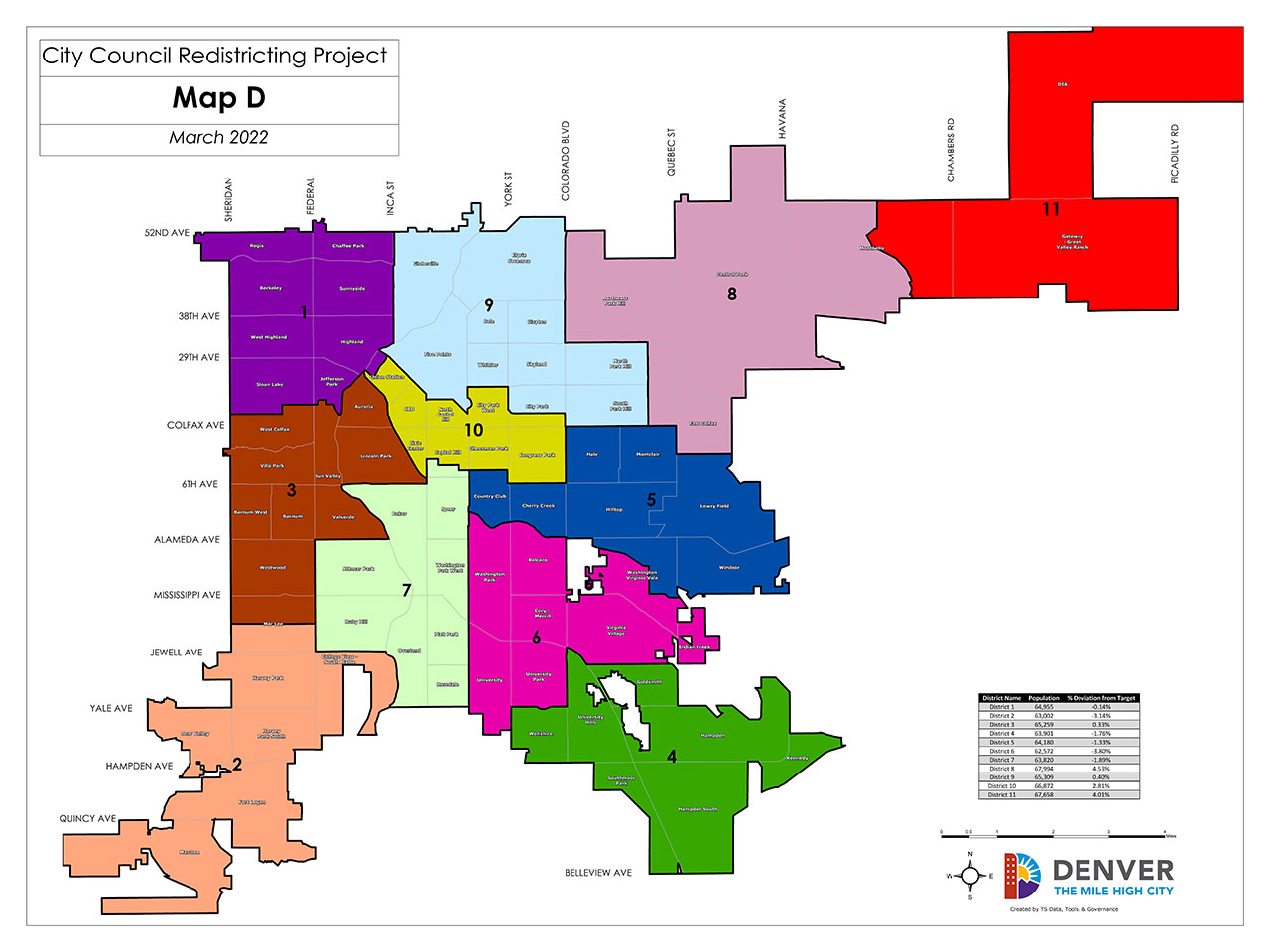
Working with a target of just over 65,000 constituents in each district, Denver City Council members spent just under a year creating and debating potential maps. On Tuesday, they will likely vote to adopt Map D, which is sponsored by at least seven council members.
CdeBaca said she thinks hearing from the people at Tuesday’s public hearing will be essential.
“People should take ownership over this government and understand that they should have a say. And in the limited spaces where they do have a say, they need to exercise their voices,” CdeBaca said.
The city started community engagement last summer knowing it had a compressed timeline, Lapel said. This process started with identifying communities of interest and getting community feedback on maps while also allowing residents to submit their own ideas.
Rebecca Theobald, a professor at the University of Colorado, Colorado Springs who has long worked on redistricting issues, said she thinks Denver did “an extraordinary job” gathering public feedback.
“Anybody who was paying attention who was caring about this topic had an opportunity to draw their own map,” Theobald said. “…This lasts for 10 years, and so if your neighborhood is kind of stuck off somewhere where no one is listening to you, then you’re calling out into the wind for the next decade.”
CdeBaca said she doesn’t believe the community engagement process has been authentic, though.
“I think that people want us to change and we have failed to enact their will,” CdeBaca said. “We came to the table with maps that were predetermined. Before we even met the community, Map D had six sponsors on it.”
Many people told city officials that they want their neighborhoods to remain whole within one district.
Theobald said while this may be what’s most important to community members, the city is required to fulfill a vast number of other requirements outlined in its charter before it can start going by neighborhood. She said this is where the council actually has the most flexibility when constructing districts.
Theobald said there are two mindsets when it comes to neighborhoods being split between council districts.
“My neighborhood is in two council member districts, and so maybe they will hear us more,” Theobald said. “But what has happened is often that is not the case. … If you’re in a neighborhood that is low-income, minority, has already been split by a highway, doesn’t have any parks and then that group of people is split again — they’re going to be ignored and not listened to. That’s the pattern that we see.”
Theobald said the redistricting process was originally structured to systematically discriminate against minority communities, so today, an emphasis on minority-majority and minority-influence districts has become key. Minority-majority districts are where non-white voters make up more than 50% of the voting-age population, and minority-influence districts are where non-white voters make up between 35% and 50% of the voting-age population.
Denver’s current map has four minority-influence districts and two minority-majority districts. And with the map Denver will likely vote to adopt Tuesday, it will have one minority-influence district and four minority-majority districts. Theobald noted, though, that district structures don’t guarantee any one candidate will be elected — it’s just a way to predict and ensure fair representation.
“Race or ethnicity is not definitive in terms of how people are going to vote, but one does the best one can as a cartographer to understand historical patterns over time,” Theobald said. “It simply means that there might be less chance that that individual will be elected.
“In terms of minority representation, the key piece is that the individuals in those districts feel that they are represented.”
District 1 Councilwoman Amanda Sandoval, who chaired the council’s Redistricting Committee, said this is what got her interested in leading the council’s redistricting process. She said the most impactful work she feels she’s done was running COVID-19 vaccine clinics with the four other Latinas on council for the city’s most vulnerable populations.
“I was told during one of the vaccine clinics how important it is for elected officials to always advocate for the 30% who can’t show and the 30-40% who don’t have a voice and who aren’t at the table and who are just working their everyday lives to make it through life,” Sandoval said. “That really struck me, so I believe that representation is important.”
While the map Sandoval sponsored made it through committee, it didn’t make it through a first vote at last Monday’s council meeting. Map D, which goes to a final vote tomorrow, is sponsored by Council President Stacie Gilmore as well as Councilmembers Chris Herndon, Jolon Clark, Kendra Black, Chris Hinds, Paul Kashmann and Amanda Sawyer. CdeBaca was the only council member to vote no on both of the maps that passed committee.
Map D would keep all current council members within the same district they now represent. If approved, these would be the largest drawn districts in the city’s history.
“For the three council districts that were so much over, almost 10-12 thousand people over, I think that they’re going to see the ability to hopefully have better case management and hopefully have better casework,” Sandoval said. “I bet they’re really overwhelmed having that many people, but I think the rest of us, Council Districts 2 and 3 will grow, and I think they’ll grow accordingly and be able to build it into their work plans.”
District 8 will have the largest population of about 68,000, a 4.5% deviation above the target population, and District 6 will have the smallest population of about 62,600, a 3.8% deviation below the target population. CdeBaca said she doesn’t think it will be long before her district, District 9, gets back up into the 70,000 range. Her district currently has the highest population, with over 10,000 constituents above the target population, so bringing that down could free up resources for her office.
Another concern that comes up is undercounts, which is likely in District 9 as well as west Denver’s District 3. This district only grew by 908 people, according to census data, but there’s a large immigrant community that might not have felt comfortable or safe completing the census, Lapel said. She said this shows how certain neighborhoods might not be getting the same attention and resources as others.