Owner of Gaylord Rockies resort to reap $1.3 billion in tax incentives
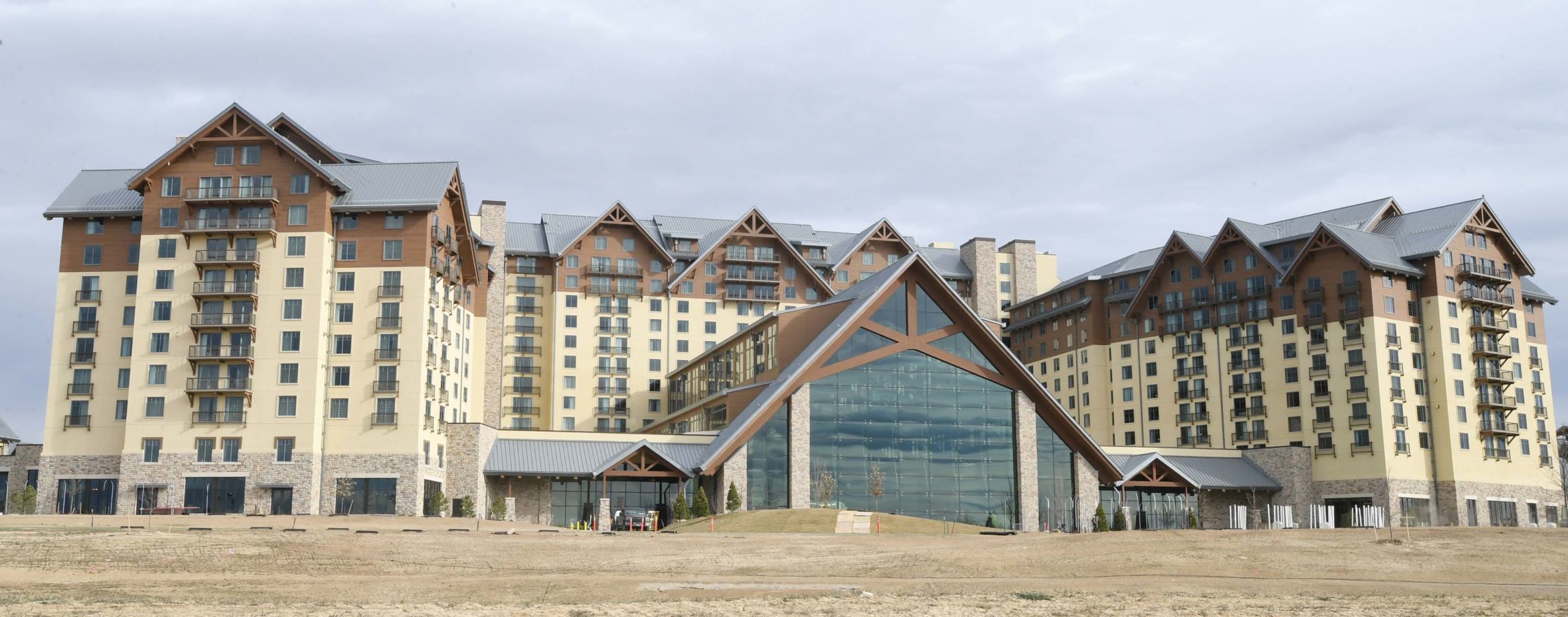
Ryman Hospitality Properties’ recent announcement it is buying the remaining interest in the Gaylord Rockies Resort and Convention Center means it can push the gas pedal to the floor creating the “Opryland of the West.”
But Ryman isn’t the only one paying for the Gaylord Rockies: Colorado and the City of Aurora will pay Ryman more than $1.3 billion in the next 23 years, according to records obtained by the Denver Gazette via Colorado’s Open Records act.
The 1,501-room resort – the state’s largest – was completed by a joint venture that included Houston-based RIDA Development Corp., in 2018. Operated by Marriott International, Gaylord sports more than 486,000 square feet of meeting space on 85 acres, 8.5 miles southwest of Denver International Airport off E-470.
Momentum came to a screeching halt as the COVID-19 pandemic shut it down, then limited its capacity – as it did all hotels in 2020. Before that, it had 1.1 million rooms booked through 2028.
The $210 million deal, expected to be finalized in the third quarter of 2021, allows Ryman to purchase the remaining 35% ownership interest in the Gaylord Rockies joint venture and includes 130 acres of undeveloped, adjacent land.
Starting in 2015, RIDA began receiving tax revenue rebates as laid out by a 2011 incentive agreement signed by the City of Aurora, the Aurora Economic Development Council, the Aurora Urban Renewal Authority (AURA) and the states’ Office of Economic Development and International Trade (OEDIT).
Those taxes include: state and city sales, incremental property tax from Adams County, use, lodger’s, and an occupational privilege tax, according to Aurora’s most recent Schedule of Tax Collections document.
While the first $10 million of annual tax revenues (adjusted 3% annually) from the property goes back to the City of Aurora, the rest goes to Ryman, according to the agreement.
“AURA committed 100% eligible tax increment revenue from property taxes from the city, county, school district and others for 25 years starting in 2018,” according to a report Gaylord filed with OEDIT — which it is required to do annually.
Aurora will refund 96.3% of sales tax collected there, 96.25% of its lodgers tax and 93.3 percent of its use tax.
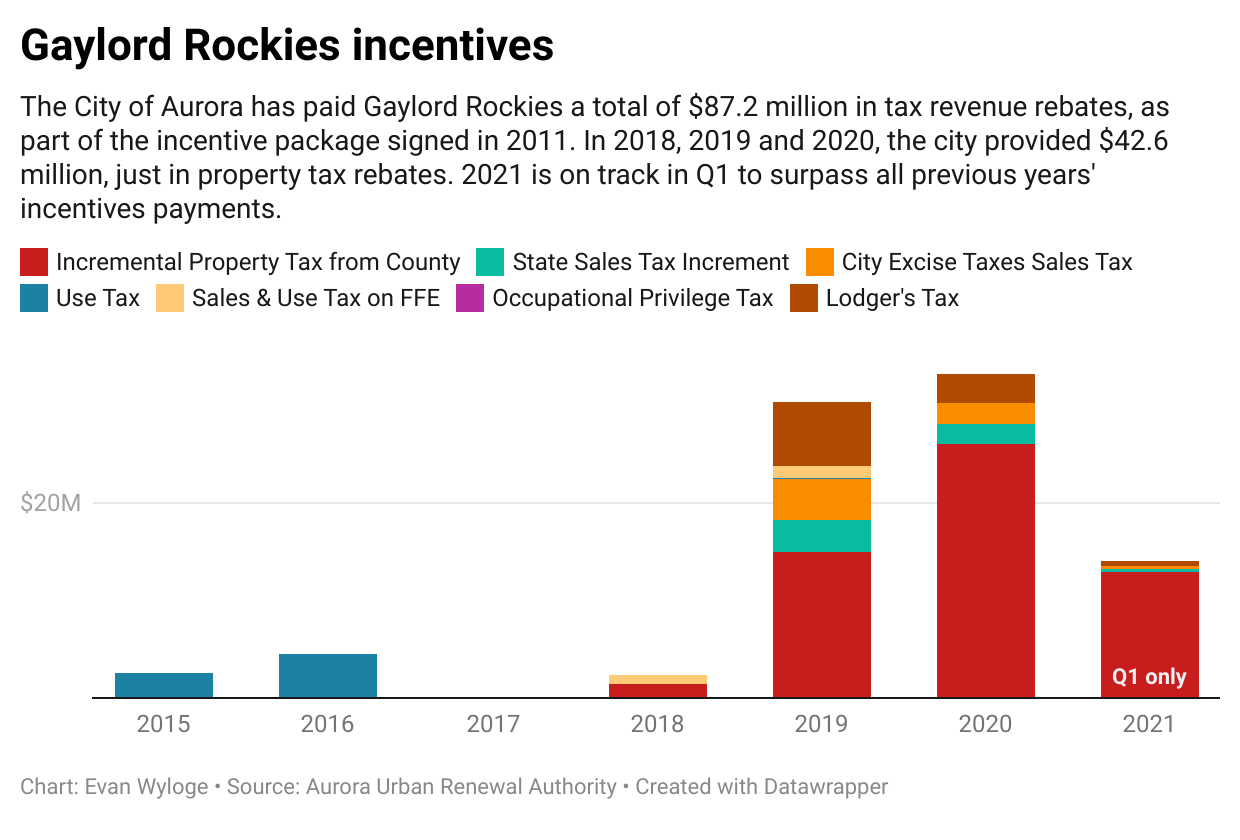
For the first four years, RIDA received between $2.4-$4.5 million annually in tax revenue rebates. But once Gaylord was open for the first full year in 2019, those revenues shot up to $30.4 million. Even during the pandemic shutdown year of 2020, Gaylord did enough business to get $33.2 million in tax revenue rebates.
For the first quarter of 2021, that paycheck – which will go to Ryman after the deal is complete – was $14 million. At that rate, Gaylord could earn up to $56 million for 2021. Multiply that 2021 number – which is conservative based on room bookings recovering from a pandemic with a huge loss in business/group travel – by the 23 years remaining on the contract, and Ryman could conservatively get $1.28 billion.
“The city does not expect a net positive fiscal impact from the project until the financial obligations in the development are met,” the Gaylord report states.
As property values in Colorado continue to increase, Gaylord’s property tax will, too. But it all goes to Ryman for the next 23 years.
Don’t forget OEDIT tossed in an additional $81.4 million in state sales tax revenue rebates: 66 percent of all state sales tax collected by Gaylord, under the Regional Tourism Act.
RIDA estimates the Gaylord Rockies cost $800 million to complete.
Was the huge price tag too much?
There’s no cap on the amount of tax revenue rebates, according to the contract. By way of comparison, the Denver Urban Renewal Authority typically caps tax increment financing incentives at 20% of the total project budget and/or require the developer/owner refund some of the rebates if the project exceeds the estimated revenue the project earns, according to Executive Director Tracy Huggins
Mike Press, a specialist on site selection, grants and tax incentives with Scout Economics, said the tax incentive package is more than twice as generous as he advises for such projects.
“I would recommend the maximum incentive package be valued at half the incremental state and local tax receipts for the first 10 years,” rather than 93-96 percent of tax receipts for 24 years.
Press helped broker Boeing Company’s world headquarters move from Seattle to Chicago, after considering Dallas and Denver. He’s worked for both governments and businesses.
Gaylord’s report to OEDIT argues that, despite the City of Aurora getting minimal tax returns on the project for the next 23 years, the resort has spurred development Aurora was looking for in its northeast boundaries. Those developments include: Rockies Village, 130 acres of mixed use including office, hotel and multifamily; Painted Prairie with some 3,000 homes planned or underway; and High Point at DIA with almost 900 homes built.
“The project has resulted in the positive economic development benefits to the City as well as secondary fiscal revenues from this additional development,” Gaylord’s report to OEDIT states. “The project has provided a major destination attraction in northeast Aurora that has resulted in a number of additional employment or mixed-use projects being approved and starting development.”
“There are no means to measure the fiscal impact to adjacent jurisdictions,” according to Gaylord’s report. “Neither Gaylord nor Marriott track their guests spending patterns outside the facility.”
Ryman’s move was hardly surprising – it has been the plan all along as the real estate investment trust (NYSE: RHP) owns 100% of its other resort/convention center properties. Those include Gaylord Opryland in Nashville, Tenn.; Gaylord Palms in Kissimmee, Fla.; Gaylord Texan in Grapevine, Texas and the Gaylord National in National Harbor, Maryland/Washington D.C.
For the Gaylord Rockies to get to this point, it took many years, a shifting set of players, multiple lawsuits and controversy over the amount of taxpayer-funded incentives the project received, and will continue to collect through 2043.
Proponents argue the cost to Colorado and Aurora is well worth it, because those tax collections would not have been possible from the prairie land that existed there before Gaylord. They also argue the governments didn’t shell out any up-front money, and that the economic benefit to the region and state will eclipse the incentives paid to get it built.
“The Gaylord property is an amazing asset to Colorado, especially once tourism ramps up,” said Che Sheehan, a program analyst for OEDIT. “That was the whole crux of incentivizing building activity specifically built to attract convention business.”
Under the Regional Tourism Act, OEDIT awarded up to $81.4 million worth of sales tax rebates to the project in 2012. Sheehan said the Gaylord project was the first to get RTA funding, a program created after the Great Recession intended to “create unique and extraordinary projects.”
OEDIT had a third-party analyst scrutinize the deal before any incentives were granted. It estimated the project would create 2,546 jobs, including indirect and induced jobs.
“Gaylord seeks to attract conferences and conventions that Colorado and metro Denver cannot currently accommodate,” according to a 2012 letter from former OEDIT head Ken Lund. “Thus, the Gaylord attraction will likely generate substantial out of state tourism.”
The letter noted during the four public hearings OEDIT held before approval, “the Economic Development Commission heard concern from many members of the public regarding the fact that the Gaylord project was heavily subsidized by the City of Aurora and would divert business from downtown Denver.”
Competing hotels in downtown Denver and in Colorado Springs indeed opposed the incentives given to the project by OEDIT and the City of Aurora. They alleged it created an unfair competitive advantage for Gaylord. But a judge dismissed their lawsuit, saying the businesses had no standing.
Now the sentiment seems to be there’s enough tourism/convention business to go around.
“Honestly, I think once we opened the community moved on,” said Ira Mitzner, CEO of RIDA, in a phone interview. “People realized we were going after a completely different customer, and a customer who had never come to Colorado.”
“At the end of the day, we’ve had some great years in Denver with the tourism and hospitality industries being very strong,” said Gregory Leonard, general manager of the Hyatt Regency Denver at the Colorado Convention Center. “Even with the Gaylord, the years since they opened in 2018 were all very positive” (before the pandemic).
How Gaylord Rockies came to be
Gaylord Entertainment Corp. first floated the idea for the huge resort/convention center in 2010, as the Great Recession was winding down. But the company was looking to get out of the development business, so it dropped out of the project after the incentives package was signed in 2011 as it transformed itself into the REIT that is now Ryman.
Gaylord had brought Marriott in as the operator, who then found developer RIDA, Mitzner said.
RIDA, after getting approved by Aurora and Colorado to take over, then spent years “battling those who didn’t want to see the project happen,” he said.
“That number of rooms and amount of meeting space under one roof didn’t exist in Colorado until Gaylord,” Mitzner said. “Coming out of the Great Recession, and taking a chance in an unproven environment like that – this wasn’t something that other folks had done. We were really pioneering.”
“RIDA did make out well, they did. But they also invested a ton of money,” said Wendy Mitchell, president and CEO of the Aurora Economic Development Council.
Mitchell and former Aurora Mayor Steve Hogan, who died before the Gaylord opened, championed the development for years.
“The economic benefit to the state will be $270 million annually, and over 30 years it could have an $8.2 billion economic impact and create 2,500 permanent jobs,” Mitchell said. “It’s easy to throw stones, but this is a huge opportunity.”
Mitchell did not elaborate on how that estimate was reached.
Estimates also showed the development could bring more than 400,000 out-of-state visitors per year, she said.
“All of those tourists will have an opportunity to spend money, and go to the mountains and see the rest of Colorado,” Mitchell said. “We want them to do that – there’s enough for everyone.”
The only problem with that logic is that Gaylord resorts are fueled by the brand’s hallmark “Everything in one place” concept. In addition to 1,501 rooms, Gaylord Rockies offers eight restaurants, a spa, salon, shops, pools, a lazy river, and convention space all under one roof so guests don’t really have to go anywhere else. “Rustic alpine charm and exciting “open-air” activity make this Rocky Mountain Front Range retreat an adventure in itself,” its web site boasts.
Ryman kept buying more of the joint venture as construction went on, with investments of $86 million in 2016, and another $240 million in 2018, according to an investors update document.
“I spoke to the (Ryman) CEO and they wanted to take the opportunity coming out of the pandemic,” Mitzner said. “So they made an offer. I thought it was fair, but it’s bittersweet. I love the Aurora community. It’s just a wonderful group of people who stood shoulder-to-shoulder with us.”
Breaking down the Gaylord economic incentives
Aurora tried to give the developers even more tax rebates.
Gaylord Rockies sits on a plot of land that Aurora created its own tax increment financing district for, deeming the prairie land “blighted.” It even tried to raise the lodging tax in that district – which was land owned by LNR CPI High Point LLC – by a 2% “enhanced tax” above the existing lodging tax rate so it could pay the joint venture more in tax rebates, the contract shows. After a successful lawsuit by Adams County citizens, a judge struck down that enhanced tax as unconstitutional.
Asked if the project could have been built without all the incentives, OEDIT’s Sheehan said: “I don’t believe so.”
“That’s the core crux of the RTA, it couldn’t have happened ‘but for’ the incentives,” he said.
Mitzner said they wouldn’t have been able to secure the $500 million construction loan without the economic incentives pledged by the state and City of Aurora.
“All of our incentives are performance based,” Mitchell said. “No (upfront) checks are being written. They had to bring it, spend the construction money to bring business to get those rebates.”
“The business deal that was put together, we felt what we got was appropriate,” Mitzner said. “We took a great risk. And for those out there saying ‘you only had to give half’ – that’s Monday morning quarterbacking. There was no construction loan without the package we had. The hotel would not have existed today. I will tell you sincerely in my heart I believe it’s a win for the community, the state of Colorado, the City of Aurora and the 470 corridor … Both parties got a good bargain.”
According to the annual report Gaylord filed with OEDIT in September, the project had created 2,094 permanent jobs as of Q4 2019. Those jobs were worth about $69.9 in annual payroll, which earned the state $1.77 million in payroll tax.
It’s unclear how many of those jobs were lost in 2020, or what the current employment level is there.
Marriott officials did not return several emails and phone calls over several days from The Denver Gazette, seeking information on employment level, future bookings or upcoming conventions.
“We’re going to continue to see what this does for Aurora, the region and the state as people start traveling again,” Mitchell said. “It’s clear that Ryman believes in this project … it’s a publicly traded company and they are careful with their responsibility to investors. They realize the opportunity Colorado will bring.”
“Adding full control of the hotel and surrounding land creates an opportunity to develop Gaylord Rockies into the ‘Opryland of the West,’” a report to Ryman investors states.
Hyatt’s Leonard said when the Gaylord opened, it pulled some groups that typically stay downtown with bargain prices.
“Any time there’s a new property, they offer very competitive rates to bring people out there and experience what they have to offer,” Leonard said. “We did see some of that fall off, but nothing too intense. … We sold the positives of downtown. Those were endless and will be again.”
Mitchell defends the incentives, and said the Gaylord Rockies will help not only downtown, but Colorado.
“This is an important project for the State of Colorado. You’re never going to change my mind on that,” Mitchell said. “This is going to be a game changer for years.”